
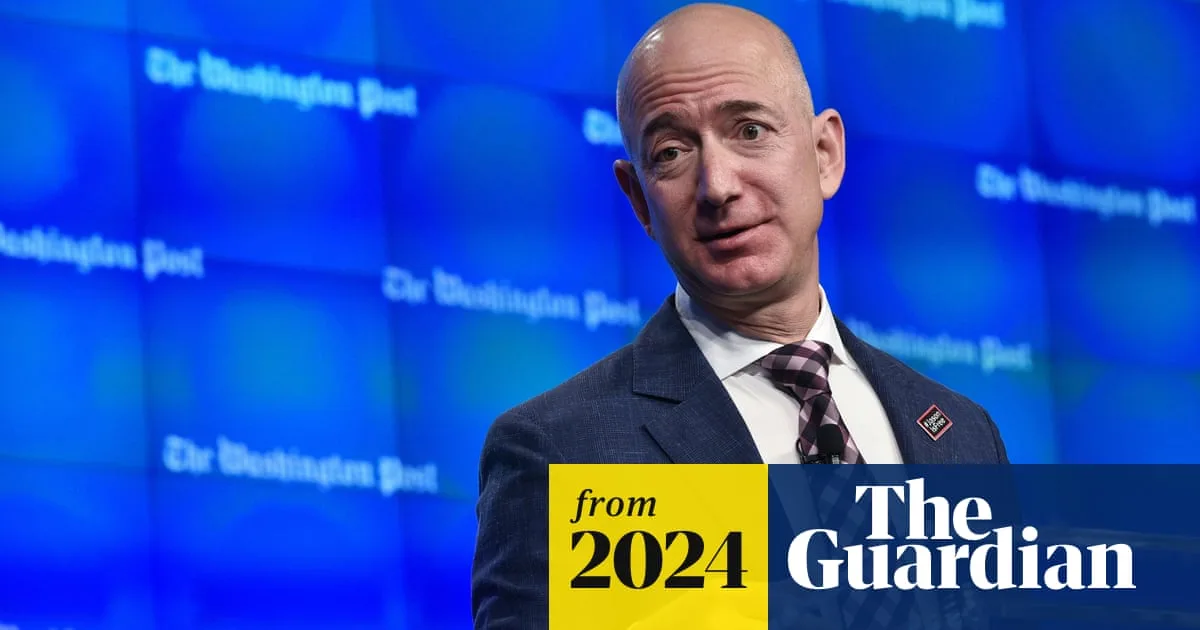
Jeff Bezos, the multi-billionaire owner of the Washington Post, has faced mounting criticism after executives from his aerospace company, Blue Origin, met with Donald Trump on the same day the newspaper declined to endorse a candidate in the US presidential election. The meeting took place hours after the Post announced it would not endorse Kamala Harris, despite its editorial board having already drafted a statement of support.
The Post’s decision, announced on Friday, was made without reference to Bezos’s other business interests, including Amazon and Blue Origin, both of which compete for lucrative federal contracts. However, within hours of the announcement, Blue Origin’s chief executive, David Limp, and vice-president of government relations, Megan Mitchell, met briefly with Trump after a campaign speech in Austin, Texas. CNN also reported that Amazon’s CEO, Andy Jassy, had recently reached out to speak with the former president by phone.
The timing of the meeting drew fierce criticism, including from the Post’s own staff. Editor-at-large Robert Kagan resigned on Friday, alleging a quid pro quo. “Trump waited to make sure that Bezos did what he said he was going to do – and then met with the Blue Origin people,” Kagan told the Daily Beast on Saturday. “Which tells us that there was an actual deal made.”
The Post’s publisher, Will Lewis, appointed by Bezos in January, defended the owner by insisting the decision to spike the endorsement was his alone. However, this did little to quell internal dissent, with 18 opinion columnists signing a dissenting column calling the move “a terrible mistake”. Former employees, including Watergate journalists Carl Bernstein and Bob Woodward, described the decision as “disappointing”. The newspaper’s cartoon team published a dark, formless image protesting the non-endorsement, playing on its “democracy dies in darkness” slogan.
The backlash extended to readers, with high-profile figures such as author Stephen King and former congresswoman Liz Cheney announcing they would cancel their subscriptions. The controversy drew parallels to a similar decision by the Los Angeles Times, whose billionaire owner, Patrick Soon-Shiong, also blocked an endorsement of Harris. Critics noted that both instances fit the definition of “anticipatory obedience” outlined in Tim Snyder’s book On Tyranny, where power is surrendered to an aspiring authoritarian before they demand it.




