

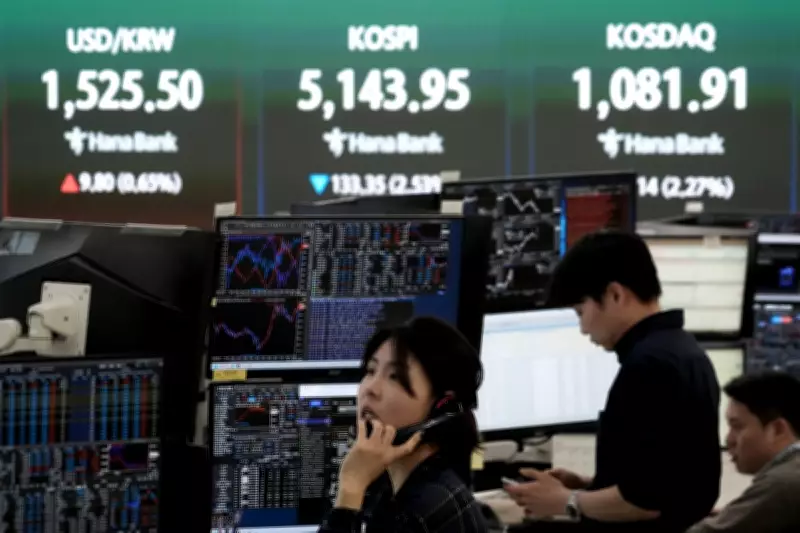
Oil prices have steadied and Asian stock markets are predominantly trading lower on Tuesday, as conflicting indications about a potential de-escalation in the Iran war continue to create uncertainty among investors. The mixed signals have led to cautious trading across the region, with several major indices recording losses.
Asian Market Performance
In Asia, Tokyo's Nikkei 225 index dropped by 1.2% to 51,245.50, erasing gains accumulated since the beginning of the year following the onset of the Iran war on February 28. South Korea's Kospi experienced a more significant decline, falling 3.4% to 5,097.11. Hong Kong's Hang Seng index decreased by 0.5% to 24,624.55, while the Shanghai Composite index in China slipped 0.4% to 3,908.28.
However, not all markets followed this downward trend. Australia's S&P/ASX 200 bucked the pattern, rising by 0.7%, whereas Taiwan's Taiex was trading 2.2% lower. Early on Tuesday, U.S. futures showed a positive movement, increasing by nearly 1%, suggesting potential resilience in American markets.

Oil Market Dynamics
With the Iran war now entering its fifth week, ongoing attacks in the Middle East persist without a clear resolution in sight. Brent crude futures, the global benchmark, were less than 0.1% lower at $107.36 per barrel on Tuesday. Meanwhile, benchmark U.S. crude edged up by 0.1% to $102.94 per barrel, indicating relative stability after recent surges.
Oil prices have witnessed a dramatic increase throughout March, with Brent crude prices soaring more than 40% since the conflict began. This surge is largely attributed to supply concerns and geopolitical tensions affecting global energy markets.
Geopolitical Developments
Recent incidents have further complicated the situation. On Tuesday, a drone struck a Kuwaiti oil tanker in Dubai waters, resulting in a fire. Additionally, U.S. Gulf allies have privately urged the White House to continue military efforts, arguing that Iran has not been sufficiently weakened. Officials report that these allies are pressing U.S. President Donald Trump to maintain the fight.
In a contrasting development, President Trump has claimed that the United States is engaged in negotiations with Iran's parliamentary speaker, although Iran has denied that any such talks are taking place. This discrepancy adds to the uncertainty surrounding diplomatic efforts to resolve the conflict.
Strategic Chokepoint Concerns
Maritime traffic disruptions at the Strait of Hormuz remain a critical concern for global energy supplies. Approximately one-fifth of the world's oil typically passes through this strategic waterway. Iran has been accused of effectively establishing a "toll booth" in the strait, prompting threats to control the passage.
In response, U.S. Secretary of State Marco Rubio stated that President Trump has "options available" to address Tehran's threats. This situation underscores the ongoing risk to oil transportation routes and its potential impact on energy markets worldwide.
Wall Street and Commodities
On Monday, Wall Street stocks presented a mixed performance. The S&P 500 declined by 0.4% to 6,343.72, and the Nasdaq composite fell 0.7% to 20,794.64. Conversely, the Dow Jones Industrial Average added 0.1%, closing at 45,216.14.
In corporate news, shares of food distributor Sysco plummeted 15.3% after the company announced a $29 billion deal to acquire supplier Jetro Restaurant Depot. This significant acquisition has influenced market sentiment and stock performance in the sector.
In other early Tuesday dealings, precious metals saw gains. Gold prices increased by 0.7% to $4,587.80 per ounce, while silver prices rose 2.4% to $72.25 per ounce, reflecting a flight to safe-haven assets amid ongoing geopolitical tensions.
Currency Movements
Currency markets also experienced shifts. The U.S. dollar weakened slightly against the Japanese yen, trading at 159.61 yen compared to 159.71 yen previously. Meanwhile, the euro strengthened against the dollar, trading at $1.1472, up from $1.1465. These movements highlight the broader financial market reactions to the evolving geopolitical landscape and economic indicators.






