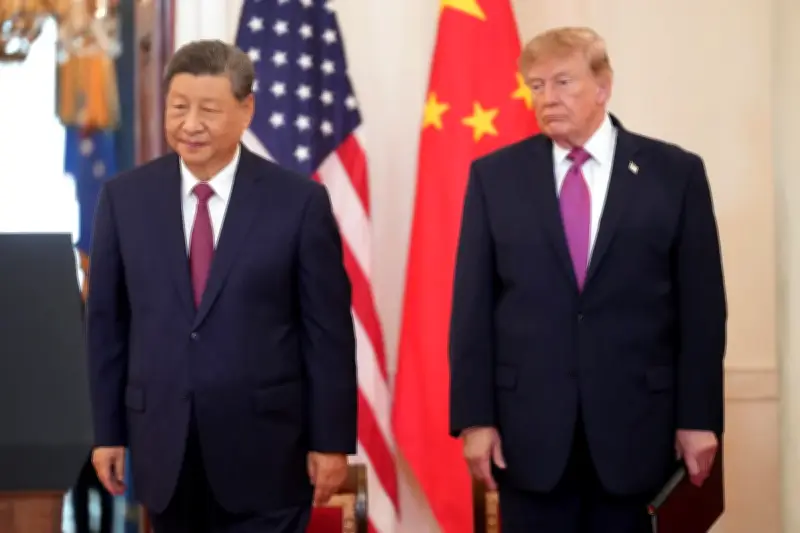
London stocks ended lower on Thursday as investors weighed developments in the US-China summit and kept a watchful eye on elevated bond yields and oil prices.
The FTSE 100 index ended down 25.27 points, 0.2%, at 10,679.99. The FTSE 250 fell 207.26 points, 0.9%, to 24,154.32, and the AIM all-share shed 8.48 points, 1.1%, at 784.96.
In European equities, the CAC 40 in Paris fell 0.5%, while the DAX 40 in Frankfurt declined 0.6%. In New York, the Dow Jones Industrial Average was down 0.7% at the time of the closing bell in London, the S&P 500 was 0.5% lower, and the Nasdaq Composite gave up 0.8%.
Market uncertainty and bond yields
Kathleen Brooks, research director at XTB, said that “there is no clear direction for markets”.
“Are we in a bond crisis or not? Is the Iran war getting worse or is the situation improving? Are enough oil supplies getting through the Strait of Hormuz, and will Ukraine continue to target Russian refinery infrastructure?” she asked.
Ms Brooks thinks that while these questions remain unanswered, “volatility will continue to dominate, especially in the commodity and bond markets”.
Some grounds for optimism came as US President Donald Trump greeted his Chinese counterpart Xi Jinping in Washington, with the two countries stating they have agreed to a two-month extension of their trade truce, although they remain at odds over Beijing’s diplomatic and economic support for Iran.
“Working together, President Xi and I have made tremendous strides on the issues facing our two countries,” Mr Trump said. “During this visit, we will also discuss pressing issues concerning security, technology, and super intelligence – SI.”
Mr Xi took a more measured tone.
“We have both the capability and responsibility to develop and manage AI for good and ensure that the development of AI is always under human control,” he said at the White House.
Mr Xi added that the two countries had a “historic responsibility of advancing human development and progress” and should “strengthen communication”.
Oil prices and rate hike expectations
Higher oil prices and elevated bond yields kept any market enthusiasm in check. The yield on the US 10-year Treasury was quoted at 5.11%, stretched from 5.08%. The yield on the US 30-year Treasury was quoted at 5.45%, widened from 5.38% the day before.
Neil Wilson, investor strategist at Saxo UK, said: “Bond yields are blowing out again partly because the US economy is booming.”
S&P Global’s “flash” US composite PMI output index, released on Wednesday, improved to 58.4 in September from 56 in August. The reading, a 62-month high, beat the MNI-cited consensus of 55.3.
Deutsche Bank’s Jim Reid said the strong data played into the narrative of “resilient growth, which in turn would enable the Fed to keep hiking rates to deal with inflation”.
XTB’s Ms Brooks said: “It is rare to get movements this volatile in sovereign bond markets, which is another sign that sovereign debt is going through an uncomfortable adjustment period.”
She pointed to a combination of rising government debt loads and deficits, resilient economic growth and rising inflation risks.
“These things together are anathema to the bond market and it is no surprise that yields are rising,” she said.
Adding to the nervy mood, a sharp rebound in oil prices also rekindled inflation fears. Brent oil was quoted at 107.25 dollars a barrel in London on Thursday at the time of the equity market close, up from 102.74 dollars late on Wednesday.
Trade Nation analyst David Morrison noted that market expectations for another 25-basis-point rate hike by the US Federal Reserve next month had now risen to around 75%, up from 55% last week.
Corporate movers and fiscal news
The pound was quoted at 1.3214 dollars on Thursday, down from 1.3254 dollars at the same time on Wednesday. Against the euro, sterling ebbed to 1.1628 euro from 1.1636 euro. The euro fell to 1.1367 dollars from 1.1391 dollars. Against the yen, the dollar was trading at 158.98 yen, up from 158.39 yen.
In the UK, the Treasury is considering accepting a smaller fiscal buffer at next month’s budget in an effort to limit tax rises and spending cuts, the Financial Times reported. The newspaper said the Treasury and Number 10 are discussing whether Chancellor John Healey could target less headroom against the government’s fiscal rules than the £23.6 billion forecast by the Office for Budget Responsibility in March.
Gilt investors surveyed by the FT suggested the buffer could fall to around £14 billion without triggering a significant market sell-off, although some argued that headroom below £20 billion could undermine confidence.
On the FTSE 100, the higher oil price saw BP and Shell gain 2.6% and 1.7%, with Ithaca Energy up 2.0%. JD Sports continued its roller-coaster week, rallying 3.4% after further consideration of Wednesday’s results.
British American Tobacco was in demand ahead of a US capital markets event next week, rising 1.1%, but Standard Life and Computacenter fell 4.2% and 4.4% as they traded ex-dividend. Pest control specialist Rentokil Initial fell 4.3% following cautious comments at a JPMorgan conference in London by industry peer Rollins, which slipped 6.5%.
Rollins’ management told the conference that since July, demand has “stayed choppy and early green shoots failed to hold”, according to JPMorgan.
On the FTSE 250, Raspberry Pi was the star performer, up 20%, as it said it was well placed for further rapid growth after delivering a record first-half performance driven by strong demand, increased unit shipments and a favourable product mix. The Cambridge, England-based maker of low-cost computer boards expects full-year EBITDA to be ahead of market consensus.
Vistry opened sharply lower but clawed back losses as the trading day went on as the market assessed a turnaround plan from chief executive Adam Daniels. Shares in the Kent-based housebuilder ended down 3.1% as Daniels ruled out the need for an equity raise and outlined a vision of a slimmed-down business.
Vistry will target around 12,000 completions per annum over the medium term with a tenure mix of around 60% partner-funded and 40% open market. In 2025, completions totalled 15,658, down from 17,225 in 2024. It will consolidate from 25 regions to 12 larger operating regions to reflect lower volume targets and to obtain cost efficiencies.
RBC Capital Markets analyst Anthony Codling said the review is, at first glance, “what we had hoped for – a root and branch deep dive with no stone unturned and no target too precious to challenge”. But he cautioned that “talk is cheap, but money buys houses – we like the talk, we now need to see if the walk can match it”.
Gold was quoted at 4,252.84 dollars an ounce, down from 4,283.94 dollars.
The biggest risers on the FTSE 100 were JD Sports Fashion, up 2.2p at 76.4p; BP, up 14.6p at 571.8p; Ithaca Energy, up 5.8p at 296p; Shell, up 61p at 641p; and Bunzl, up 36p at 688p. The biggest fallers were Computacenter, down 240p at 5,240p; Rentokil Initial, down 13.9p at 309.2p; Standard Life, down 39p at 887p; Compass Group, down 1.1p at 29.1p; and Kingfisher, down 10.8p at 328.2p.
Friday’s local corporate calendar has half-year results from Malibu Life Holdings. Friday’s global economic calendar has eurozone money supply figures, consumer confidence data in Germany and the UK, US durable goods orders numbers and the Michigan consumer sentiment index.