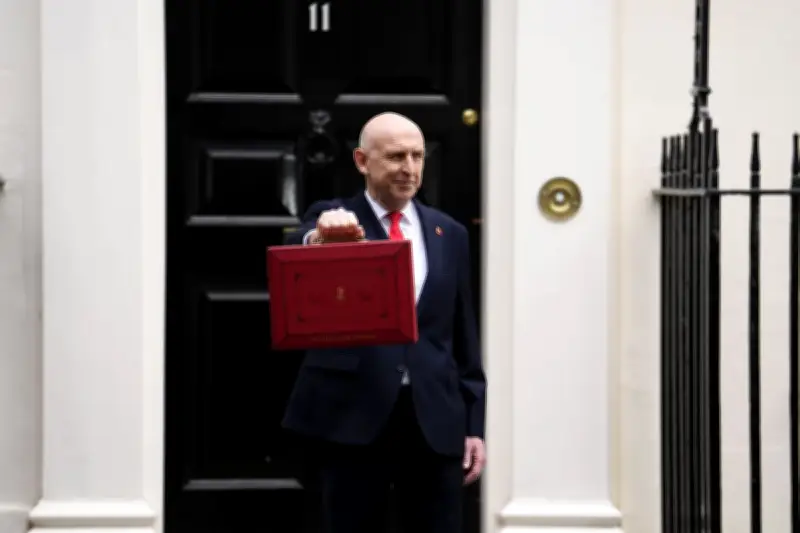
Stocks in London ended mixed on Wednesday as investors assessed Chancellor John Healey's first Budget and looked ahead to an expected US interest rate hold. The FTSE 100 index ended up 7.96 points, or 0.1%, at 10,694.50, while the FTSE 250 ended 77.11 points lower, 0.3%, at 24,639.26, and the AIM all-share advanced 2.43 points, 0.3%, at 760.92.
Mr Healey delivered his first Budget, which he said was "for the working people of Britain" and built on "fiscal discipline". He said the Labour government's plans will give "breathing space" to households and bring "innovation and growth in every postcode". He announced increases to taxes on profits earned by banks and betting companies to help fund support for soaring energy bills.
Market reaction to the Budget
Tom Stevenson, investment director at Fidelity International, said: "For investors, the message was one of stability, with few major surprises to unsettle financial markets." Peel Hunt chief economist Kallum Pickering called it a "mostly inconsequential" Budget, one that markets can "tolerate". "For all Prime Minister Andy Burnham's talk that the UK should not be in hock to the bond market, his government's first Budget, delivered by Chancellor John Healey, was plainly designed with the market in mind," he noted.
Sanjay Raja, Deutsche Bank's chief UK economist, commented: "The Chancellor's mantra heading into the autumn Budget was to 'do no harm', and we think the Chancellor successfully met this objective." ING said the Budget "keeps the deficit on a downward trajectory and, crucially, doesn't do anything that could make life harder for the Bank of England. But many of the UK's longer-term challenges remain unfunded and unaddressed, while the Budget keeps alive the option of an early election in 2027".
Forecasts and fiscal headroom
The challenging economic backdrop was laid bare in forecasts from the Office for Budget Responsibility. While growth this year was upgraded to 1.2% from 1.1%, the watchdog slashed its estimate for next year from 1.5% to 1%. Inflation is forecast to reach 3.1% in 2026 and 3.4% in 2027, before returning to 2% in 2028, around a year later than forecast in March. Fiscal headroom against the current Budget rule is seen at about £15 billion in 2029-30, down from £23.6 billion in the March 2026 forecast, before being rebuilt to £22 billion in 2030-31.
Bond markets took the Budget in their stride with yields on UK 10-year gilts nudging down to 5.33% from 5.34% at the same time on Tuesday. Kathleen Brooks, research director at XTB, said the bond market's verdict is a "decent B+", adding "overall, this Budget is steady as she goes". On currency markets, sterling was little moved, quoted at 1.3310 dollars, up from 1.3307 dollars, and edging down to 1.1941 euros from 1.1943 euros.
Sector moves
On the FTSE 100, banks held firm despite the news that UK lenders will pay an extra 3% banking surcharge, rising to 6%. The Government said the higher levy will be temporary and in place for 15 months. RBC Capital Markets analyst Benjamin Toms estimates the changes to the surcharge will be a net headwind for bank FY27 profitability of up to 4%. "The market will be sceptical that these changes will be temporary based on experiences elsewhere in Europe such as Spain," he added. Lloyds Banking Group closed up 1.7%, Barclays up 1.6% and NatWest up 2.0%, while Standard Chartered rose 2.4% after raising guidance alongside third quarter earnings.
Entain rose 3.6%, and Rank jumped 12%, despite the extra gambling duty. JPMorgan said the increase in machine gaming duty to 25% from 20% was "a relief versus worst-case fears". But housebuilders went into reverse despite confirmation of a support scheme for first-time buyers. Barratt Redrow slumped 6.6%, Taylor Wimpey fell 7.3% and Persimmon 6.9%.
In European markets, the CAC 40 in Paris ended flat, while the DAX 40 in Frankfurt climbed 0.4%. In New York, the Dow Jones Industrial Average was up 0.3%, the S&P 500 was 0.2% higher, but the Nasdaq Composite eased 0.1%. The yield on the US 10-year Treasury was quoted at 5.03%, stretched from 5.00%, and the 30-year yield widened to 5.33% from 5.31%.
Looking ahead
Investor attention now switches to the Federal Reserve's interest rate call. David Morrison at Trade Nation commented: "As far as investors are concerned, the consensus expectation is that interest rates will be left unchanged, even though all major US inflation measures show that prices are far from stable, and are well above the Fed's 2% target." The European Central Bank holds its own monetary policy meeting tomorrow, while the Bank of Japan meets on Friday; both are expected to keep rates unchanged.
Drugs maker GSK gave up 4.8% despite third quarter earnings and sales ahead of forecast, unsettled by a below-consensus contribution from its vaccines division. On the FTSE 250, Hunting plunged 9.5% as it lowered full-year guidance for the second time in just over two months, citing the impact of the Middle East conflict on second-half trading. Chief executive Jim Johnson said: "Whilst the long-term fundamentals of our end-markets remain robust, which includes ongoing strong trading results within our Subsea-focused businesses, the protracted and deepening nature of the conflict in the Middle East has impacted our overall results in Q3 and into Q4, with a deterioration in the short-term trading outlook seen in recent weeks." Hunting cut its full-year 2026 adjusted EBITDA guidance to 128 million dollars to 133 million dollars from 138.0 million dollars to 141.0 million dollars previously.
Brent was quoted at 116.37 dollars a barrel, up from 114.13 dollars, while gold was quoted at 4,039.18 dollars an ounce, down from 4,057.67 dollars. Thursday's local corporate calendar has third quarter results from Shell and Lloyds Banking Group, plus trading statements from Glencore, Haleon and IMI. The global economic calendar includes the eurozone interest rate decision, UK mortgage approvals, US personal consumption expenditures figures and initial jobless claims data.