

Asian Markets Exhibit Divergent Trends Following Wall Street's AI-Driven Decline
Asian shares presented a mixed picture on Tuesday, reflecting the aftermath of a significant sell-off on Wall Street that targeted companies perceived as potential losers in the ongoing artificial intelligence boom. This market activity coincided with heightened uncertainty stemming from former President Donald Trump's latest tariff announcements and a key Federal Reserve interest rate decision looming on the horizon.
Regional Market Performance Highlights Divergence
In Japan, the Nikkei 225 index surged by 0.9% to reach 57,354.14, buoyed by advances in computer-chip related companies. Notably, chip testing equipment manufacturer Advantest saw its shares climb 4.6%, while machinery maker Disco Corp. added 2.2% to its value.
Mainland China's markets, reopening after a weeklong holiday, recorded gains exceeding 1%. The Shanghai Composite index rose 1.2% to settle at 4,129.78. Conversely, Hong Kong's Hang Seng index fell 1.9% to 26,564.01 as traders opted to lock in profits from recent rallies.

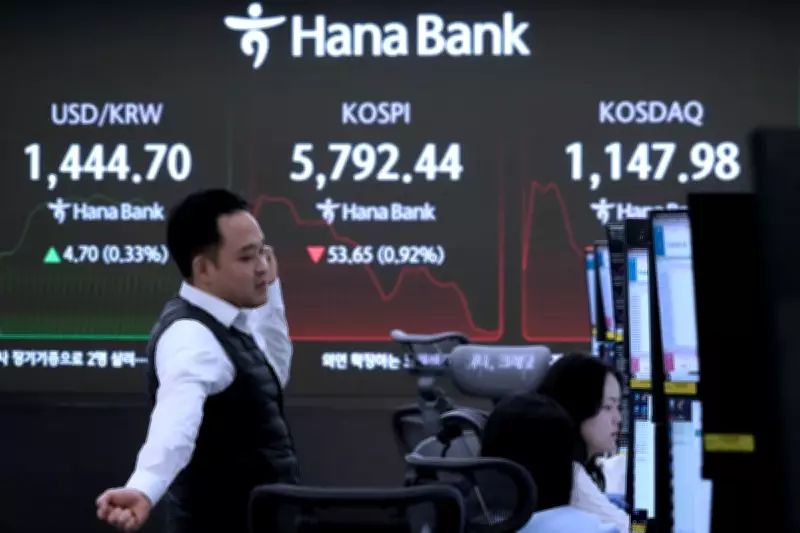
South Korea's Kospi picked up 1.8% to achieve a fresh record of 5,951.90, driven by substantial gains for Samsung Electronics, which jumped 3.2%, and SK Hynix, another prominent chip maker, which advanced 4.8%.
Other regional markets showed varied movements. Taiwan's Taiex gained 2.4%, while Australia's S&P/ASX 200 edged 0.1% lower to 9,014.50. India's Sensex experienced a modest decline of 0.3%.
Wall Street's AI Anxiety Triggers Broad Sell-Off
The mixed performance in Asia followed a pronounced slump on Wall Street, where the S&P 500 fell 1% to 6,837.75, the Dow Jones Industrial Average dropped 1.7% to 48,804.06, and the Nasdaq composite sank 1.1% to 22,627.27. This decline was precipitated by heavy selling of shares in companies suspected of being vulnerable to disruption from AI-powered competitors.
Cybersecurity firm CrowdStrike plummeted 9.8%, extending its year-to-date loss to 25.3%. This drop was partly attributed to a new tool from Anthropic that scans codebases for security vulnerabilities, unsettling the broader cybersecurity sector. Similarly, software company AppLovin sank 9.1%, taking its loss for the year to date to 43.5%, as investors grew concerned that AI competition could fundamentally reset industry dynamics and erode customer bases.
Market attention is now sharply focused on Nvidia's upcoming profit report scheduled for Wednesday. Rising apprehensions suggest that major tech firms like Alphabet and Amazon may be investing so heavily in Nvidia's chips that recouping these expenditures through enhanced productivity and future profits could prove challenging.
Trump's Tariff Moves and Broader Economic Uncertainties
Compounding market volatility, former President Donald Trump announced temporary 15% tariffs on other countries following a Supreme Court ruling that struck down his sweeping "reciprocal" taxes on imports. This swift move underscores the persistent uncertainty clouding the global economic outlook, with investors anticipating prolonged legal battles before clarity on future trade frameworks emerges.
Federal Reserve Governor Christopher Waller added to the economic discourse, describing the likelihood of an interest rate cut at the next March meeting as a "coin flip." This marks a notable shift from his position in January, when he dissented against the central bank's decision to maintain steady rates. Lower rates could stimulate the economy, as advocated by Trump, but also risk exacerbating inflationary pressures.
Sector-Specific Declines and Commodity Movements
Beyond AI concerns, specific sectors faced distinct challenges. Airline stocks declined after severe winter weather disrupted thousands of flights across the Northeast. United Airlines lost 5.2%, American Airlines fell 4.9%, and Delta Air Lines sank 3.7%.
In pharmaceuticals, Novo Nordisk's U.S.-traded stock tumbled 16.4% after a trial for its CagriSema drug showed lower weight loss percentages compared to a rival product from Eli Lilly, whose shares rose 4.9%.

Commodity markets saw upward movements, with U.S. benchmark crude oil gaining 57 cents to $66.88 per barrel and Brent crude rising 59 cents to $71.70 per barrel. These gains were fueled by geopolitical tensions, including fears of potential U.S. military action against Iran.
Currency markets reflected these dynamics, with the U.S. dollar strengthening to 155.16 Japanese yen from 154.66 yen, while the euro weakened to $1.1775 from $1.1786. Bitcoin experienced a decline of 2.4%, settling at $63,330.
As global markets navigate these multifaceted challenges, the interplay between technological disruption, political decisions, and economic policy continues to shape investor sentiment and market trajectories worldwide.





