

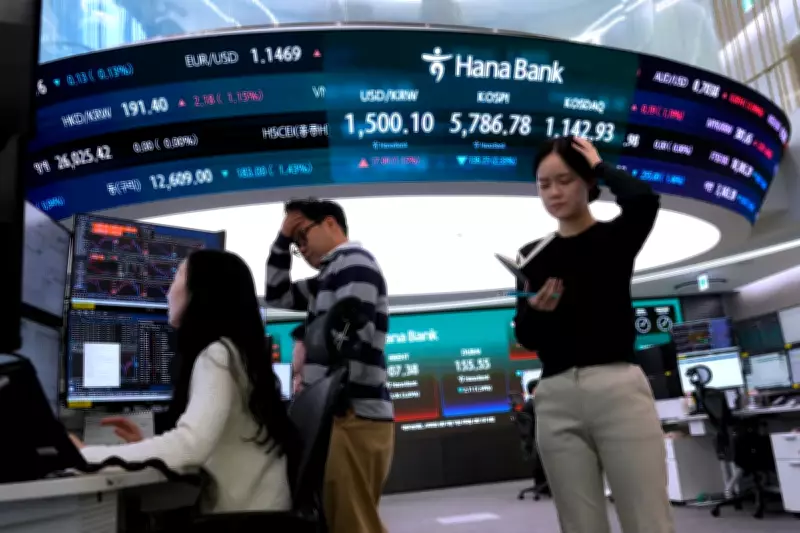
Asian stock markets experienced a significant downturn on Thursday, following a sharp decline on Wall Street as oil prices skyrocketed past $111 per barrel. The sell-off was exacerbated by mounting concerns over inflation and geopolitical instability in the Middle East, which have rattled investor confidence globally.
Market Declines Across the Region
Major indices across Asia posted substantial losses in response to the negative cues from the United States. In Japan, the Nikkei 225 plummeted by 2.5% to close at 53,875.94, while South Korea's Kospi index dropped 1.3% to 5,845.62. Hong Kong's Hang Seng index slipped 0.2% to 25,725.77, and the Shanghai Composite index in China shed 0.9% to 4,027.73.
Australia's S&P/ASX 200 also declined, falling to 8,504.20, and Taiwan's Taiex index retreated by 1.2%. These widespread losses underscore the pervasive anxiety among investors as they grapple with the dual pressures of soaring energy costs and economic uncertainty.

Oil Prices Spike Amid Geopolitical Tensions
The surge in oil prices has been a primary driver of the market turmoil. Brent crude, the international benchmark, was trading at $111.24 per barrel, marking a significant increase of 3.6% from the previous day. Meanwhile, U.S. benchmark crude oil rose by 0.8% to $96.80 per barrel.
This spike is largely attributed to escalating conflicts in the Persian Gulf, which have disrupted the region's energy industry. Iranian state television reported that the Islamic Republic would target oil and gas infrastructure in Qatar, Saudi Arabia, and the United Arab Emirates, following an attack on facilities linked to its offshore South Pars natural gas field. Such disruptions threaten to keep oil and gas prices elevated for an extended period, potentially triggering a debilitating wave of inflation across the global economy.
Wall Street Slump and Inflation Concerns
On Wednesday, U.S. stocks also faced heavy losses, with the S&P 500 falling 1.4% and erasing its gains for the week. The Dow Jones Industrial Average dropped 768 points, or 1.6%, and the Nasdaq composite slid 1.5%. These declines were fueled by a report indicating that inflation pressures were building even before the onset of the war with Iran, with U.S. wholesale inflation unexpectedly accelerating to 3.4% last month.
Compounding these worries, the Federal Reserve decided to maintain its main interest rate steady, rather than resuming cuts aimed at stimulating the job market and economy. Fed Chair Jerome Powell expressed uncertainty about the future trajectory of oil prices and the full impact of President Donald Trump's tariffs, further dampening investor hopes for lower interest rates.
Broader Economic Implications
The combination of high oil prices and persistent inflation poses significant risks to economic stability. If energy costs remain elevated, they could exacerbate inflationary pressures, leading to higher consumer prices and reduced purchasing power. This scenario is particularly concerning for economies already grappling with sluggish growth and geopolitical uncertainties.
Investors are now closely monitoring developments in the Middle East and central bank policies, as these factors will likely dictate market movements in the coming weeks. The current volatility highlights the fragile state of global financial markets in the face of overlapping crises.






