
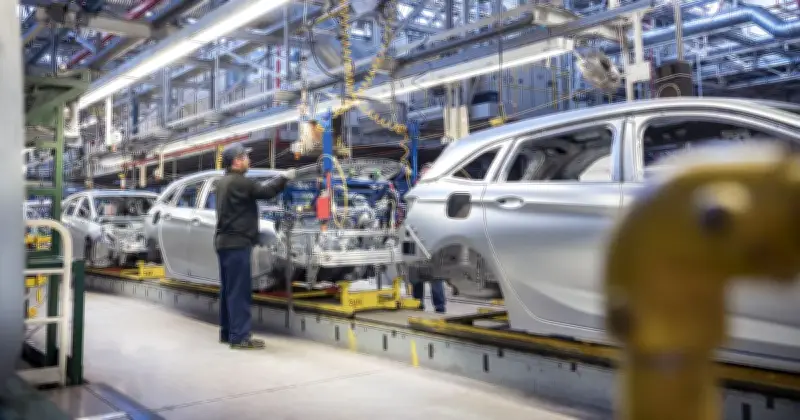
Jaguar Land Rover (JLR) has confirmed it will cut 4,000 jobs to address a reported £451 million loss, with most of the redundancies affecting its UK workforce and most workers expected to leave at the end of this month. The company said the move would help build a “stronger and more competitive company for the long term” after revenue fell in the three months to June, with sales down 9.2%.
JLR chief financial officer Richard Molyneux said: “The programme has gone strangely according to plan. Not an awful lot has gone according to plan this year, but this programme has.”
Wider industry restructuring
The warning signs predate JLR’s announcement. Last year, Stellantis closed its Vauxhall factory in Luton, with 1,100 roles lost. In February, Aston Martin confirmed it would cut 600 roles following financial losses. Three months later, Nissan confirmed it would stop using one of its UK production lines alongside news of 900 job losses across Europe.
David Bailey, Professor of Business Economics at the University of Birmingham, said: “The UK car industry is under real pressure, and workers have every reason to be concerned. We are facing a perfect storm of weak demand, the costly transition to electric vehicles, intense Chinese competition and uncertainty over government policy. The danger is that we lose not just jobs on assembly lines, but the highly skilled supply chains, engineering capabilities and industrial expertise that underpin the whole sector. Once those capabilities disappear, they are extraordinarily difficult to rebuild. This is about the future of one of Britain's most important manufacturing industries. The danger is not just fewer jobs today; it is losing the industrial capabilities we will need tomorrow.”
ZEV Mandate under scrutiny
The government’s Zero Emissions Vehicle (ZEV) Mandate dictates how many electric cars manufacturers must build each year, with penalties for missing targets. The 2026 target requires EVs to make up 33% of new cars, but actual electric car sales currently sit at around 26.2%. The Society of Motor Manufacturers and Traders (SMMT) said no single car maker, including those that only make EVs, thinks the mandated target of 80% by 2030 is achievable.
Manufacturers have voiced concerns. Before the Vauxhall Luton plant closed, Stellantis warned that factory closures were possible without help with ZEV Mandate targets. Renault Group CEO François Provost said the mandate had to be adapted, while Ford boss Lisa Brankin demanded an “urgent review” of targets.
The Department for Transport (DfT) is reviewing the rule and targets could be watered down, but no decisions have been made. Officials stressed that the government is working closely with industry to deliver jobs, investment and innovation for communities across the UK.
Discounts and Chinese competition
Firms face a £12,000 penalty per non-compliant car, though they can offset credits for future years or trade tokens with other brands. Mike Hawes, chief executive of the SMMT, said manufacturers were relying heavily on discounts and incentives to drive demand, which he described as not sustainable in the long term.
Stuart Gallagher, editor-in-chief of Evo, said motoring discounts were at “unprecedented” levels, with reductions of as much as 15% on cheaper electric cars common and discounts of over £15,000 available on premium brands such as BMW. David Bailey warned of the knock-on effect on jobs: “Discounting is one way manufacturers can stimulate EV demand and meet their targets, but it comes at a cost. If a manufacturer has to sacrifice margin to sell an electric car, that leaves less money available for investment in new models, factories, technology and ultimately jobs.”
Chinese models are also drawing customers away. The Jaecoo 7, built by Chinese manufacturer Chery, has sold almost 40,000 vehicles this year alone. Dubbed the “Temu Range Rover” by customers, the car is almost identical to the Evoque but around £20,000 cheaper. Industry experts believe China is around 10 years ahead of Europe in EV battery manufacturing. The EU and the US have imposed tariffs on Chinese imports, but the UK has not followed suit.
Gallagher said: “Europe and the UK are unable to compete on manufacturing costs and are therefore operating with one hand tied behind their back when it comes to selling to the consumer. The real test is yet to come when the first wave of UK and European owners of Chinese cars decide they want a new car and if they return to a European or UK brand or stick with their newfound admiration for the Chinese brand they currently own.”
BYD has been banned from selling its Range Rover Defender clone in Europe by a court in the Netherlands. The EU is also considering new “Made in Europe” rules that would force firms to source 70% of non-battery components from within the EU. Mike Hawes warned the proposed legislation would disadvantage British-built cars in the UK’s biggest market. Andy Burnham has pushed for Britain to be excluded from the rules, but EU chiefs would likely expect the UK to introduce tariffs on China for closer alignment.
Bailey added: “If Europe introduces a Made in Europe regime that protects its industrial base, the UK needs to be inside it. That is mission-critical for the future of British automotive manufacturing. If protecting access requires trade measures against Chinese imports, those measures should be on the table.”
Investment and production uptick
The DfT said the government had secured over £1 billion of investment from Bentley, McLaren and Nissan. McLaren plans to expand its Research and Development and production site in South Yorkshire and open a new vehicle production facility in the UK, creating 1,000 new jobs by 2032. According to the SMMT, car production in August recorded its strongest increase since December 2025, rising by 6.1% to 39,328 units, though total units remain down on pre-pandemic totals.
Edmund King, President of the AA, said job losses elsewhere were “concerning” but the industry was not in terminal decline: “We shouldn’t conclude that the UK car industry is in terminal decline or attribute every job loss to one policy. Manufacturers are facing a combination of intense global competition, new technology, changing consumer demand, high costs and geopolitical and trade pressures. At the same time, we are seeing investment and recruitment in parts of the industry, which demonstrates that there are opportunities as well as challenges.”
Mike Hawes added: “Britain remains a major automotive nation, with world-class engineering, a highly skilled workforce, leading research and development capabilities, and a diverse manufacturing base producing everything from luxury and performance vehicles to commercial vehicles and advanced technologies.”




