
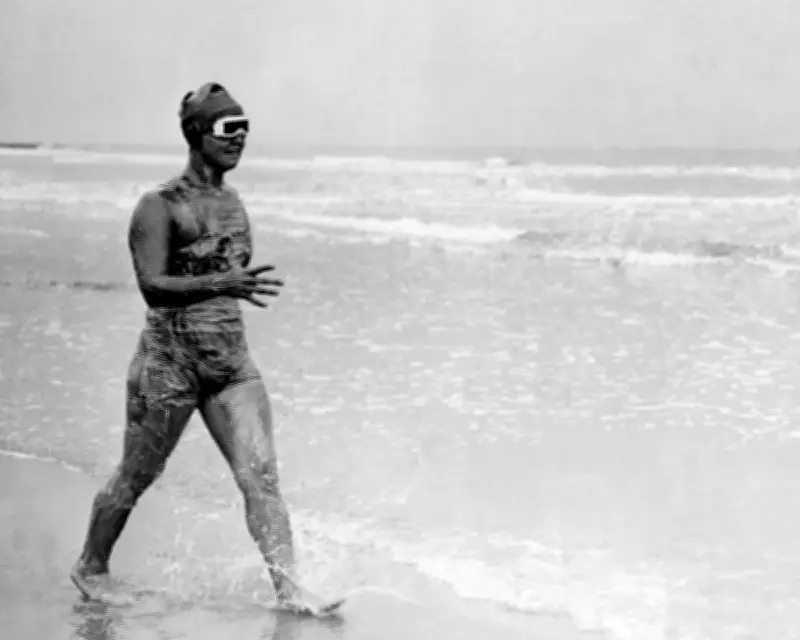
On 7 August 1926, Miss Gertrude Ederle, a 19-year-old New York swimmer, became the first woman to swim the English Channel. She crossed from Cape Gris-Nez in France to Deal, England, in a time initially reported as 14 hours 45 minutes, later confirmed as 14 hours 39 minutes. This beat the previous record of 16 hours 33 minutes set by Italian swimmer Tiraboschi in 1923. Only five people had previously completed the swim. Miss Ederle's fellow countrywoman Clarabelle Barrett had come within two miles of success the previous Monday.
Miss Ederle began her attempt at seven o'clock in the morning under unfavourable conditions. A strong south-west wind arose within an hour, creating rough seas. Despite this, after six hours she was about 10 miles off the French coast, well to the eastward. This was her second attempt; her first had been in 1925.
Editorial: Miss Ederle's Victory
An editorial on 9 August 1926 noted that it was over 50 years since Webb first swam the Channel, and for 30 years after, he seemed a superman. In the last few years, four men had succeeded, two in shorter times. Now, for the first time, the distinction and the record fell to a woman. The editorial stated, "With Miss Ederle's plucky victory a great deal of the confident assumption of the past is discredited."
Wiseacres had argued that man was better suited to bear the prolonged discouragements of tides, cold, seasickness, and inflammation of the eyes. Several magnificent attempts by women had lately discounted this head-shaking. Miss Ederle had beaten the men under far from ideal conditions, facing a rough sea early on and the giant pull of the tides. Webb swam 45 miles; Burgess covered 63 miles in 1911. But Miss Ederle, like Tirabocchi, had strength and will to combat the third tide's pull and gain the shore.
American Jubilation and German Claims
On 9 August 1926, the sport-loving American public was jubilant. Newspapers gave whole pages to pictures of the heroine, her mother, and family. Her biography was broadcast. The New York Times said Miss Ederle won through a combination of pluck, skill, and luck: "A natural swimmer of great power and self-confidence, it was her indomitable spirit that shone out most in her triumph yesterday."
By 12 August 1926, Germany claimed Miss Ederle as German, noting she was only American by naturalisation of her parents, who were pure German. She was born at Weilheim an der Teck in Wurtemburg, and the family emigrated when she was a child. It was announced she would visit relations in south Germany before returning to the States.




