
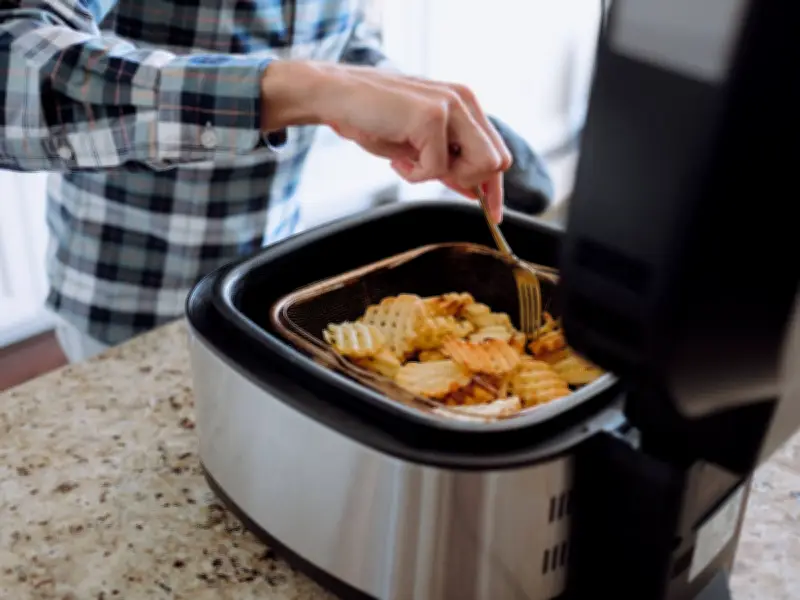
Air fryers have become a fixture in countless homes in recent years, prized for their capacity to prepare food quickly. The gadget can handle everything from chicken to sausages to cupcakes, frequently in less time than a conventional oven.
Energy consumption and costs
According to the Energy Saving Trust, cooking accounts for 3% of the average household's energy consumption. With energy bills remaining elevated, it's worth thinking carefully about which appliances you rely on for meal preparation.
Depending on what you're making, certain appliances are considerably more energy efficient than others, which can help reduce both energy bills and CO2 emissions.
Air fryers: cheaper for small meals
According to the Energy Saving Trust, when preparing the exact same meal, air fryers are "cheaper" to run. However, the appliance you need largely depends on the quantity you're cooking. Air fryers, for instance, are best suited to cooking for one or two people.
An air fryer operates much like a compact conventional oven. Due to their smaller size, they are often cheaper to operate than a full-size oven for an equivalent meal. When using the appliance, try to avoid opening the compartment unnecessarily, as this releases heat and wastes energy.
Ovens: better for batch cooking
Ovens are generally considerably larger than other cooking appliances, meaning they require more energy to heat up. As a result, a standard electric oven can prove the most costly cooking appliance to run when preparing individual portions.
Nevertheless, their greater capacity means significantly more food can be cooked simultaneously, making an electric oven far more practical for batch cooking or feeding a large gathering. Similar to using an air fryer, try to minimise opening the oven door unnecessarily while the oven is in operation to retain hot air and cut down on wasted energy.
Microwaves: most efficient for reheating
When reheating food is required, opting for a microwave is your best choice. Rather than warming the surrounding air, microwaves heat food directly. Consequently, they operate rapidly, meaning the per-use cost is likely significantly lower than that of alternative cooking appliances.




