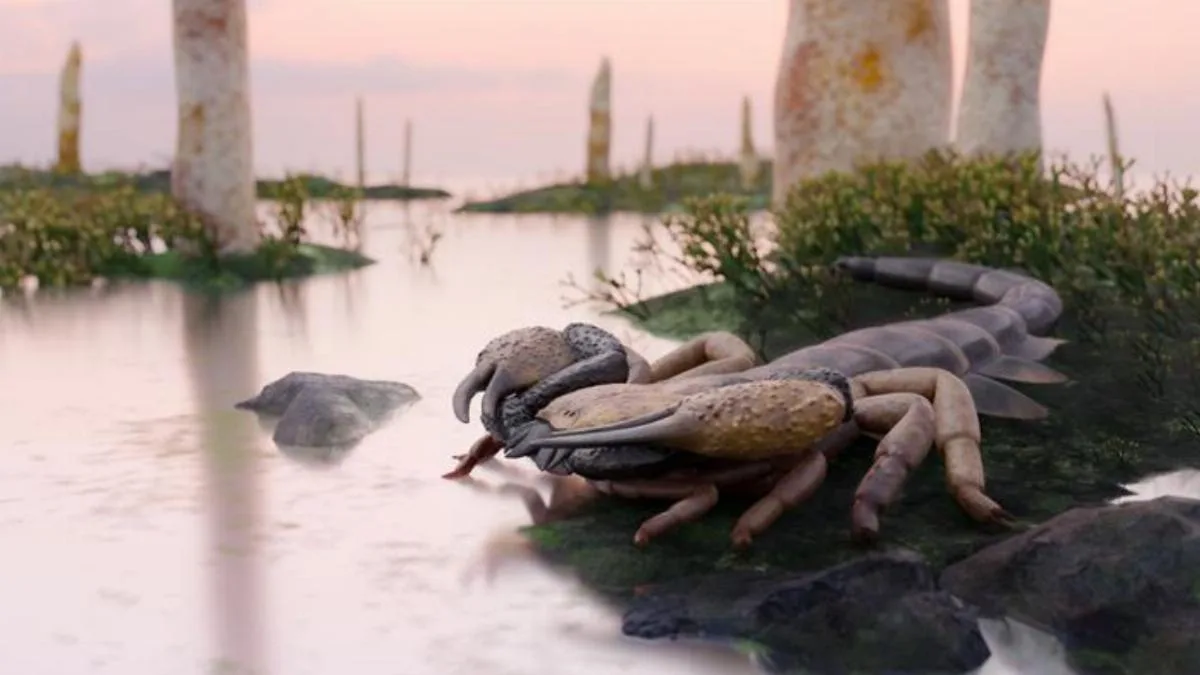
Scientists have confirmed that a metre-long scorpion with 16cm pincers, named Praearcturus gigas, roamed what is now Britain 415 million years ago. The findings, published in the journal Palaeontology, were made possible by studying fossils housed in the Natural History Museum’s collections for over 150 years.
Researchers from the Natural History Museum and the University of Manchester used modern analytical techniques and comparisons with newly described fossil species to identify Praearcturus as a distinct species of scorpion. Dr Richard J. Howard, lead author of the study, said: 'Confirming that this animal is a scorpion fundamentally changes our understanding of how and when these creatures evolved to such extraordinary sizes.'
The giant scorpion lived during the Early Devonian period, when small plants and fungi had only recently begun to spread across the landscape. Unlike later giant arthropods, Praearcturus did not benefit from high atmospheric oxygen levels; instead, its enormous size may have been linked to a lack of competition from other large predators.

Evidence from the fossils suggests the scorpion may have spent part of its life in water. Some specimens show flap-like structures on the abdomen similar to those found in modern crustaceans, raising the possibility that the animal could move between aquatic and terrestrial environments. Dr Russell Garwood, co-author of the study, noted: 'What makes Praearcturus so interesting is that it became enormous at a time when life on land was otherwise very small.'
First described in 1871, Praearcturus gigas was originally thought to be a giant crustacean resembling a woodlouse. The fragmentary nature of the fossils, which lacked key anatomical features such as a tail, made classification difficult for over a century. Dr Greg Edgecombe, co-author, added: 'The boundary between land and sea was much less defined at this time. Praearcturus gives us a fascinating glimpse into how early animals adapted to these changing environments.'