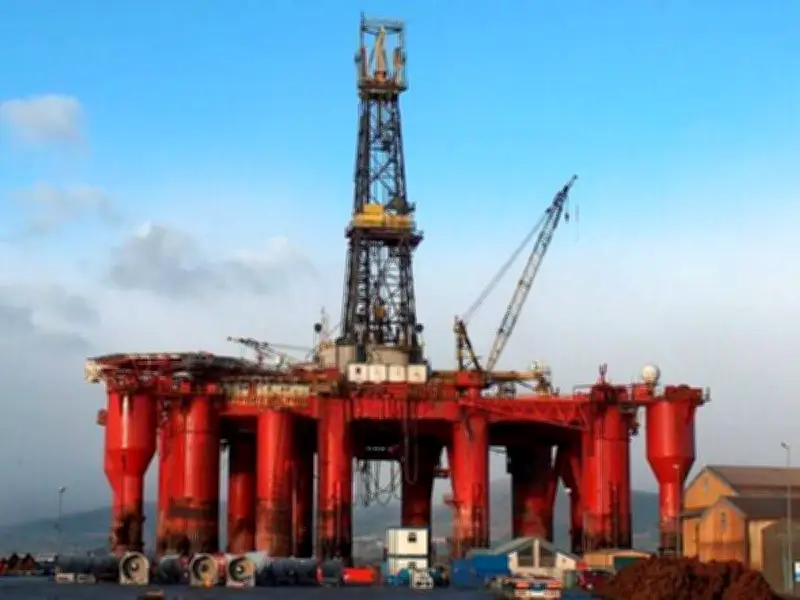
The 1983 Byford Dolphin decompression disaster in the North Sea claimed the lives of five out of six men involved after a diving bell was prematurely unlatched, causing a catastrophic loss of pressure that has been described as one of the most gruesome deaths in history.
The incident took place on the Byford Dolphin, a semi-submersible oil drilling rig that operated across the British, Norwegian, and Danish sectors of the North Sea, performing seasonal drilling for different companies. The rig was the location of multiple accidents involving its workers throughout its operational years.
Fatal Deep-Sea Operation
In November 1983, a crew consisting of two British and two Norwegian divers - Roy P Lucas, 38, Edwin Arthur Coward, 35, Truls Hellevik, 34, and Bjørn Giaever Bergersen, 29 - alongside dive tenders William Crammond, 32, and Martin Saunders, 30, were deployed on the rig to carry out a deep-sea diving operation.
At the point of the incident, all six men were carrying out their duties beneath the water, performing routine maintenance on the rig at a depth of 295 feet. To safely execute their work, the crew were housed in specially designed compression chambers throughout their scheduled 28-day stint, preventing dangerous levels of nitrogen accumulating in their bloodstreams.
Within these chambers, the divers would inhale a precisely measured combination of gases, ordinarily oxygen and helium, calibrated according to the depth of their dive. The crew employed a technique known as 'saturation diving', which allowed them to spend extended periods at considerable depths underwater. This approach was used to safeguard the crew against decompression sickness, more commonly referred to as 'the bends', upon their return to the surface.
The Moment of Catastrophe
The men relied on a specialist transport vessel, a diving bell, to safely travel between their living quarters and their underwater worksite. On 5 November 1983, divers Hellevik and Bergersen were completing a 12-hour shift, assisted by dive tenders Saunders and Crammond, and were heading back to their sleeping quarters via the diving bell.
For the safe functioning of the diving bell, it was vital that the crew made certain the transportation vessel was sealed and properly reconnected before they returned to their highly pressurised sleeping chambers. This process was essential to avoid rapid decompression in the body, which could prove fatal. Once inside, the divers needed to shut the door and regulate the pressure in their sleeping chamber to form an airtight seal, isolating the chamber and linking it to the dive bell, which would slowly depressurise for the divers' safety.
On that tragic day, the pressure in the inner crew chambers 1 and 2 (typically pressurised to nine atmospheres) dropped to one atmosphere within a split second. This happened because one of the external divers committed a human error and released the diving bell too early before full depressurisation had taken place. This blunder caused the clamp - which was maintaining the chambers sealed - to open before Hellevik had completely closed the chamber door. Consequently, the pressure in the sleeping chamber suddenly shifted from that experienced at 295 feet beneath the surface to surface air pressure.
Aftermath and Sole Survivor
Coward and Lucas were reportedly resting in chamber 2, under a pressure of 9 atmospheres when the tragic incident unfolded. The sudden, violent rush of air escaping the chamber caused the diving bell to be forcefully propelled, striking Crammond and killing him instantly. Three divers inside the sleeping chambers died immediately as the nitrogen in their blood turned into bubbles, effectively boiling them from within and reducing their bodies to fragments.
Hellevik, who was closest to the partially closed chamber door, was sucked through a narrow 60cm gap, resulting in his organs being ejected from his body. The autopsy report stated: "The scalp with long, blond hair was present, but the top of the skull and the brain were missing. The soft tissues of the face were found, however, completely separated from the bones." His abdominal and thoracic organs had been expelled. Hellevik's body was reportedly dispatched for autopsy in four separate bags gathered from different locations around the rig, with each portion of his body inside the bags of bone and tissue reportedly showing some indication of injury.
Saunders, the sole survivor of the horrific accident, sustained severe injuries including collapsed lungs, back fractures and a broken neck. The fatal event was also attributed to engineering failures, as the Byford Dolphin oil rig was utilising an outdated diving system from 1975, lacking fail-safe hatches, outboard pressure gauges or an interlocking mechanism.