

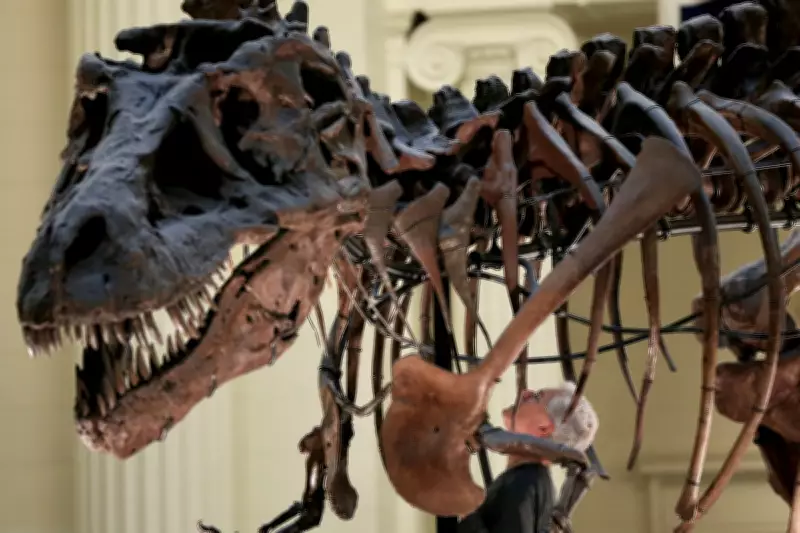
A recent scientific investigation has shed light on the evolutionary forces that shaped the iconic Tyrannosaurus rex, revealing that its formidable skull and remarkably small arms are directly linked to the escalating size of its prey. The study, published on Friday, indicates that the robust skulls of carnivorous dinosaurs evolved as a direct response to the increasing size of the plant-eating dinosaurs they hunted. This development subsequently led to a reduction in the forelimb size of these predators, a phenomenon observed independently across five distinct theropod lineages.
The Evolutionary Arms Race
Tyrannosaurus rex, an apex predator with a massive skull and famously diminutive arms, is a prime example of this evolutionary trend. Lead author Charlie Scherer, a paleontologist at the University of Edinburgh, explained that natural selection prioritized stronger heads for hunting, rendering forelimbs less essential and leading to their reduction. "As prey animals grew larger and more heavily armored, predators needed more powerful skulls to subdue them," Scherer said. "This shift in hunting strategy made the forelimbs less critical for capturing and killing prey, allowing them to shrink over time."
Independent Evolution
The research team analyzed the fossil records of five distinct theropod lineages, including tyrannosaurs, abelisaurids, and carcharodontosaurids. They found that in each lineage, the evolution of a robust skull preceded the reduction of forelimb size. This pattern suggests that the trade-off between head and arm strength was a common solution to the challenges of hunting large prey.

"It's a remarkable example of convergent evolution," Scherer noted. "Different groups of dinosaurs arrived at the same solution independently, which underscores the selective pressure exerted by giant herbivores."
The Mystery of T. rex's Arms
Despite decades of study, the precise function of T. rex's small arms remains a puzzle. The arms were too short to reach its mouth or to be used effectively in combat. Some researchers have proposed they were used for grasping mates during reproduction, for levering themselves up from a resting position, or for slashing at prey. However, the new study suggests they might be vestigial structures, maintained primarily due to complex genetic factors rather than any specific function.
"The arms may have persisted because the genetic pathways that control their development are deeply intertwined with other essential structures," Scherer explained. "Once they became non-essential for survival, natural selection no longer acted to maintain their size or strength, but eliminating them entirely would have required major genetic changes that were not favored."
The findings provide a clearer understanding of the evolutionary pressures that shaped one of the most famous dinosaurs and highlight the intricate balance between different anatomical features in response to ecological challenges.






