
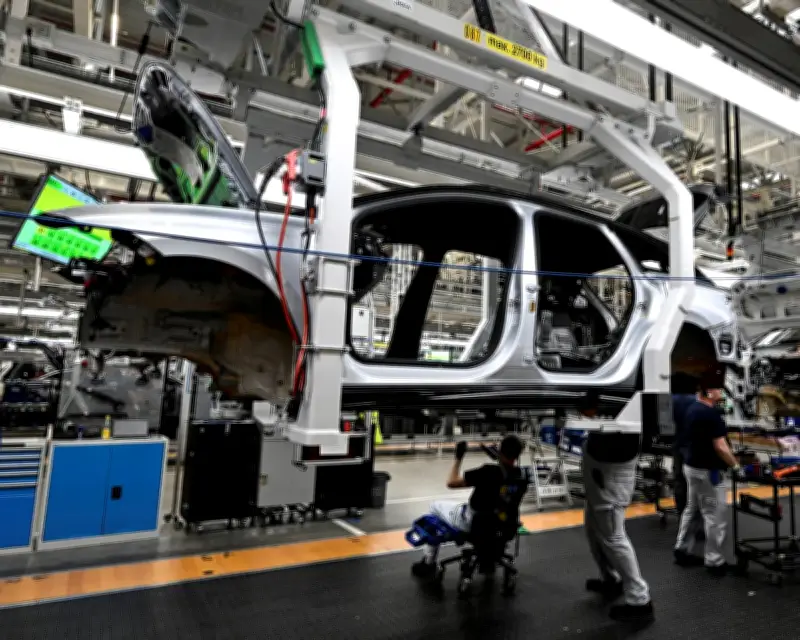
Volkswagen's proposal to slash up to 100,000 jobs and close factories faces a major test on Thursday as they are formally put to its supervisory board, with protests planned at all plants in Germany.
IG Metall, the influential staff union, has organised demonstrations involving shop stewards and union council members at 18 sites at Europe’s biggest carmaker, including its headquarters. It told the chief executive, Oliver Blume, that he cannot “pass the buck for failures of recent years on to the workforce.”
Union Leadership Sends Clear Signal
Christiane Benner, the chair of the union, said: “This sends a clear signal to the board,” which will be asked to review the wide-reaching plans, leaked to the media last month, for the first time today at VW’s headquarters in Wolfsburg.
Thursday’s demonstrations will target factories producing cars for VW as well as others in the manufacturing group, including the Audi and Porsche plants, along with the truck and bus maker Man between 11.20am and 2pm.
Radical Transformation Plan Details
Blume has drawn up a radical transformation plan, with the key sticking points being the possible closure of four German plants – Hanover, Emden, Zwickau and Audi’s Neckarsulm site – as well as up to 50,000 in additional job cuts tied to it, sources have said.
With more than 650,000 staff across Germany and about 3 million employed directly and indirectly by the country’s car industry, the board meeting is being seen as a major test for the future of the German economy.
In addition, the company is reviewing its sprawling structure and may carve out or spin off its core brand division and components technology business in an attempt to simplify its sprawling structure.
Industry-Wide Employment Concerns
The presentation by Blume’s team comes after the car trade representative body, the VDA, predicted potential employment collapse across the sector in Germany and the wider continent unless “bold decisions” were taken, including the potential sell-off of unviable plants to foreign car companies.
The carmaker employs more than 650,000 people across all its brands, which include Audi, Bentley, Skoda, Seat and Cupra, and has been hit hard by growing Chinese competition and the struggle to shift to electric cars from combustion engines.
Board Structure and Union Resistance
Months of talks with unions would follow if the proposals are accepted by the board, which is made up of company representatives, union representatives and local politicians, a structure set under the Volkswagen Act, a set of laws passed in the 1960s designed to protect the carmaker from hostile takeovers.
Currently, only 19 of the 20 seats on the supervisory board are occupied, leaving the board’s shareholder representatives with one fewer seat than the labour and workers’ side, which continues to hold 10 seats.
Closures of plants covered by the “Volkswagen law” require a two-thirds majority, meaning approval for such a move is virtually impossible against union opposition.
Two of the company’s plants at risk – Zwickau and Neckarsulm – are not covered by the law, meaning their closure would not require supervisory board approval. However, it is likely that efforts to actively shut them down would be met with massive resistance and protests from unions and local politicians and could include costly strikes.




