

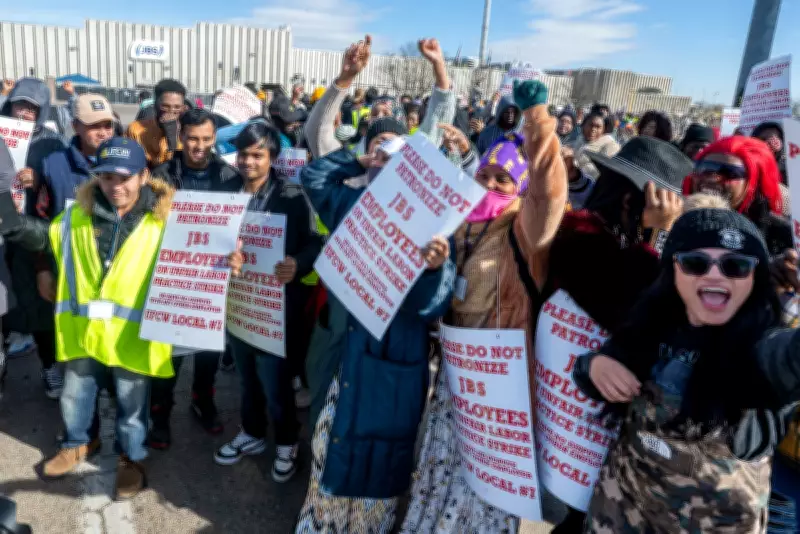
Thousands of workers at one of the United States' largest meatpacking facilities are now entering the third week of their strike, intensifying their demands for increased wages and enhanced healthcare benefits. The walkout, which commenced on 16 March at the Swift Beef Co. plant in Greeley, Colorado, has garnered support from 99 per cent of the plant's 3,800 employees, all members of the United Food and Commercial Union Local 7.
Uncertain Impact on Consumer Beef Prices
Industry experts caution that it remains premature to assess whether this prolonged strike will lead to higher beef prices for shoppers. Jennifer Martin, a specialist from Colorado State University's animal sciences department, highlighted that the current industrial landscape differs significantly from past decades. "The industry is now less burdened by excess slaughter capacity, which had previously kept profit margins low," she explained.
Company Operations and Industry Profits
JBS USA, the plant's owner and the world's largest meatpacking company with a market capitalization of $17 billion, announced on Friday that it is operating at limited capacity. The firm is shifting beef production to other locations to meet customer demands. Amid the Greeley strike and other capacity reductions, including the closure of a major Tyson Foods plant in Nebraska, JBS and other companies are reportedly seeing profits increase.

"It's not necessarily in favour of the employees," Martin added. "The lack of harvest capacity at one facility right now might actually be a benefit to the larger industry in the sense of improving profit margins."
Historical Context and Union Stance
This strike marks the first significant walkout at a US slaughterhouse since workers protested at a Hormel plant in Minnesota in 1985, a confrontation that lasted over a year and involved violent clashes between police and protesters. In Greeley, thousands of workers have consistently appeared on the picket line over the past two weeks.
Union officials have rejected the company's offer of 2 per cent wage hikes, arguing it falls short of inflation rates. "The Union stands ready to meet with JBS at any time, but make no mistake, workers will continue to fight until JBS rights these wrong," stated union President Kim Cordova.
JBS's Position and Broader Implications
JBS, which is the top employer in Greeley—a city 50 miles northeast of Denver with approximately 114,000 residents—emphasized its commitment to maintaining supply chain stability. "We are maintaining supply, supporting the long-term stability of the beef chain, and minimizing disruption for producers, customers, and consumers," said JBS spokesperson Nikki Richardson via email. "Our priority is to keep product moving while we work toward a resolution in Greeley."
Notably, JBS was approved for trading on the New York Stock Exchange last May, despite facing environmental opposition and a federal probe that resulted in a guilty plea for bribing Brazilian officials to secure financing for its US expansion. With negotiations currently stalled, the company holds a strong position relative to the striking workers, according to Martin, as the industry adapts to reduced capacity and potential profit gains.






