

Teenagers might not receive the full minimum wage before 2030, a minister suggested today. Treasury minister Torsten Bell stated there was no 'timeline' on Labour's manifesto pledge to equalise the rates for all adults.
The stance emerged after Labour heavyweight Alan Milburn joined businesses in warning about the impact of increasing the costs of employing young people. Since 2024, the pay floor for workers aged between 18 and 20 has jumped 26 per cent to £10.85 an hour. The minimum wage for older workers has also increased, but not by as much, rising 11 per cent to £12.71 an hour.
This policy has coincided with youth unemployment soaring, sparking fears that young people are being priced out of work. Speaking on BBC Radio 4's Today programme, Mr Bell insisted the Government remained committed to equalising the minimum wage for all adults. However, when pressed on whether that would happen by the end of the Parliament — expected in 2029 — he stressed 'that's not what it says in the manifesto'.

'It doesn't set the timeline on that because that's the important role of the Low Pay Commission to advise,' Mr Bell said. He added: 'The manifesto commits us to equalising the rates. We're absolutely committed to doing that.'
Labour's 2024 general election platform pledged to 'remove the discriminatory age bands, so all adults are entitled to the same minimum wage, delivering a pay rise to hundreds of thousands of workers across the UK'.
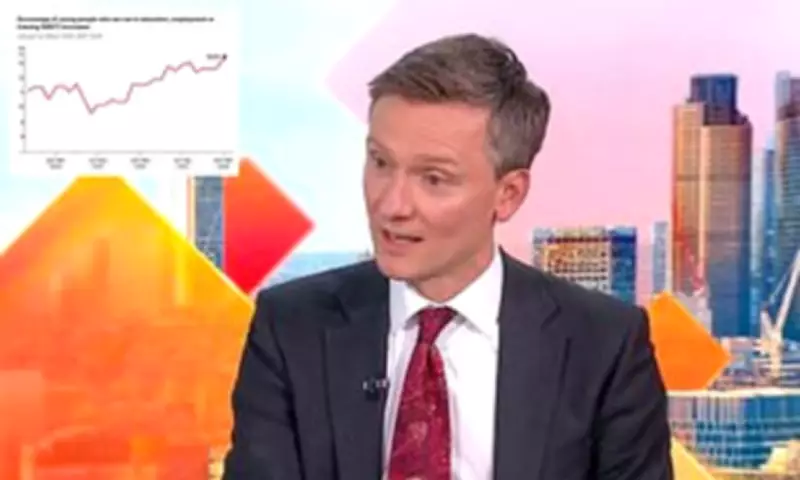
In a damning new report released yesterday, Mr Milburn stated that the cost to the country of the growing number of young people classed as Neets — not in education, employment or training — will rise to £125 billion a year, more than the Government spends on education. His long-awaited review was published as new figures from the Office for National Statistics revealed that the number of Neets has now passed one million.
Mr Milburn branded it a 'moral crisis' that one in six youths aged 16-25 will be on out-of-work benefits by the end of the decade, and said it was 'probably the most significant challenge facing our country today'. He found that Britain was an outlier in the EU, with only Romania recording a higher youth Neet rate.
Mr Milburn, a former Labour health secretary, backed Tony Blair's criticism of Government policies that have been blamed for making it harder for employers to hire young people. In a scathing attack on Labour's policy agenda this week, the ex-prime minister accused Keir Starmer's administration of lacking a 'coherent plan' and holding back business. Sir Tony singled out measures including new workers' rights laws and the above-inflation uplift to the minimum wage.
Mr Milburn suggested ministers should reconsider these policies as he called for a 'whole system reset' on education, welfare and health policy to get young people into work. Prior to the publication of Mr Milburn's report, the ONS said the number of people aged between 16 and 24 and not in employment, education or training rose to 1.01 million in the three months from January to March. This is the highest level since the three months to December 2013, when the figures were calculated with a different methodology, and also represents a 55,000 increase compared with the previous quarter. The data showed that 613,000 of these young people were considered economically inactive — meaning they are unable to work or not seeking work — over the period, marking a record high.






