

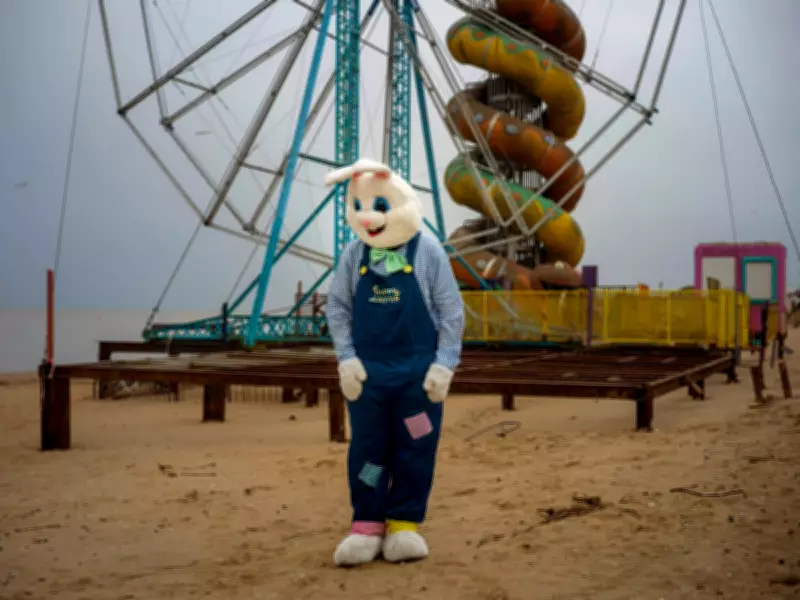
In the Lincolnshire seaside town of Cleethorpes, 19-year-old Cohen sits in the back seat of a car, donning an Easter bunny costume. A group of teenagers nearby stare in amusement, but Cohen remains unfazed. He is preparing for new photographs to promote his mascot business, Co Co Mascots, ahead of the holiday season.
Cohen, who lives with his parents in neighbouring Grimsby, started Co Co Mascots last year as one of many attempts to secure employment. The business allows people to hire him in various outfits for birthday parties, events, and doorstep surprises for children. While he has completed a few paid gigs, boosting his confidence, his ultimate goal remains a permanent job.
For the past year, Cohen, who has a learning disability, has applied for roles in holiday parks, retail, charity shops, and even Grimsby Town FC, which was hiring a new mascot. He volunteers at a local Scope charity shop once or twice a week and has begun a college placement at Morrisons. Despite his efforts, paid work has eluded him. "Retail was a big thing for a lot of people here at one point," he says. "But a lot of it's closing down now. It's now made up of vape shops and barbers, not places where you can get a job."

Grimsby was recently labelled Britain's "worklessness capital" due to a high proportion of working-age people claiming benefits. This rhetoric feels demoralising for Cohen, who says he is "throwing everything" at finding work. Once one of the world's largest fishing ports, Grimsby remains the UK's biggest fish-processing hub, but it has a higher rate of working-age adults out of employment than the national average. Additionally, 41% of under-16s in the town live in relative low-income families.
For many young people in coastal communities like Grimsby, finding paid employment is challenging, and having a disability compounds the issue. "The hardest thing is not hearing back and not getting feedback," Cohen says. "I start overthinking because I want it too much. A lot of the time, I think they see you have a disability and will pick the person without one because they think the person with a disability is more work."
Cohen has been volunteering in charity shops and food banks for over a year and does not view his disability as a barrier. "My mind can wander a bit when I work, so I need a nudge every so often. I just need a bit of support until I get used to the job and what is expected of me." His employment options are further limited because neither he nor anyone in his household drives, preventing him from seeking work outside town. "You do have those times when you doubt yourself, but then you get back to it," he says. "Mum and Dad have always been positive and told me not to put myself down."
Local graffiti artist Lynsey Powles, who runs the youth hub TickArt Office and helped Cohen establish Co Co Mascots, worries about young people like him being left behind. "There are a lot of kids in Grimsby who will engage, but if they don't fit into a box, they are never given any hope or support," she says. "The kids here need opportunities to do things they're interested in and can aspire to."
Adults like 35-year-old Lewis, living in Grimsby's YMCA while awaiting council housing, echo this sentiment. After being made redundant, he experienced homelessness. "When young adults and kids feel lost or trip up, they don't know who to ask," he says. "There's not enough qualified people here to give them advice." Lewis has done bar work and run a food truck at Grimsby FC, but his long-term dream is to run a village pub.
Cohen spends one evening a week at EVO Wrestling Academy, a local wrestling club where other teenagers and young adults gather. "It has been a bit mixed up growing up here," he says. "I was bullied, so I didn't like to leave the house, but with volunteering and wrestling, I've started to get out more. I wouldn't leave my hometown. I've been here since birth and don't plan on leaving."
Lisa February, 25, moved to Grimsby from London as a child and has co-founded lowercase theatre, working with aspiring artists. "I was always told it was a dead end and there was nothing for me here," she says. "But I always want to come back. I have a lot of family and friends and a community that cares about me."

Back on the seafront, Cohen finishes his photo session, feeling happy and optimistic. Next, he heads to his one-day-a-week placement at Morrisons, filling shelves. He has been told it could lead to a job offer. "I'm kind of nervous," he says. "I've heard they're all really nice, so fingers crossed it's all going to be OK."





