

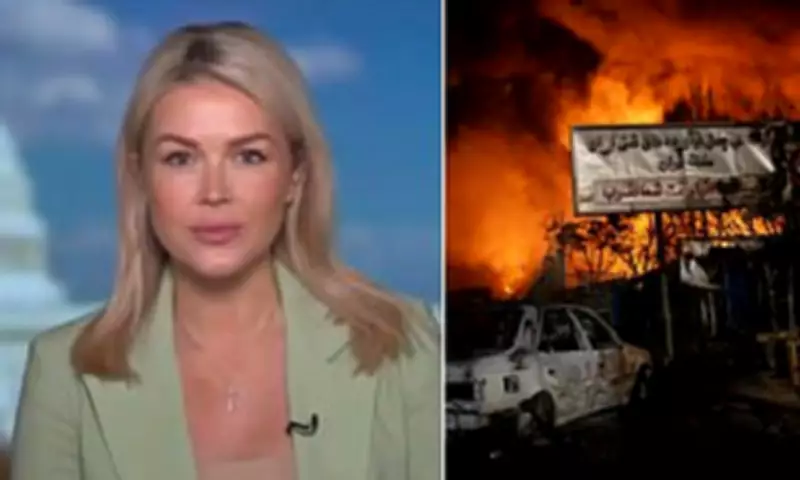
White House Press Secretary Karoline Leavitt has brushed aside mounting concerns over rising US gas prices amid the ongoing military conflict with Iran. During a Sunday appearance on Fox News' Sunday Morning Futures with host Maria Bartiromo, Leavitt framed the situation as a necessary sacrifice for broader strategic objectives.
A Temporary Disruption for Long-Term Gain
Leavitt asserted that the current spike in fuel costs represents a 'short-term disruption for the long term gain of taking out the rogue Iranian terrorist regime.' This statement comes as crude oil prices have surged dramatically, closing at approximately $90 per barrel on Friday. This marks a sharp increase from $65 per barrel on February 26, just prior to the joint US-Israeli strikes on Iran on February 28.
Current prices are now the highest observed since the onset of the 2022 Russian invasion of Ukraine, highlighting the significant market volatility triggered by the conflict. Leavitt further defended the administration's multitasking capabilities, stating that President Trump can 'walk and chew gum at the same time,' effectively managing both international conflicts and domestic issues concurrently.

Energy Secretary Projects a Swift Return to Normalcy
Energy Secretary Chris Wright echoed this sentiment during his own rounds on Sunday news programs. Appearing on CBS's Face the Nation, Wright acknowledged to host Margaret Brennan that 'Yes, we have a temporary period of elevated energy prices,' but he was quick to add reassurance. 'It will not be long before the prices come back down again,' he stated.
Wright provided a more specific timeline, emphasizing that 'In the worst case, this is weeks. This is not months.' He argued that the military action would ultimately lead to a 'much better place,' resulting in a 'defanged' Iran that can no longer threaten its neighbors, American soldiers, or disrupt global energy markets by destabilizing the Middle East. 'They can move to commerce, not conflict,' Wright concluded.
In a separate interview with CNN's State of the Union host Jake Tapper, Wright set a clear target, noting the administration's desire to see gasoline prices 'back below $3 a gallon. And it will be again before too long.' When pressed by Tapper for a precise schedule, Wright reaffirmed his 'weeks, not months' prediction.
Assurances of Ample Supply Amid Market Turbulence
The Energy Secretary also sought to calm fears of an energy shortage. On Face the Nation, he stated unequivocally that 'there's no energy shortage at all in the Western Hemisphere.' He elaborated that while refineries in Asia and Europe are experiencing interruptions to normal crude flows due to the conflict, 'there is massive energy stores around the world.' Wright highlighted the United States' position as a net exporter of oil and a significant net exporter of natural gas.
However, the market reality is stark. Iran's decision to shut the Strait of Hormuz, a critical chokepoint through which a fifth of the world's oil flows, has sent prices soaring. Brent crude oil jumped more than 10 percent in a single week, rising from $72 to over $82 a barrel.
Internal Pressure and Political Ramifications
Despite public assurances, internal pressure is mounting within the administration. Sources reveal that White House Chief of Staff Susie Wiles has demanded urgent action to bring gas prices down as the war with Iran sends oil costs skyrocketing. Energy Secretary Wright and other top officials, including a council led by Interior Secretary Doug Burgum, 'are getting screamed at to find some good news,' according to industry executives.
In response, energy executives and Trump administration officials have reportedly pitched various ideas. These include implementing a temporary holiday on the federal gasoline tax or deploying military personnel to defend oil infrastructure in Gulf states. One energy executive told Politico that the White House is 'looking under every rock for ideas on improving energy prices, especially gasoline prices.'

Press Secretary Leavitt dismissed such reports as 'sensationalist, unverified gossip for clicks. Nobody is panicking.' A separate White House official pointed to economic indicators, telling the Daily Mail that Wall Street is not anticipating significant inflation, with Treasury yields down 50 basis points since Trump took office and core inflation at its lowest rate in nearly five years.
Delicate Political Timing
The pain at the pump arrives at a politically delicate moment for President Trump, who faces crucial midterm elections in November. A new Daily Mail/J.L. Partners poll indicates his approval rating has hit its lowest point ever, dropping four points to 44 percent since Friday. This decline underscores the potential domestic political cost of sustained high fuel prices, even as the administration projects confidence in a rapid market correction.





