

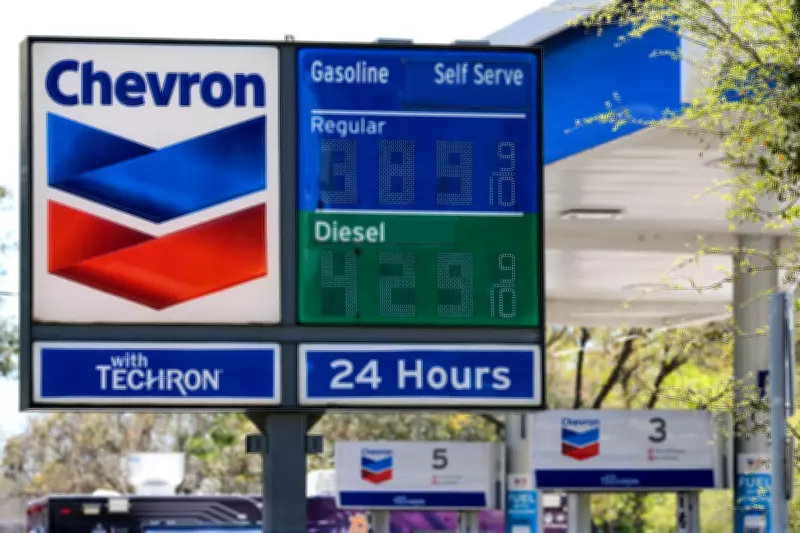
US Gas Prices Surge to Highest Level Since 2023 as Iran Conflict Escalates
The ongoing war in Iran has severely disrupted the global oil supply chain, leading to a sharp increase in fuel costs that is putting significant financial pressure on households across the United States. According to the latest data from motor club AAA, the national average for a gallon of regular gasoline has jumped to $3.79, marking the highest price point since October 2023. This represents a substantial rise from the $2.98 average recorded before the conflict began with joint U.S. and Israeli attacks on Iran on February 28, 2026.
Immediate Economic Impact on American Drivers
For many Americans, the pain at the pump is one of the most immediate and tangible effects of the war. Amanda Acosta, a resident of Louisiana, expressed her frustration while filling up her car this week, stating, "It's pretty hard. I mean, times are tough for everybody right now. I'm getting way less gas and paying way more money." Her sentiments are echoed by drivers nationwide, as the conflict has caused crude oil prices to soar and swing rapidly due to supply chain disruptions and production cuts across the Middle East.
Brent crude, the international benchmark, was trading at over $102 per barrel on Tuesday, up from approximately $70 just weeks ago. Similarly, U.S. benchmark crude has reached nearly $96 per barrel. This surge is primarily driven by Iran's effective halt of tanker movement through the Strait of Hormuz, a vital passageway that once handled about one-fifth of the world's daily oil shipments. Additionally, strikes on oil and gas facilities by Iran, Israel, and the U.S. have further exacerbated the supply crunch.

Political and Economic Ramifications
The White House is under increasing scrutiny as President Donald Trump, who previously boasted about keeping gas prices low, has shifted his stance. In a recent social media post, Trump argued that higher oil prices benefit the U.S. because it is now the world's largest crude producer, claiming, "when oil prices go up, we make a lot of money." While oil companies may profit from these elevated prices, consumers are feeling the pinch, with rising costs adding to existing cost-of-living strains and potentially pushing up stubborn inflation in the short term.
Experts warn that this could apply more pressure on the Trump administration, especially as affordability remains a top concern for voters. Francesco D'Acunto, a finance professor at Georgetown University, explains that as households pay more for necessities like gas, many middle- and low-income families will be forced to cut budgets elsewhere. He adds, "These combined inflation shocks, and overall high uncertainty during times of war, also makes many houses and consumers freeze," potentially delaying major financial decisions such as buying a car or house, which could have broader economic repercussions.
Regional Variations and Broader Impacts
The impact of higher fuel prices varies across the country. On Tuesday, California had the highest average at over $5.54 per gallon, while Kansas recorded the lowest at about $3.21. Factors such as nearby refinery supply and differing tax rates contribute to these disparities. Beyond gasoline, diesel prices have also spiked, with the U.S. average topping $5 per gallon, up from $3.76 before the conflict.
Dan Bradley, a flatbed truck driver from Pennsylvania, highlighted the dual burden on work and personal vehicles, remarking, "It sucks when you're filling up. What are you going to do, not get gas?" Conversely, some regions, like west Texas, see a silver lining. Clay Plant, a resident of Lubbock, Texas, noted that rising oil costs boost local economies as drilling activity increases, saying, "It's kind of a good sign for us. I look at it as my friends and family get to eat and they get to go to work."

Global Scramble for Supply and Future Uncertainty
Despite the U.S. being a net exporter of oil, it is not immune to price spikes, as oil is a globally traded commodity. The country relies on imports because its refineries are primarily designed to process heavier, sour crude, whereas most domestic production is light, sweet crude. In response to the crisis, the International Energy Agency has pledged to release 400 million barrels from member nations' stockpiles, with the U.S. contributing 172 million barrels from the Strategic Petroleum Reserve. The administration has also temporarily freed up Russian oil from sanctions related to the war in Ukraine.
However, analysts caution that these measures offer only short-term relief. Refineries purchase crude oil in advance, and it takes time for new supply to reach consumers. Additionally, seasonal factors are at play, with U.S. gas prices typically rising in warmer months due to increased driving and a shift to more expensive "summer blend" fuel. The road ahead remains uncertain, and if the war drags on, prices could worsen, further straining household budgets and the broader economy.





