

US employers spend more than $1.5bn annually on efforts to oppose labor unions, according to a report released on Wednesday by the Economic Policy Institute (EPI). This expenditure includes hiring consultants and law firms specializing in union avoidance, as well as legal services during union elections and organizing campaigns.
Key findings on spending
The EPI estimates that employers allocate $442m per year to union-avoidance consultants alone. Amazon, for instance, spent $26.6m on such consultants in 2025, based on US Department of Labor filings. An Amazon spokesperson defended the practice, stating, “It’s important that our teammates and partners understand the truth, so we’ve continued to work with experts in the field who are able to share objective facts about what it actually means to have an external party take their voice.”
Impact on workers and union density
Margaret Poydock, a co-author of the report and senior policy analyst at EPI, highlighted the misallocation of funds: “This is millions or even billions of dollars that’s not going towards workers and investing into their workplace.” She attributed the decades-long decline in union membership and density partly to the influence of union-avoidance law firms and consultants. Union density in the US now stands at 10%, down from 20.3% in 1983, despite Gallup polls showing nearly 70% of Americans approve of labor unions.

Role of law firms and consultants
The report notes that Littler Mendelson, a law firm representing Amazon, Starbucks, and Delta Air Lines in union campaigns, operates its own Workplace Policy Institute. Through this institute, the firm has tracked and opposed legislation aimed at expanding workers’ rights, such as opposing California’s AB5 (which sought to combat worker misclassification) and supporting Prop 22 (which allowed ride-share apps to classify drivers as independent contractors).
“These law firms and consultants are essentially exploiting loopholes and weaknesses in our federal labor law and reporting requirements,” said Poydock. “But despite that, workers are still organizing, they are still winning elections and reaching first contracts. They’re trying to erode worker rights, not just for union workers or workers trying to form unions, but workers at large.”
Power imbalance and delays
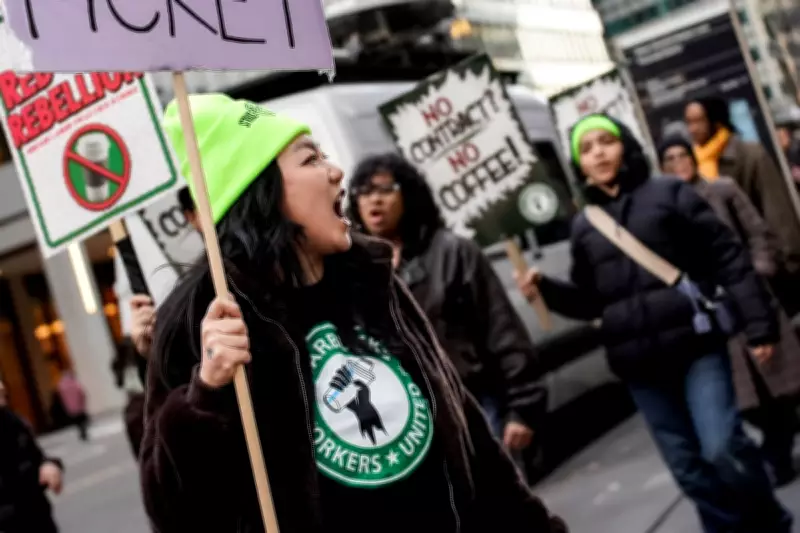
Teke Wiggin, a co-author and strategic coordinator at the non-profit LaborLab, emphasized that US employers already wield significant power over workers, and the use of union-avoidance consultants further magnifies this imbalance. A previous EPI report found that employers are charged with violating labor law in 41.5% of all union elections. Through delay tactics and appeals, it takes an average of 465 days for workers to reach a first union contract, with some cases taking much longer—such as at Starbucks, where workers have yet to secure a first contract since the first US store won a union election in 2021.
“Employers always have the choice to voluntarily recognize a union or agree to a neutrality agreement,” Wiggin added. “If they don’t, that’s a choice to try to bend the will of workers who are seeking to exercise their rights to free association, and that’s immoral and offensive to democratic values and the right to free association.”






