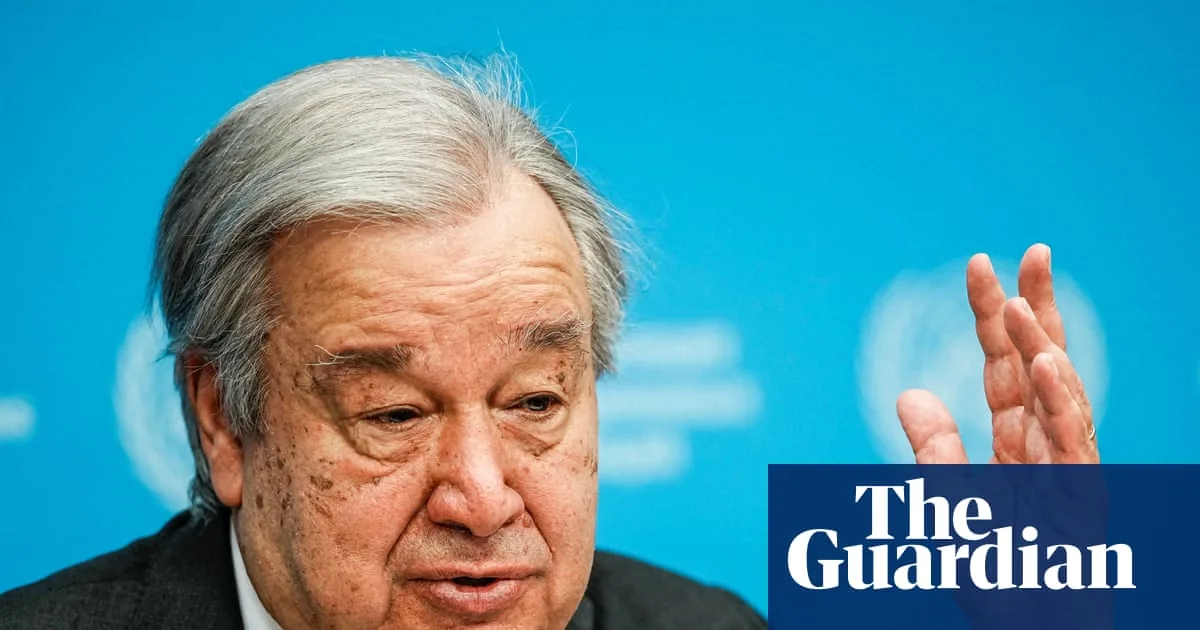
UN Chief Demands Economic Overhaul to Prevent Planetary Disaster
UN Secretary-General António Guterres has issued a stark warning that the global economy requires radical transformation to cease rewarding pollution and environmental destruction. In an exclusive interview following a UN conference of leading economists, Guterres emphasised that humanity's future depends on urgently revising "existing accounting systems" that are pushing the planet toward disaster.
The GDP Fallacy and Environmental Costs
"We must place true value on the environment and go beyond gross domestic product as a measure of human progress and wellbeing," Guterres declared. "Let us not forget that when we destroy a forest, we are creating GDP. When we overfish, we are creating GDP."
For decades, politicians and policymakers have prioritised growth measured by GDP as the primary economic objective. However, critics argue that endless, indiscriminate growth on a planet with finite resources is exacerbating both the climate crisis and increasing inequality.
Guterres explained: "Moving beyond gross domestic product is about measuring the things that really matter to people and their communities. GDP tells us the cost of everything, and the value of nothing. Our world is not a gigantic corporation. Financial decisions should be based on more than a snapshot of profit and loss."
International Expert Collaboration
In January, the UN hosted a Geneva conference titled "Beyond GDP," attended by senior economists from around the world, including Nobel laureate Joseph Stiglitz, leading Indian economist Kaushik Basu, and equity expert Nora Lustig. These three experts form part of a group established by Guterres tasked with developing a new dashboard of economic success measures that incorporates "human wellbeing, sustainability and equity."
A report published by the group late last year argued that as the world grappled with repeated global shocks over the past two decades—from the 2008 financial crash to the COVID-19 pandemic—the need for economic transformation had become increasingly urgent. The report noted these events were worsened by the "triple planetary crisis of climate change, biodiversity loss, and pollution" and warned that rapid technological change was disrupting labour markets and exacerbating inequality.
Expert Perspectives on Economic Transformation
Professor Basu, who co-chairs the UN group alongside Lustig, stated: "Nations are so locked into the game of beating other nations in terms of the GDP metric, that the wellbeing of ordinary citizens and sustainability are getting ignored. If all the new income accrues to a few individuals, and the GDP grows, all citizens are expected to cheer. This is feeding hyper-nationalism, inequality and polarisation."
Professor Lustig added that GDP was never "designed to measure human progress, yet it remains the dominant benchmark of success." She explained: "Economic growth can coexist with poverty, exclusion, violence, and serious violations of human rights—outcomes that remain largely invisible in conventional economic accounts. The group's aim is not to replace GDP but to complement it, helping governments and the public assess whether development is truly improving human wellbeing, advancing equity, and safeguarding sustainability now and for future generations."
Broader Economic Debates and System Change
The UN initiative follows a recent report indicating that current economic models are fundamentally flawed because they fail to account for the impact of climate shocks, such as extreme weather disasters and tipping points, potentially crashing the global economy.
These concerns emerge amid growing debates in academia, civil society, and policy circles about creating economic structures compatible with greater equality and sustainability. Various approaches include:
- Green Keynesians or green growth advocates
- Post-growth initiatives like doughnut, wellbeing, and steady-state economics
- Degrowth movements emphasising planned reduction in damaging production in richer countries
Jason Hickel, a political economist and prominent degrowth proponent, noted these ideas are gaining traction, citing a survey where 73% of nearly 800 climate policy researchers worldwide support post-growth positions. While backing Guterres's call to move beyond GDP, Hickel argued: "A deeper system change is required. Specifically, we need to democratise control over production, which can enable us to change what we produce and for whom. The dominance of GDP is not an accident; it occurs because GDP measures what is valuable to capital. It is the structure of capitalism that ultimately must be overcome."