
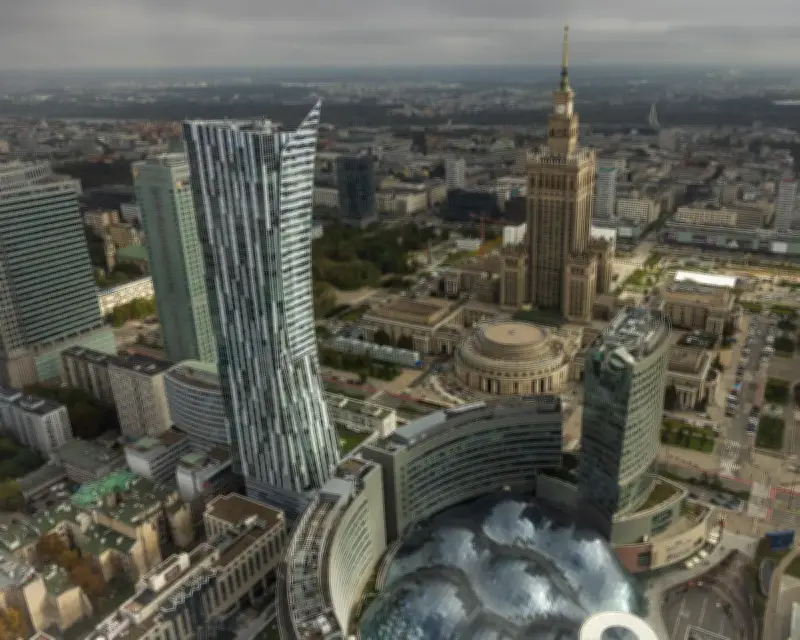
Poland's national income surpassed $1tn (£755bn) last year, ranking the country among the world's 20 largest economies, with income per capita projected to soon overtake Japan and Spain, according to International Monetary Fund projections. Over four decades since regaining independence from Soviet-dominated rule, incomes have converged with western levels at the fastest rate in the world, rising from 40% of the EU average in the mid-1990s to 81% last year.
From communist shortages to economic miracle
Marcin Bosacki, the Polish deputy foreign minister, recalls queueing after school in the 1980s for up to five hours to buy butter and meat as the communist government imposed martial law. The Gdańsk shipworkers' Solidarność movement and Pope John Paul II's 1979 pilgrimage paved the way for Poland's transition to democracy in 1990 and an "economic miracle," with integration into Nato in 1999 and EU accession in 2004 also helping.
Above the rain-soaked streets of Warsaw, the observation deck of the Varso tower overlooks the Soviet-era Palace of Culture and Science, built in the 1950s as a symbol of the postwar socialist era. For some, the palace is a drunk confectioner's nightmare and a relic of oppression that should have been demolished; for others, it is an icon and a monumental warning from history.
Reversing the brain drain
For years, many Poles emigrated to earn more abroad, a brain drain accelerated by EU membership. Since 2021, when Brexit was enacted, twice as many Poles left the UK than arrived each year. Meanwhile, Germany recorded more non-Germans moving to Poland in 2024 than heading in the opposite direction for the first time on record.
Jedrzej Kolesinski and Krzysztof Gornicki, architects at Foster + Partners in Warsaw, are among those returnees. Both moved to London in their 20s and led the design team behind the Varso tower they now occupy. Gornicki says Poland has changed dramatically, and the pair are now working to design Warsaw's new airport, the biggest greenfield infrastructure project in Europe.
Rising costs and new challenges
Since 2004, the average monthly wage has more than tripled in nominal terms to 8,904 złoty (£1,723) last year. The net monthly salary in Warsaw has risen by 120% since 2016, according to Deutsche Bank, lifting it above Rome and Lisbon. A meal for two in the capital now costs more than in Tokyo, and the price of a cappuccino has doubled.
The influx of global capital has driven up living costs, squeezing out poor Varsovians. Income inequality is among the highest in Europe, while growing political divisions set the stage for a fractious general election next year. Rafał Brzoska, the billionaire founder of InPost, says Poland must focus on productivity, technology, cheaper energy and better regulation, adding: "We don't have labour cost advantage at all."
Ambitions for a tech hub
Poland is pushing to become a regional tech hub, bolstered by a $1bn investment fund to support tech startups and AI companies. The number of high-growth firms is rising, including ElevenLabs, an $11bn AI audio generation company. The OECD's Pisa scores rank Poland equal to the UK among top countries for maths, and a greater share of adults have higher education qualifications than in Germany.
Michał Nowakowski, co-chief executive of CD Projekt Red, the games company behind The Witcher and Cyberpunk 2077, says young Poles have no inferiority complex. "We have really good universities and skills teaching people. I think that can take us to unprecedented heights as a country. There's nothing holding us back."




