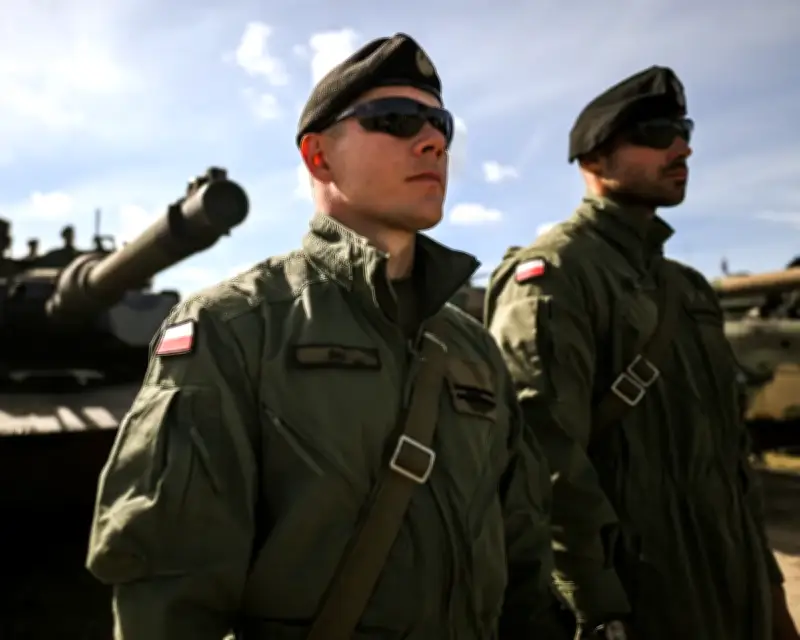
Poland's defence spending as a share of GDP has more than doubled from 2.2% to 4.8% this year, fuelling economic growth but also raising concerns about fiscal sustainability. The surge, driven by Russia's invasion of Ukraine, has transformed the country's defence industry and attracted international investment.
Defence investment boom
In Czosnów, a village north of Warsaw, a new hi-tech weapons facility has opened on what was a cornfield two years ago. The site, operated by MBDA Polska, a subsidiary of the European arms group, is part of Poland's rapid military build-up. Jim Price, managing director of MBDA Polska, said the company had to move fast to meet Polish needs, shifting from importing weapons to manufacturing them domestically. "We had to build up our Polish subsidiary – and that means Polish jobs," he said.
Poland's defence budget has grown at a blistering pace, with spending reaching $53bn (£39.8bn) this year, the fourth-highest in the EU after Germany, France and Italy. The government's focus is on the risk of a Russian test of Nato resolve, but also on growing the economy.
Economic impact and fiscal concerns
The defence boom is not cost-free. Poland is predicted to run the biggest fiscal deficit in the EU next year at 7.1% of GDP, and Moody's downgraded the country's long-term sovereign credit rating to the lowest level since 2002. Leszek Kąsek, an economist at ING Bank, said: "This path is not sustainable."
Despite the economic turnaround since joining the EU, with living standards rising from 40% of the EU average in the mid-1990s to 81% last year, political polarisation over defence and EU relations is growing. President Karol Nawrocki, backed by the Law and Justice party, attempted to block access to €44bn (£38bn) of defence investment loans under the EU's Safe programme.
Domestic industry and international partnerships
Warsaw has pledged to channel almost 90% of the Safe loans to domestic industry, led by state-owned Polska Grupa Zbrojeniowa (PGZ). International partnerships are also key, with Babcock working with PGZ on the Miecznik frigate programme, and BAE Systems partnering with Mesko to build an artillery plant near Katowice. Poland plans three new munition factories by 2028, aiming to increase 155mm ammunition production from 5,000 rounds in 2023 to 200,000 a year in the next two years.
Local contractors are already benefiting. Advanced Protection Systems (APS), which builds counter-drone systems, has increased its headcount from about 150 to 200 this year, playing a role in Warsaw's $4bn anti-drone wall programme. Co-founder Maciej Klemm noted the shift in migration trends, with Poles returning to Poland after Brexit, and said: "We have technical talent; we can build on this, and grow companies in Poland."