
From 'animal spirits' and robots taking on Victorian laws to train wifi, there was much for business to absorb at this year's Labour conference. Chancellor John Healey's speech on re-industrialisation grabbed the headlines, but plenty more happened across the fringe and exhibition areas in Liverpool as ministers, business leaders and entrepreneurs discussed their needs and how they could help each other. BusinessLive has compiled a list of key takeaways for businesses from Britain's biggest political showcase.
Robots hindered by 1835 law
At an event hosted by the Centre for the Analysis of Taxation (CenTax) and the Chartered Institute of Taxation (CIOT), panelist Lisa Johnson, vice-president for global public affairs at Starship Technologies, discussed the company's autonomous delivery robots. She explained how Starship's fleet of six-wheeled machines delivers products, including food and groceries, to homes and businesses, including in Milton Keynes where trials have been under way. The company wants to speed up the rollout but is hindered by the 1835 Highways Act, which Johnson says bans 'carriages' from pavements, including Starship robots.
She said: "I don't think the people who drafted that law had the foresight to see that autonomous delivery robots would be working years later". The point was not really about the MPs of 1835 but the need for regulatory change to be more swift and efficient to help businesses develop their technology.
'Tax should just happen'
At the same event, Financial Secretary to the Treasury James Murray dampened speculation about the Budget, saying: "If you're expecting me to tell you what's in the Budget, then you'll be disappointed. But I expect you knew that already." He did accept comments from other speakers that the UK tax system for entrepreneurs can be too complex, stating: "We don't want people spending all their time working out how the tax system works. We want them to be productive, to grow their business, to do what they do best." He said he liked the phrase that "tax should just happen".
Paul Aplin, president of the CIOT, called for a simplification of the tax system and a reduction in the regulatory and administrative burden on businesses. Prof Arun Advani, Director at CenTax, said the workload can be "disproportionate" when regulations apply to small firms and microbusinesses as they do to larger firms. He noted a recurring theme in his work was that it was "extremely hard to navigate" the tax system without professional advice, and there is a worry that only the biggest businesses and wealthiest entrepreneurs can "afford the big cheques to get the best advice", which is not good for supporting start-ups and scaleups. Advani said he expected a "relatively quiet Budget" and pleaded that if tax changes were going to happen, they should happen sooner rather than later to give people time to adjust.
Train wifi and mobile signal
Tax simplification was a popular topic, but another subject united the room. Aplin talked about the need to improve productivity across the UK, adding: "What crippled my productivity on the way to Liverpool wasn't tax. It was not being able to get a 4G signal". He added: "Tax isn't everything." There were supportive mutters in the room as he spoke about his four wasted hours of travel when he couldn't get any work done. "Train wifi", people nodded wisely.
Unleashing 'animal spirits'
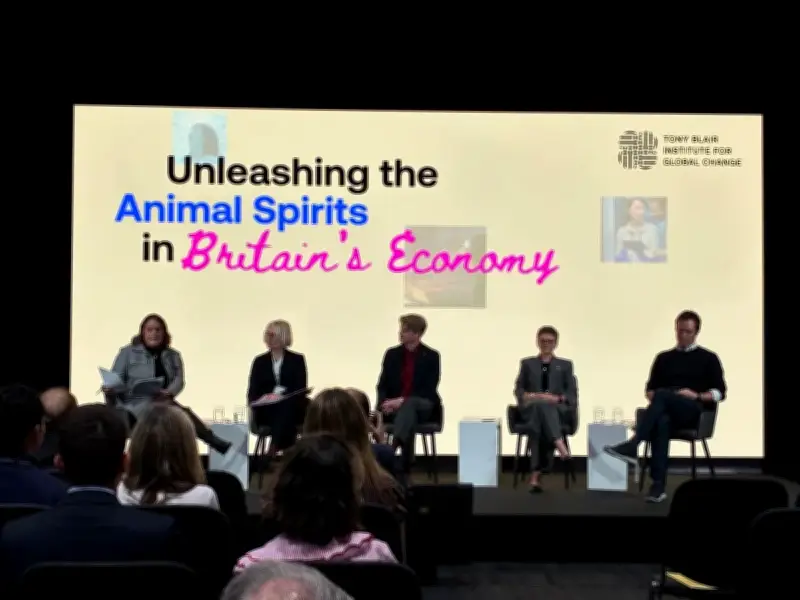
At a debate in the Tony Blair Institute hall titled "Unleashing the animal spirits in Britain's economy", Chief Secretary to the Treasury Emma Reynolds discussed the Chancellor's re-industrialisation pledge, pointing out the vision included industries old and new. She had recently visited the semiconductor cluster in Newport, South Wales, a prime example of modern hi-tech industry vital to the AI cluster, but also enjoyed a recent visit to Numatic in Somerset, home of the Henry vacuum cleaner. She said: "We want all sorts of business, including a medium-sized business employing 1.100 people in Somerset, grasping those opportunities."
Reality of buying British
Ed Conway of Sky News, author of Material World, was on the Animal Spirits panel briefly before leaving to interview John Healey. He said the Chancellor's speech "wasn't seismic," showing the new government faced tough fiscal challenges. On the pledge to reindustrialise, he mused: "Part of the reason we have deindustrialised is that we like cheap things." He highlighted the Government's backing of plans to reopen a tungsten mine in Devon, noting the mine closed because it was cheaper to buy tungsten from other countries. He observed that we have got so used to buying things cheaply that we may have forgotten that buying British might cost money, and we may have to accept higher prices for reasons such as protecting supply chains or national security. He asked: "are we being too cheap?" and mused that perhaps "we need things to become more expensive", adding: "There's a willingness to start the conversation, but it's a discomforting conversation".
Growth in every postcode
Ministers and panelists kept returning to the theme of spreading growth across the country. Reynolds talked about spreading growth from Henry makers in rural Somerset to the most hi-tech IT spinouts at British universities. Fellow panelist and Greater Manchester Mayor Bev Craig said she was "optimistic" about re-industrialisation and highlighted Greater Manchester's Atom Valley regeneration zone as an example of what hi-tech industrialisation could look like. Murray said: "I don't want to see entrepreneurs clustered in one part of the country. I want them in every region and every neighbourhood and every city, town and rural area. The only way to high growth in the UK is if every region plays its part."
Chancellor's deal with business
At the CBI Business reception hours after his big speech, John Healey offered businesses a "deal". "Growth doesn't just happen," he said, adding the job of government is to work with business to stimulate growth. "In the end," he said, "it is private business that creates the jobs, creates the wealth, that creates the profits… that allow you to invest in the future." He said the Government and businesses needed to do a deal to work together, with ministers adhering to fiscal discipline and supporting business at a time of cost pressures, and businesses agreeing to continue having the confidence to invest and take risks to grow. He said: "If we can do that, and we can do that together… then I very much welcome the chance as Chancellor to work with you." He declared: "Talking Britain down does no one any good."
Business needs a voice in government
Jonathan Reynolds, who first served as Business Secretary in 2024-25 and returned to the job this year after Andy Burnham became Prime Minister, spoke at a "fireside chat" event. Asked by Shevaun Haviland, director-general at the British Chambers of Commerce, what it was like to be back, he replied: "If you've been following events at conference this week… I'm pretty much the happiest cabinet member in Britain." He praised his team and accepted there were "Lots of things to fix, lots of things to improve upon". He told the room of business leaders: "My job is to do the things you're in charge of, and also to be the voice of business in government as a whole." He added: "It's a legitimacy I don't take lightly."
Costs still need to come down
At his fireside chat, Reynolds declined to preview the Budget but said his department had made its submissions to Number 11. He said his relationship with John Healey was strong and he had been pleased with the Chancellor's comments about the need to tackle the cost of doing business as well as the cost of living. "People know the kind of things that obsess me," he said, including high industrial energy prices and the "aggregate effect" of costs and regulations. Haviland had responded to the Chancellor's speech by saying: "Firms are being asked to invest while facing a tsunami of rising costs from employment, energy and business rates. For a typical SME their policy related operating costs have increased by more than 70 per cent in 10 years." Later on Tuesday, Prime Minister Andy Burnham acknowledged the impact high electricity prices were having on businesses, saying there would be reforms to the energy market. He said: "One of the biggest barriers to growth in the UK is the cost of energy. British businesses and billpayers pay some of the highest energy costs in Europe. Within 10 years I want those costs to be in line with our neighbours."
Employing young people
Asked what he wanted from business to support his work, Reynolds gave one simple answer: "Employing young people". He said the Government wanted to support people not in employment, education or training, and to do that it will need businesses to hire young people. "That's what I'll be coming to you to talk about," he said to BCC members. In his speech later on Tuesday, the Prime Minister also pledged to support young people, with plans to change the education system to offer academic and technical pathways from 14, as well as offering apprenticeships and work placements.
Young entrepreneurs are our future
The country will also need young entrepreneurs, like those taking part in Young Enterprise, who showed off their work at the conference fringe later on Tuesday. Young Enterprise provides financial and enterprise education to young people, best-known for helping young people at schools and colleges to set up their own businesses. Some graduates from the scheme took the stage at the Purpose Coalition's fringe event "Britain's growth starts young". Dylan Morris was managing director of a company at Coleg Cambria that created sportswear brand Mountforce, which won the Young Enterprise North Wales final last year. Now graduated, he is continuing to run the business and is ambitious to grow the brand. He joked that he originally wanted to be the "next Ben Francis," inspired by the billionaire founder of Gymshark, but quickly realised "it wasn't going to be easy". He said Young Enterprise had been vital in his business journey, as in his business studies at college "We only learned what it takes to become an entrepreneur, not what they actually do." Young Enterprise CEO Sarah Porretta said the programme showed the power of enterprise education and teaching young people what business really involves. She said education tends to focus on helping young people into employment, though "many young people not only show an appetite for enterprise, but they're already doing it."




