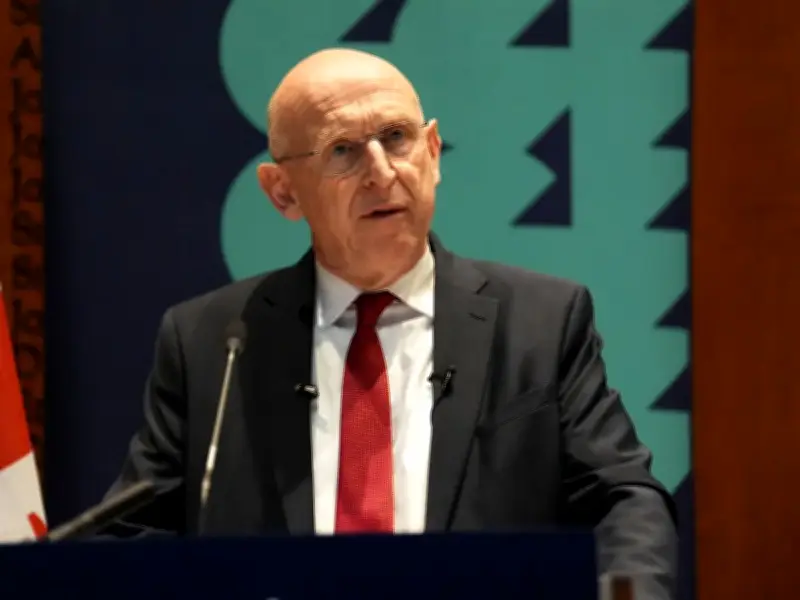
Chancellor John Healey will announce a new £150million fund for fast-growing firms in the North in a major speech on Monday, declaring a “fundamental shift” in power across the UK. He has vowed that the “next chapter of Britain’s growth story will be written in more places across the country” as he looks ahead to next month's crucial Budget.
The ex-Defence Secretary, who was a surprise appointment as head of Andy Burnham's Treasury, last week indicated that the country faces a tough October budget due to Donald Trump’s war in Iran. But he will seek to tell a "new story about Britain" and strike a note of optimism about the potential for regional growth in more areas.
Chancellor's optimistic message
Insiders say Mr Healey wants to emphasise that Britain is on the up, in contrast to opposition parties like Reform UK who spent their annual conference last week talking the nation down. Setting out his direction, Mr Healey is expected to say: "Ask an economist what growth is and you’ll get a number. But ask the country and you’ll get a different answer. A young person getting a new job in a company that’s on the up. A sole trader winning a new contract that pays for a holiday with their kids. A business winning a new export order, giving the community around it a new lease of life."

He is expected to add: "The Prime Minister laid out a clear diagnosis of what has gone wrong in the past. The solution is a fundamental shift that starts with putting power in the right places. The next chapter of Britain’s growth story will be written in more places."
Scale-up fund and partnerships
A new £150m scale-up fund from the British Business Bank is expected to support university spinouts - companies formed based on academic research - as well as other ambitious businesses across the North. Alongside this, the National Wealth Fund (NWF) has agreed to enter into strategic partnerships with South Yorkshire Mayoral Combined Authority, Liverpool City Region Combined Authority, North East Mayoral Strategic Authority and Cardiff Capital Region.
The Treasury said the partnerships will give more areas direct access to the NWF's investment expertise “to help develop and grow project pipelines, attract public and private finance and deliver key infrastructure”. Ministers on Sunday also published plans to slash outdated corporate reporting rules to free family firms and businesses from excessive paperwork, with the Government saying the plans will save businesses more than £450million a year in total.
State role and devolution
The Chancellor will also admit Britain needs “an active, accountable state at all levels to remove blockages and create the conditions for more investment" to support businesses. The message reflects Mr Burnham’s pledge to “rewire” the state and put “place” at the heart of his government's strategy. Writing in the Sunday Times, the Prime Minister said the state was both “too strong where it needs to let go, and too weak where it needs to act”.
He added: “If we’re going to get good growth in every postcode, we need to do things differently. In fact, we need to turn the entire system on its head.” Mr Burnham - the former Greater Manchester mayor - has long been a champion of devolving power, with Manchester enjoying better growth than the rest of the UK in recent years. A report by Mandala Partners suggested Manchester's economic model could unlock up to £80billion a year if replicated across England - enough to boost every household in the UK by roughly £2,800 a year.
In an interview with the Financial Times last week, Mr Healey said he would ensure the UK emerges from his first Budget with a solid “buffer against uncertainty” but warned conflict in the Middle East could make it tough. Economists have predicted that the fiscal buffer Rachel Reeves built up in her last budget will be squeezed by the inflationary pressures of ongoing global turmoil.

Business Secretary Jonathan Reynolds on Sunday said the benefits bill needs to be reduced but that the Government needs to make a "positive case" for cutting it. The Cabinet minister, whose son has learning disabilities, told Sky News cuts must not be "punitive" and those who are most vulnerable must be protected. He added: "I think many, particularly younger people, what they need is an intervention which is not welfare benefits, which is not giving them money. It might be medical, it might be some other form of support."