Greater Manchester's economy continues to outpace other regional authorities, outperforming both the UK average and London. The region has recorded the strongest productivity growth of any established mayoral authority in England over the past two decades.
Figures between 2004 and 2024 show that output per job in Greater Manchester increased by 27.1% in real terms, compared with 16.4% across the UK. The data, from the Office for National Statistics (ONS), has been analysed by the Northern Powerhouse Partnership (NPP) think tank and the Manchester Evening News/Reach Data Unit. The latest available data goes up to 2024.
Annual growth and comparison with other regions
Greater Manchester's growth equates to an average annual increase in productivity of 1.2%, compared with 0.8% nationally. It puts the region ahead of other mayoral authorities, with Cambridgeshire and Peterborough close behind at 26.5%, followed by the West of England at 22.9%.
London's output per job grew 10.3% over the past two decades, below the UK national average. Henri Murison, chief executive of the Northern Powerhouse Partnership, said: "I'm pleased that Greater Manchester is doing really well and has significantly closed the gap with London. But I take no glee in the fact that London is not doing as well. I want Greater Manchester to keep on growing, but with a London that is also doing better."
Mayor highlights community benefits
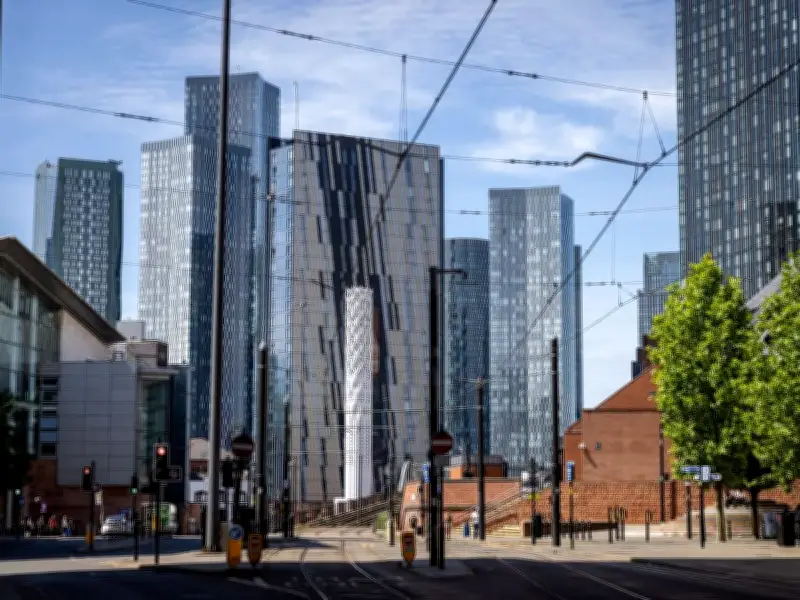
The data offers a positive picture of Greater Manchester's long-term economic performance, highlighting the progress made in increasing the value of output generated by its workforce. The region's mayor Bev Craig said: "Greater Manchester continues to change enormously. You can see it in the new homes we're building, the high streets we're transforming, the businesses we're helping to open and the jobs they're creating."
She added: "And you can see it in these figures, which show that output here has grown faster than in any other established mayoral authority and outstripped both London and the UK as a whole. We're proving that economic growth doesn't have to be driven from London and the south east and that giving places the power to shape our own futures can unlock the country's economic potential."
Mayor Craig said local leaders need to do more to make sure more parts of the city region can feel the benefits. She said: "But I'm clear that we need to do even more than we have before to ensure that every person and place here feels the benefits of Greater Manchester's growth. That means investing in a way that creates more good jobs, more affordable homes, thriving town centres and new opportunities for young people everywhere, so that no community is left behind."
To achieve this, Ms Craig pointed to Greater Manchester's Good Growth Fund. It means that any organisation in the region which gets investment from the pot must promise to deliver wider community benefits alongside any new development.
Mixed picture across the north
However, there were some periods when there was a dip. Professor Raquel Ortega-Argilés, chair of regional economic development at the University of Manchester, said: "The recent picture is more mixed. Output per job fell by 2.4% in 2022 to 2023, then rose by 0.7% in 2023 to 2024, matching UK growth while Greater Manchester added jobs faster. The rebound is welcome, but it did not make up for the previous year's fall. The challenge now is to sustain job growth alongside gains in output per job."
Mr Murison believes it's about the bigger picture and long-term productivity and growth in the region is going in the right direction. The figures also reveal a more mixed picture across the north, with only three mayoral authorities recording productivity growth above the UK average. Alongside Greater Manchester, Tees Valley saw output per job increase by 18.9%, while West Yorkshire recorded growth of 18.8%.
Others lagged behind the national figure. South Yorkshire recorded growth of 14.8%, the North East 13.6% and Liverpool City Region 12.1%. Growth was weaker still in Hull and East Yorkshire, where output per job increased by just 5.1%, while York recorded a fall, at minus 6.7%.
Reasons behind Greater Manchester's success
Asked why York hadn't done as well, Mr Murison said: "It's a different economy. It's comparing apples and pears. You have the city of York but then it's surrounded by a rural hinterland. Transport there isn't as well integrated. They've not delivered a lot of office space, it's hard to grow your business in York. Manchester, however, has Spinningfields and other developments like Bruntwood."
As for why Greater Manchester has been largely a success, Mr Murison said some of the factors were the city centre regeneration, investment in transport and the business and research developments in the city. "You have the development around the Oxford Road Corridor, you've got significant business clusters which have generated real benefits," he said. "There's the link between the universities and local business leadership. It's uniquely joined up here. Greater Manchester has maximised all its institutions."
He traced it back to former Chancellor George Osborne's 'Northern Powerhouse' project, when he initiated the 'devo Manc' settlement in 2014, transferring powers and funding from Whitehall to the Greater Manchester Combined Authority (GMCA). Mr Murison said it was not just the devolution but what came after. "When you look back, Greater Manchester didn't just get formal devolution first, but deeper devolution," said Mr Murison. "The culture here is important. There were a large number of things that Greater Manchester did that other areas didn't. It's positioned itself uniquely which is why the conurbation has grown. Now other areas are replicating that. Leaders here had a clear thought-out plan, which has been successful."