

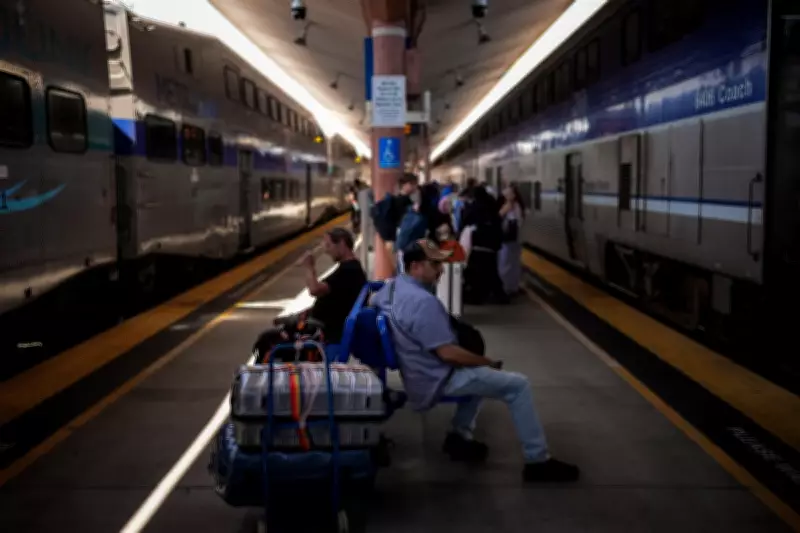
As the Memorial Day weekend ushers in the summer travel season in the United States, elevated fuel prices and broader inflationary pressures are prompting many Americans to adjust their vacation plans. While industry forecasts indicate that millions still intend to travel, the rising costs are reshaping how and where people choose to go.
Local Adventures Replace Distant Getaways
Stephanie Bernaba, a 47-year-old mother of three from coastal Rhode Island, has shifted her family's focus from faraway trips to nearby beaches, bike rides, and hiking trails. "I've been trying to do more of that because one, it's quality time. Two, it's fresh air. And three, we're not spending an arm and a leg," she explained. This recalibration reflects a broader trend as higher fuel prices—driven by the Iran war and other factors—make travel more expensive.
The U.S. Travel Association projects that annual travel spending will grow by a modest 1% this year, largely supported by domestic leisure travel. Even the FIFA World Cup, which attracts international soccer fans, has not significantly boosted overall spending. Airfares have risen globally due to increased jet fuel costs, and sticking closer to home does not fully shield travelers from price hikes. The Institute on Taxation and Economic Policy estimates that Americans will spend an extra $3.5 billion on gasoline over the holiday weekend alone. According to AAA, the average price for a gallon of regular gas in the U.S. stood at $4.56 on Thursday, up from $3.18 a year ago.

Rising Costs Across the Board
Other travel expenses have also climbed. The latest consumer price index reveals that airfares were 20.7% higher in April compared to the previous year, intracity transit costs rose 5.6%, lodging increased by 4.3%, and dining out became 3.6% more expensive. Despite these increases, many Americans still plan to travel, albeit with modifications. AAA forecasts that 45 million U.S. residents will journey at least 50 miles from home between Thursday and Monday, and the Transportation Security Administration expects to screen 18.3 million passengers from Thursday to next Wednesday.
Bank of America analysts note that many households are making trade-offs, such as opting for shorter trips or cheaper accommodations. Mastercard reports that consumers are increasingly focused on value, adjusting destinations and timing rather than forgoing travel altogether. "Generally, it's certainly more of a demand reshuffling than a demand softening," said David Tinsley, a senior economist at the Bank of America Institute.
K-Shaped Spending and New Priorities
Analysts describe travel spending as "K-shaped," with higher-income households continuing to spend while lower-income families pull back. Bank of America indicates that lower-income households are significantly more likely to have no summer travel plans this year. Travelers also face additional stressors, including airline flight cancellations and route reductions to save on fuel, as well as memories of recent government shutdowns that disrupted travel. Geopolitical tensions add further uncertainty for those considering international trips.
Marta Soligo, a tourism sociologist at the University of Nevada, Las Vegas, emphasized the role of unpredictability: "The key word here is unpredictability. Tourists don't like unpredictability." This may push people toward simpler, more accessible vacations that feel easier to manage.
Embracing Simpler Vacations
Jim Wang, a personal finance blogger from Maryland with a wife and four children, abandoned plans to travel to Spain for a solar eclipse after facing high airfare and complex logistics. Instead, his family will head to the Lake Tahoe area, staying at a relative's cabin for free, hiking, and enjoying a slower pace. "We're still going to travel. It'll just be different," Wang said. "The vacations are no longer as grand for the adults. But for our kids, it's still exciting."
Nancy McGehee, a Virginia Tech hospitality professor, observes that travelers are focusing more on the "why than the where." She noted, "What we're seeing is people are saying, 'Alright, we can't do that big splashy trip we wanted to do, but what else can we do?' It's more quality over quantity."

Back in Rhode Island, Bernaba has embraced this shift. "I think that's probably why my mind has gone to doing more nature-y things," she said. "Let's learn how to use the earth to enjoy ourselves because that's not going to cost as much money."





