

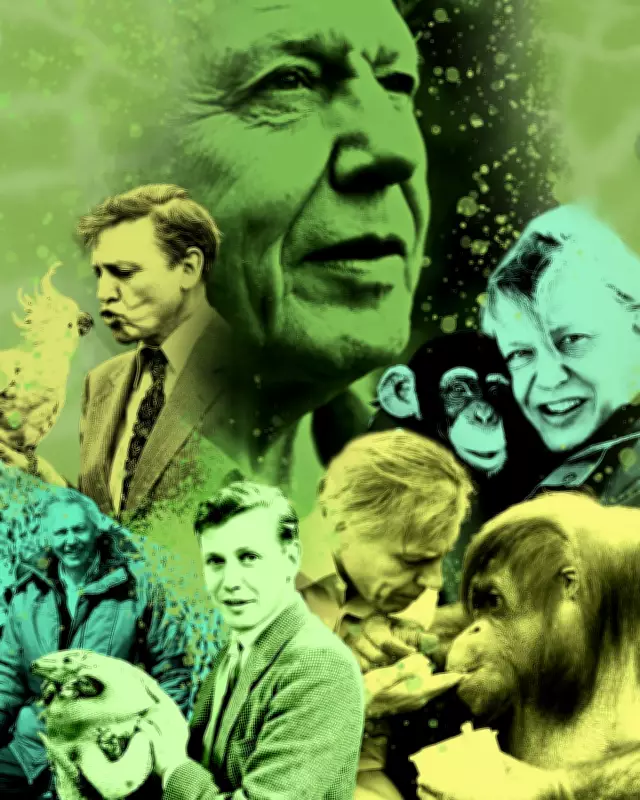
Today, David Attenborough turns 100. He is, without question, Britain's greatest national treasure; a man who has devoted his career to helping the public engage with the natural world. But his story is also the story of television. Attenborough joined the BBC just as television ownership hit its biggest period of growth, then went on to shape the medium, both on and off camera, over the next decades. He is as important a figure in television as you will ever find, and here are his wildest moments.
Early Years and Breakthroughs
At the age of 26, Attenborough gains his first television credit, producing Coelacanth, in which biologist Julian Huxley discusses the rediscovery of an ancient lobe-finned fish thought to be extinct. Like much of Attenborough's early work, the show has been lost to time. He makes his first screen appearance on the gameshow Animal, Vegetable, Mineral?, in which a panel of experts are challenged to identify unusual objects from museums. His first natural history series, Animal Patterns, debuts, with Attenborough presenting while Huxley brings a selection of animals to the studio. He returns to production, showing an early eye for audience-friendly formats, making a programme called It's a Small World, tantalisingly listed at the time as 'a close-up view of tiny things.'
Zoo Quest and Global Adventures
Attenborough's seminal series Zoo Quest starts – a documentary about an expedition to west Africa to capture a white-necked rockfowl for display in London zoo. The show is so popular that Attenborough is stopped in the street by fans desperate to know if they caught the bird. Such is its success that he sets off again the following year, this time to South America, capturing a sloth. In 2018, he told a Bafta audience that it was probably the first time anyone in the audience had ever seen one. His expedition sent him to Indonesia, where in a thrilling moment of peril he caught a komodo dragon in a wooden trap. As he sadly announced later, he was unable to secure a permit to bring it home.

Rise to Prominence
Attenborough appears on celebrated BBC radio interview show Desert Island Discs. Although the episode has been lost, his choices have not. They include Maladie D'Amour by Henri Salvador, String Quintet in C major by Franz Schubert and Stars and Stripes Forever by Albert Ketèlbey. Zoo Quest for the Paradise Birds debuts, with Attenborough finding himself being charged at by armed tribesmen in Papua New Guinea. His unflappable reaction is to hold out his hand and say: 'Good afternoon.' Unbelievably, this evaporates tensions immediately. A legend is born. Attenborough had long produced this strand of films about life in far-flung corners of the earth, but at this point his star had ascended so high that he began to narrate them.
Unforgettable Encounters
Another Zoo Quest expedition in Paraguay sees him encounter a giant swarm of butterflies. As they land on him, he forlornly exclaims that they must have confused him for a piece of rotting fruit. Realising that tribespeople were as fascinating to viewers as animals, Attenborough made The People of Paradise, venturing to Vanuatu and discovering a cargo cult – a tribe practising a religion centred on praying for planes to crash and spill their bounty. He inspires the film Born Free by visiting Kenya to shine a spotlight on Joy and George Adamson and the orphaned cubs they adopted. Another Zoo Quest series takes him to Madagascar, where he finally comes face to face with a coelacanth, his excitement palpable.
BBC Controller and Colour Television
Attenborough is persuaded to become the controller of BBC Two, a channel that has yet to find its identity. He quickly goes about reinventing it. Prior to becoming controller, and while studying for an anthropology degree, he makes a series about the Zambezi. He commissions The Money Programme, which would run for 44 years, and introduces colour television to the UK for the first time, starting with BBC Two's Wimbledon coverage. Two years later, he is promoted to BBC director of programmes, making him responsible for the output of both BBC channels.

Iconic Commissions
Thirteen years after visiting Indonesia for Zoo Quest, Attenborough returns for The Miracle of Bali, a hypnotic, full-colour travelogue about the island's people and animals. Viewers are entranced by scenes of tribespeople dancing while jabbing themselves with swords. He commissions Monty Python's Flying Circus, widely considered one of the most influential comedy shows ever made, and the snooker show Pot Black to demonstrate the appeal of colour television. It is widely thought to be the moment snooker was popularised as a spectator sport in the UK, running for 38 years. He commissions Civilisation, art historian Kenneth Clark's authoritative take on his medium, often named as the moment television matured as an art form. He also commissions The Old Grey Whistle Test, a music programme for serious music fans, and The Ascent of Man, Jacob Bronowski's authoritative history of human society's advancements through science.
Return to Filmmaking
Attenborough takes a sabbatical from his day job to film a passion project entitled A Blank on the Map, in which he makes first contact with the Biami tribe of Papua New Guinea, offering them gifts of newspaper and salt. He resigns from BBC management to make the natural history equivalent of Civilisation, and in the meantime films Eastwards With Attenborough, travelling to Borneo. Of everything he sees there, viewers are most shocked by a tribe whose skin is pale from lack of sunlight. As part of the long-running The World About Us series, he narrates The Wild Dogs of Africa, a groundbreaking film made by Jane Goodall and her husband Hugo Van Lawick, treating animals as characters and paving the way for modern wildlife documentaries.
Life on Earth and Beyond
Attenborough's long-gestating plan to make a natural history series on the scale of Civilisation and The Ascent of Man is finally realised. Life on Earth is a milestone television event, shot in 100 locations with the help of more than 500 scientists. The scale of the show is demonstrated in the first episode, which travels through Central America, the Galápagos Islands and ends with Attenborough diving in the Great Barrier Reef. It was, and remains, as ambitious as television gets. In episode 10, he goes diving again, this time up close with a pod of humpback whales, with a 40-ton mother gliding by the camera. Episode 12 contains the quintessential Attenborough moment: he encounters a band of gorillas in Rwanda, and the babies quickly start grooming him and lying on top of him. In a whispered ad-lib, he says: 'There is more meaning and mutual understanding in exchanging a glance with a gorilla than any other animal I know.' The final episode concerns human beings, using it as a warning for the future.
The Living Planet and Trials of Life
Buoyed by the reception to Life on Earth, Attenborough makes a sequel. The Living Planet is just as ambitious, as evidenced by a sequence where he stands before a volcano in Iceland as it erupts, remaining completely unflappable. Inserting himself into the action more and more, he sneaks into a cave and shines an enormous light into the face of a hibernating black bear, and ascends to the canopy of the South American rainforest, heaving himself up 200ft in the air on pulleys. He boards Nasa's gravity-defying astronaut training plane, the Vomit Comet, becoming weightless in the most infectiously joyful moment of his career. However, the final episode brings a dark look at how humanity has adapted to Earth, a nightmare of intensive fishing, battery farming and deforestation. The third part of his Life trilogy, The Trials of Life, demonstrates the sheer difficulty of being alive, with Attenborough presenting while 120 million red crabs attempt to crawl up his trousers.
Continued Exploration
Attenborough presents Life in the Freezer, a look at the wildlife of Antarctica, at the age of 67. He turns his attention to flora for The Private Life of Plants, using groundbreaking timelapse technology to witness the movement of plants, including the Strangler Fig which wraps around host trees. The Life of Birds introduces a lyrebird that mimics 20 species of birds, a car alarm, a camera shutter and a chainsaw. Attenborough visits Lord Howe Island and attempts to attract Providence petrels by mimicking their call, with birds falling to the ground and crawling all over him. The series ends with a sober look at the impact of humankind on birds. His increasing focus on environmentalism is underlined with State of the Planet, arguing that humans are triggering a mass extinction.
The Blue Planet and Beyond
The Blue Planet takes viewers to the depths of the world's oceans, showing alien-like creatures such as pulsating jellyfish and shrimp that fire bioluminescent glue. The series also gives an update on killer whales, with a brutal segment on how they work in packs to take down a much larger grey whale. One of the most haunting sections follows a whale carcass to the bottom of the sea, where a wealth of hungry creatures feast upon it. The Life of Mammals uses infrared cameras to show behaviours previously hidden, such as lions hunting at night. Attenborough walks the length of a CGI blue whale, clearly giddy about demonstrating scale. Life in the Undergrowth uses technological advances to film insects in closeup, with a standout sequence where he goads a trapdoor spider out of hiding, clutching his chest in fright. Greater horrors include a grub that latches onto an orchard spider, injects it with a hormone to 'derange' it, then slowly sucks all the liquid from its body.
Planet Earth and Climate Warnings
Planet Earth, the most expensive nature documentary ever produced by the BBC, is filmed over four years in high definition. It includes a sequence where a pride of lions take down an elephant, the first ever video footage of snow leopards, and crystal-clear footage of a great white shark breaching. Attenborough makes another urgent appeal in The Truth About Climate Change, calling for unified global action to halt the climate emergency. At 81, he completes Life in Cold Blood, his reptile and amphibian series, stating that 'The evolutionary history is finished. The endeavour is complete.' The series includes a moment where he uses infrared cameras to watch a snake kill and eat a mouse, and a scene on the Galápagos Islands where two giant tortoises attempt to have sex, with Attenborough lamenting, 'Making love in a suit of armour is not easy.'
Later Years and New Frontiers
Life captures behaviours never previously seen, including dolphins learning to catch fish by encircling them in a ring of mud, and a komodo dragon taking down a water buffalo using its venomous bite. The series includes footage of the humpback whale's heat run and killer whales chasing a seal. Attenborough makes a sorrowful episode of Horizon entitled The Death of the Oceans?, warning that the international commercial fishing industry will collapse by 2050. He leaves the BBC to make Flying Monsters 3D for Sky, the first 3D documentary on British television. Frozen Planet warns of the threat posed to the Arctic and Antarctic by the climate crisis, shamefully not broadcast in the US by the Discovery Channel. Another Sky documentary, The Penguin King 3D, offers a close-up sequence of a skua attacking a penguin colony. At age 87, Attenborough makes Galapagos 3D, sitting perfectly content surrounded by hundreds of marine iguanas.
Modern Masterpieces
Attenborough narrates The Hunt, featuring a pulsating octopus hauling itself across land in pursuit of a crab. Planet Earth II enraptures the nation with a heart-stopping moment where a marine iguana runs for its life while chased by dozens of racer snakes. Less terrifying is footage of a bear scratching its back on a tree. Blue Planet II is the most-watched TV programme in the UK in 2017, causing nationwide internet issues in China. It presents 4K images of the Portuguese man o'war, orca and humpback whales slicing through herring shoals, and a heartbreaking segment of a baby pilot whale dying after ingesting milk contaminated with plastics. Dynasties treats wildlife footage as character study, introducing David, an alpha chimpanzee beaten and left for dead by his tribe. Behind-the-scenes footage reveals that production stepped in to dig a slope to save penguins trapped inside a deep trench.
Environmental Advocacy and Recent Projects
Our Planet, Attenborough's first Netflix show made with the World Wildlife Fund, focuses on humanity's contribution to the climate crisis. It shows the world thriving without us, with deer, wolves and Przewalski's horses in Chornobyl. Climate Change: The Facts airs, where Attenborough urges humanity to start changing its behaviour, stating that without dramatic action within the next decade, we could face irreversible damage. At 96, he makes The Green Planet to bring The Private Life of Plants up to date, still compelling on camera. That same year, he narrates Prehistoric Planet for Apple TV, showing how far our understanding of dinosaurs has come. Wild Isles returns to the UK, featuring the squelchy mating rituals of garden slugs and the viciousness of seabirds. Planet Earth III pushes the envelope with shocking footage of a cobra and toad showdown, and the angel shark that can swallow prey in a tenth of a second. Attenborough shows a pack of killer whales taking down a blue whale, and makes a theatrically released movie, Ocean With David Attenborough.
A Century of Achievement
In his 100th year, Attenborough releases a flurry of new projects. Wild London sees him fondle a peregrine falcon chick with glee. Secret Garden contains a tense sequence of a blue tit chick being stalked by a domestic cat. He also releases A Gorilla Story, revisiting the famous gorilla group from Life on Earth, with unbearably poignant reminiscences about the primates he met in Rwanda in 1979.





