

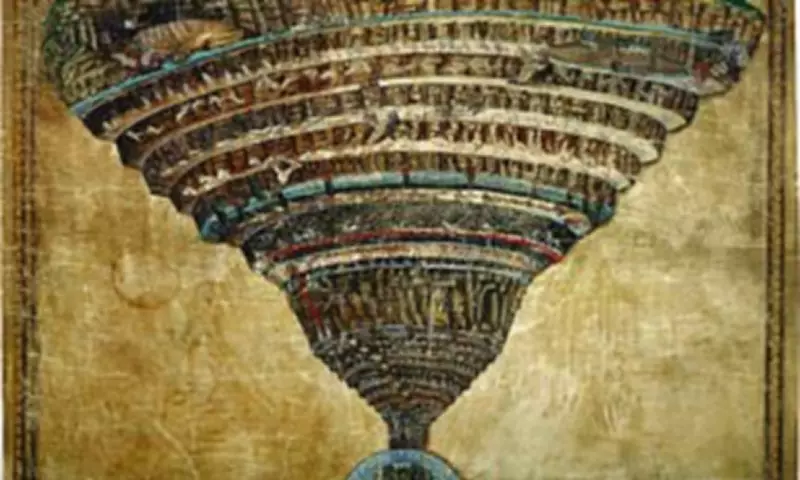
A new study suggests that Dante Alighieri's Inferno, the first part of his epic Divine Comedy, may contain surprising scientific insights about asteroid impacts. Dr. Timothy Burbery of Marshall University argues that the 14th-century poem's description of hell parallels the effects of a devastating planetary collision, predating the scientific understanding of meteors by 500 years.
Dante's Hell as an Impact Crater
In Inferno, hell is depicted as a nine-tiered pit descending into the Earth, formed when Satan fell from heaven and crashed into the Southern Hemisphere. Dr. Burbery interprets Satan as a 'high-velocity impactor' and suggests Dante intuitively grasped the geological consequences of such an event. The nine circles, with their terraced structure, resemble impact craters seen on Mars and the Moon, including the Chicxulub crater linked to the dinosaur extinction.
Scientific Parallels
Dr. Burbery notes that large asteroid impacts create terraced craters, much like Dante's layered hell. He also compares Satan's embedding in Earth's core to the protoplanet Theia, which collided with Earth and left remnants near the core. While Dante adhered to Aristotelian views that comets and asteroids were atmospheric phenomena, his imaginative leap anticipated modern meteoritics.

Historical Context
The Divine Comedy, written between 1308 and 1321, is a cornerstone of Italian literature. In Dante's time, shooting stars were seen as weather events, not extraterrestrial rocks. The connection between meteors and impacts was only established in 1833 after the Leonid meteor shower. Dr. Burbery emphasizes that Dante was not a scientist but a poet whose thought experiment foreshadowed scientific discoveries.
The Nine Circles of Hell
- Limbo: Virtuous non-Christians and unbaptized pagans, deprived of God's sight.
- Lust: Sinners blown by storms for yielding to desire.
- Gluttony: Those condemned to a freezing, putrid slush guarded by Cerberus.
- Greed: Hoarders and squanderers pushing heavy weights.
- Wrath: Sinners fighting on the frozen River Styx.
- Heresy: Heretics in burning tombs within the city of Dis.
- Violence: Murderers in boiling blood, suicides as trees, blasphemers in a desert of fire.
- Fraud: Ten ditches for various deceivers, from pimps to falsifiers.
- Treachery: Betrayers in the frozen lake Cocytus, with Satan chewing Judas, Brutus, and Cassius.
Dr. Burbery's study, published in the journal Dante Studies, highlights how Dante's vivid imagination inadvertently mirrored the physics of impact events, offering a unique intersection of literature and science.






