

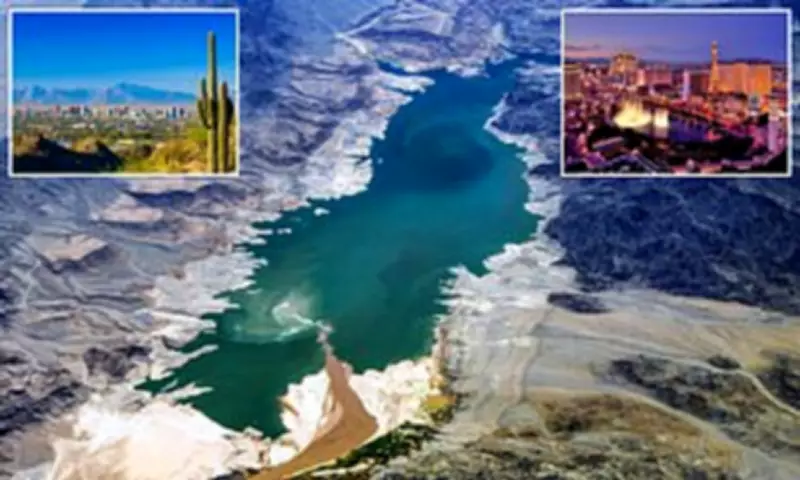
Seven states that depend on the dwindling Colorado River for their water supply acknowledge the need to reduce consumption, yet they have not reached a consensus. The two-year dispute, which has prompted some cities to warn of imminent water cuts, was supposed to be resolved by the February 14 deadline set by the federal government.
Historic Drought and Shrinking Reservoirs
According to a UCLA study, the southwestern United States has experienced its driest period in at least 1,200 years over the past two decades. Persistent lack of rainfall combined with high temperatures has significantly reduced the Colorado River's flow, leaving critical reservoirs like Lake Mead and Lake Powell at historically low levels.
Upper Basin Calls for Mediation
Last week, the Upper Colorado River Basin states—Colorado, Utah, New Mexico, and Wyoming—called for 'immediate mediation' with the Lower Basin states of Nevada, California, and Arizona. However, the Lower Basin states have not agreed to formal mediation, noting they have already committed to substantial cuts: Arizona by 27 percent, California by 10 percent, and Nevada by almost 17 percent. They argue that all river users must share conservation responsibilities and commit to large, fixed reductions.

Disagreement Over Allocation
The Upper Basin states disagree, insisting that the Lower Basin should bear most of the cuts, given their higher usage, particularly California. Their 2024 proposal suggests no fixed cuts but instead splitting the river based on real-time water supply. The seven states—Colorado, Utah, New Mexico, Wyoming, Nevada, California, and Arizona—share access to the vital Colorado River. By October 1, they must agree on a new water-sharing plan or risk unilateral federal action.
The Interior Department, led by Doug Burgum, has indicated it has the authority to cut half of Nevada's share, which would likely trigger a lawsuit that could reach the Supreme Court. Time is running out as the current water-usage plan expires in September, with a new plan required by October 1.
Interior Secretary's Proposal
Interior Secretary Doug Burgum aims to propose a plan by summer. This follows an emergency plan by his department and the Bureau of Reclamation to move water from an upstream source into Lake Powell, which supplies about 40 million people. The plan also reduces water releases from Lake Powell into Lake Mead, which serves Arizona, Nevada, and parts of California.
States are eager to resolve the issue before October 1, fearing the Interior Department might cut half of Nevada's water share. Such a move would likely lead to a costly legal battle that could take years. However, mediation may not result in a binding decision, according to John Entsminger, general manager of the Southern Nevada Water Authority. 'It’s certainly not litigation; it’s not even arbitration. It's more of a marriage counselor,' he told the Las Vegas Review-Journal. Entsminger added, 'It’s disappointing that seven professional water managers appointed by our governors can’t find a common-sense solution. I’d rather mediate than litigate.'
Impact on Cities
The uncertainty has left many cities in a difficult position. Phoenix is taking proactive steps to avoid running out of water, with officials stating there is enough stored underground for several years and that they are developing additional groundwater capacity. Currently in a Stage 1 drought, which encourages voluntary conservation, Phoenix may move to a Stage 2 drought warning by year-end, imposing mandatory limits on outdoor irrigation and a drought surcharge on water bills. 'People should not be worried that their taps are going to run dry. But a lot of the solutions to the Colorado River shortage are going to entail higher costs,' said Kathryn Sorensen, a researcher at Arizona State University, to AZFamily.
Las Vegas is also preparing for possible cuts. Located in the arid Mojave Desert, the city has become a global leader in water conservation, with nearly 99 percent of water used indoors treated and returned to Lake Mead for reuse. Nevada officials have pledged to fight any potential cuts to its Colorado River access.






