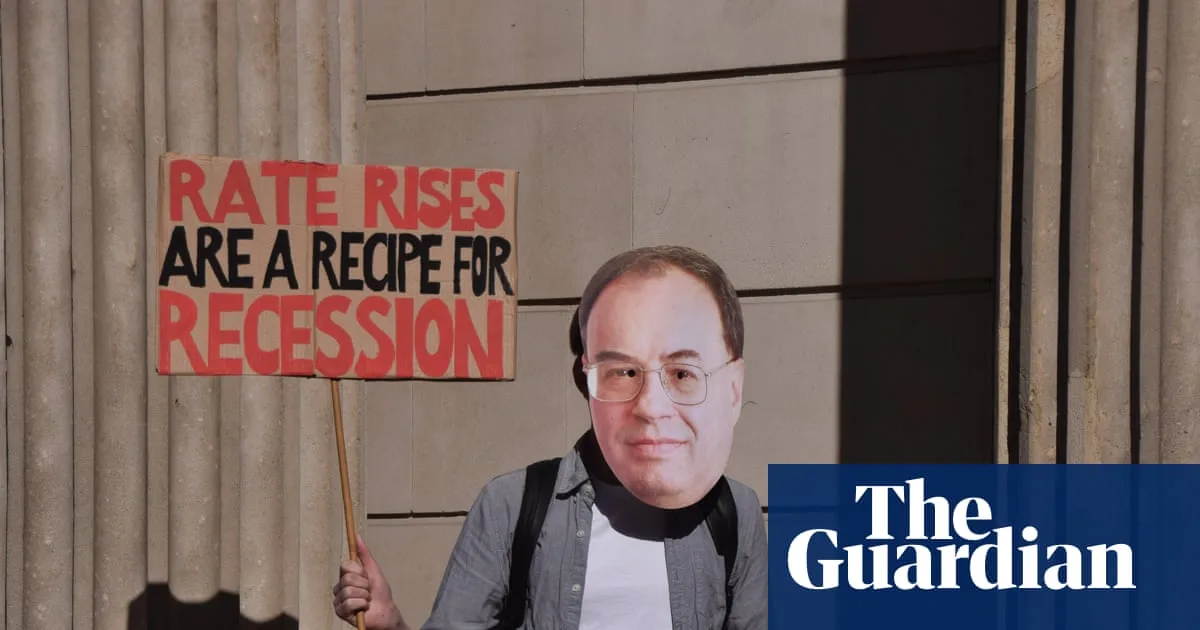
Bank of England Urged to Reject Rate Hikes Amid Iran War Inflation Shock
Bank of England Urged to Reject Rate Hikes in Inflation Crisis

Bank of England Faces Inflation Crisis from Iran War, Rate Hikes Questioned

The Bank of England's monetary policy committee convenes this Thursday amidst a global inflation shock triggered by the illegal US-Israeli war on Iran. This conflict has led to the effective closure of the Strait of Hormuz by the Iranian military, a critical chokepoint through which 20% to 30% of the world's oil, gas, and fertiliser inputs are typically shipped from Gulf states.

Energy and Food Prices Skyrocket, UK Highly Vulnerable

Benchmark oil and gas prices have surged by more than 40% and 50%, respectively. The UK is particularly exposed, as it is a net importer of gas, and the global gas price directly influences electricity costs. While the energy price cap will protect most households until summer, UK diesel prices have already risen by about 12% and petrol by 6%. In response, the government has introduced a £53 million package to support rural households that rely on oil for heating.

Analysts warn that the fertiliser shortage could precipitate a global food shock worse than the 2022 crisis following Russia's invasion of Ukraine, threatening food production across multiple continents. The UK's vulnerability is stark, with only 54% food self-sufficiency, compared to countries like the US, France, and Australia, which are fully self-sufficient.

Wide Pickt banner — collaborative shopping lists app for Telegram, phone mockup with grocery list

Interest Rate Cuts Halted as Economic Growth Stalls

Facing sluggish growth—the economy flatlined in January—and gently declining inflation since last summer, the Bank of England had been gradually lowering interest rates from a peak of 5.25% in summer 2024 to 3.75%. However, expectations now indicate an end to these cuts. Financial markets have already priced in a rate increase to 4% by mid-next year, immediately reflected in rising mortgage rates.

Central banks, including the Bank of England, faced criticism for raising rates too slowly during the previous inflation spike caused by Covid and the Russia-Ukraine war. Yet, as the cost-of-living crisis threatens to worsen for UK households, the Bank is urged to hold its nerve and continue lowering rates. This situation represents another supply-side shock where raising or maintaining interest rates will have minimal impact on price pressures but further dampen growth and investment.

Little Evidence That Rate Hikes Curb Inflation

In fact, there is scant evidence that the rapid rate hikes of 2022 significantly reduced inflation. The primary driver of decreased price growth was the eventual decline in energy and food prices in late 2022. A 2025 International Monetary Fund study found that inflation-targeting central banks that rapidly raised interest rates in 2022 performed no better than non-inflation targeting banks in managing the price rises of 2021-2022.

The current monetary policy framework in the UK, US, and eurozone remains shaped by the 1970s Middle East war inflation crisis. Back then, energy price hikes triggered wage-price spirals, leading central banks to ramp up interest rates in the early 1980s, crushing inflation but causing severe recessions and prolonged unemployment.

Modern Economy Differs: Profit-Price Inflation Dominates

Today, the economic landscape is vastly different. Labour is weaker due to declining trade unions and a globalised workforce, while firms in energy and food sectors wield significant market power to set prices. During the 2021-23 inflation period, there was little evidence of wage-price spirals; instead, profit-price inflation prevailed, as firms maintained profits by increasing prices, allowing supply shocks to ripple through the economy.

Surveys indicate that household inflation expectations are largely driven by short-term changes in the prices of frequently purchased goods, such as groceries and gas, rather than beliefs in central banks' long-term control abilities.

Pickt after-article banner — collaborative shopping lists app with family illustration

Call for Alternative Measures: Price Controls and Public Ownership

The Bank of England should acknowledge that its main policy tool is largely irrelevant in addressing geopolitical supply shocks. Instead, it should support and coordinate with the government to implement price caps or controls on essential services, preventing firms from passing price shocks to consumers. Alternatively, it could advocate for public ownership in problematic sectors like energy. Countries like Spain have demonstrated that such measures are more effective in controlling inflation than raising interest rates.

By lowering interest rates, the Bank can reduce the cost of government interventions and encourage investment in clean energy sectors, helping the UK reduce its dependence on imported fossil fuels.

Internal Support for Policy Shift

Some members of the Bank of England's monetary policy committee recognise this need. LSE economist Swati Dhingra noted last year that monetary policy alone is ill-suited to address systemic price shocks in key sectors like energy and food, potentially constraining investment and exacerbating future vulnerabilities. Unfortunately, she appears to be in the minority on the rate-setting committee. There is hope that this perspective will gain traction this week.

Josh Ryan-Collins is professor of economics and finance at the UCL Institute for Innovation and Public Purpose.