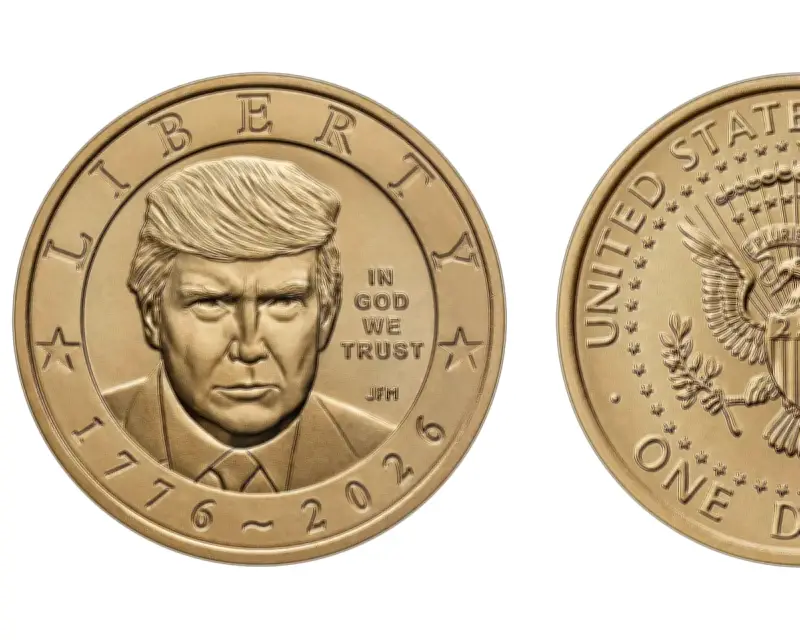
The US government has released a $1 coin bearing the image of Donald Trump, an item of currency that scholars say should be illegal, but which is happening anyway. The coin is legal tender and costs about $2.44 each when bought in bulk.
Tradition and law against living people on currency
The US has had a long tradition of not putting living people on US currency, beginning in the late 1700s when the US Mint wanted to put an image of George Washington on US money. Washington declined, saying it would be too much like a monarchy putting its rulers on money. In 1866, Congress passed an amendment barring the “portrait or likeness” of living people from appearing on currency.
That doesn’t appear to have bothered Trump. His scowling face dominates the new $1 coin, which looks gold but is actually made from zinc, manganese, nickel and copper. It costs $61 to buy 25 one-dollar coins, and about 9m of the coins are being made. They will, according to the US Mint, “honor 250 years of great American heritage”.

Treasury secretary cites precedent
Scott Bessent, the treasury secretary, has argued that during the 150th celebration of America’s “birthday”, the face of then president Calvin Coolidge appeared on a coin, so during the 250th, the Trump coin is fine.
The main problem seems to be that there’s a hodge-podge of laws which govern what can and cannot go on a coin. The 1866 ban on featuring living people arose from an impressively creative act of vanity. An incoming five-cent note was supposed to feature an image of the deceased explorer William Clark, but a treasury official called Spencer M Clark took advantage of the pair sharing a last name to instead print his own face on the note. The problem was that members of Congress a) noticed and b) were unamused. They passed an amendment which ruled that US money can only feature dead individuals – but it only applied to paper money.
“For me, I would consider it illegal,” Gabriel Mathy, an associate professor of economics at American University who has studied American currency, said of the Trump coin. “But the United States has all these laws, which really are norms because they’re not really enforceable.”
Legal challenges and the coin's release
The coin hasn’t been produced without a fight. In May, a group of Democratic members of Congress wrote to the treasury department, urging them to desist with the coin, pointing to a 2005 law which further restricted which presidents could appear on coins. And in March, James Rickher, a retired attorney in Portland, filed a request to block the coin, arguing it was illegal, but in June a federal judge denied that motion, writing that Rickher had “failed to present evidence that clearly shows he will personally suffer concrete harm from issuance of the challenged coin”, Fox 12 reported. The judge noted, however, that his ruling did not determine whether the coin is illegal or legal.
And so today, Americans will be able to honor 250 years of great American heritage by buying a questionably legal one-dollar coin for roughly $2.44. If you’d like to know who came up with such a brilliant plan, just look at the coin.