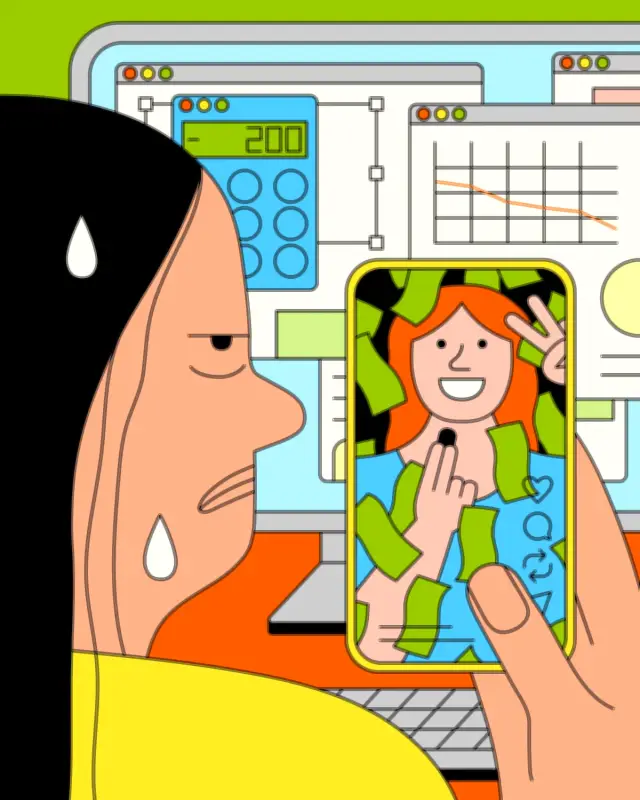
After being seduced by social media influencers promising easy money from home, a writer spent six months testing popular 'passive income' side hustles. The result: just two sales, more than $200 in expenses, and a growing conviction that these schemes echo the tactics of multilevel marketing (MLM).
The lure of side-hustle content
A specific kind of content began dominating social media feeds at the end of last year. Typical videos show an ordinary-looking woman doing ordinary things: typing on a laptop, sipping coffee, or doing light cleaning, with bright, optimistic music in the background. Text then stretches across the frame: she has made thousands of extra dollars each month, working just a few hours a day from home.
Sometimes the woman speaks directly into the camera. She was able to quit her job and spend more time with her family thanks to her side hustle. It allowed her to pay off debt, cover her mortgage and travel, all while setting her own hours. With her tips and tutorials, you too can begin making money like her.
Promises across the screen include: 'How to make passive income online …', 'How to earn daily with your phone …', 'Side hustles for women …', and 'Lazy girl side hustles that have made me over $100K …'.
The scale of the phenomenon
The gospel of making money on the side, answering to no one but yourself and with no prior training or special skills, has gone global. As of October, Instagram alone had 8.5m posts tagged #sidehustle and 25.6m tagged #passiveincome, with content creators posting from kitchens in the midwest, beaches in New Zealand, country rambles in the UK and hammocks in Bali.
'It's the perfect hybrid of labor and leisure, where the money comes in as you are going about your day,' said Brooke Erin Duffy, a communications professor at Cornell University who studies the impact of social media on creative work and labor. 'The term “passive income” puts an especially seductive spin on this. You don't have to do anything and you just reap all of the benefits.'
Testing the digital template hustle
The writer decided to test some of these hustles, with rules: no putting her face on social media and no using AI to create products. She chose digital templates – making invitations, planners or ebooks on Canva and selling them on marketplaces such as Etsy. She named her store GirlyGirlStationary and focused on invitation templates with a boozy bachelorette aesthetic.
But she was not a professional graphic designer. She got overwhelmed quickly, second-guessing every design decision. A quick Etsy search turned up thousands of templates that looked better than hers, many clearly using the same Canva artwork and styling. Some shops had more than 2,200 templates for sale; it had taken her eight hours to make eight and another five to fix them after realizing she had used Canva Pro elements that buyers would have to pay to download.
She made her first sale 12 days after launching the store, but didn't really make any profit. Each template went for $2. Adding in the processing fee, the transaction fee and the listing fee of $0.20 per listing, she made about $1.25 on that one sale. In total for her first month on Etsy – about 23 and a half hours of work – her net profit was negative 32 cents.
MLM echoes and the course economy
The language of side-hustle influencers felt immediately familiar to anyone who has encountered MLM schemes. 'It's a deceptive offer, that somehow you can just do this and that it can work for everybody without any acknowledgment of demand,' said Stacie Bosley, an economics professor at Hamline University who specializes in the MLM industry. She confirmed that, at face value, these side hustles did not meet the definition of an MLM.
Most audaciously, some influencers had found another way to monetize the hustle itself: selling masterclasses, PDFs, ebooks or training programs. Many of those products traced back to the same small ecosystem, with influencers spawning new micro-influencers who repeat the same scripts.
'There are thousands of accounts that are like “make money with Katie”, “make money with Marie”, “make money with Stephanie”, and they all are selling $7 courses,' said Erin McGoff, a career advice content creator with more than 7m followers across platforms. 'It's a digital marketing or digital products course, but what the course does is it upsells you to a more expensive course and then that course just incentivizes people to sell the course.'
Affiliate marketing and rejection
The writer then tried affiliate marketing, promoting a brand's products through a personalized link that earns commission on purchases. She tried Pinterest and DigiStore24, making three pins that got 79 impressions in their first six weeks – and no sales. She then applied to FlexOffers.com and was almost immediately rejected. Applications to promote Wet 'N Wild and Dr Brandt via Rakuten Advertising were also rejected the same day for failing the company's social media network policy, with no explanation.
'Affiliate marketing is a real way to make money, but it is far from a get-rich-quick secret and it is definitely not passive,' said McGoff.
Success stories and reality
Not everyone in this space is a scammer. Tricia Orme, a 38-year-old mother of two in Washington state, started exploring print-on-demand after giving birth to her son. She found a hole in the market and began using AI to generate stock images of people in blank clothing, placing her designs on to them. She became the @mockupmama, selling digital products – the stock images she created on AI. After making $146,578.22 in Etsy sales over three years, she has turned her focus toward mentorship and teaching. She has had about 300 people buy a $150-250 course from her and has about 155 active students who pay $19 a month to be in her private coaching group.
But success in these spaces is a combination of 'pluck, luck and the algorithm', said Duffy. Waleed Khan, a 24-year-old financial consultant in Calgary reviewing various side hustles, said he discovered that one person promoting the 'clipping' side hustle was actually the founder behind the clipping website he was instructing viewers to use. Khan himself didn't make much from digital templates. The only big profit he's made so far is the C$600 he got for using AI to create websites for small businesses – and that only happened when he got off the Internet and put in real world effort.
Over six months, the writer tried to launch five different side hustles. She made just two sales and spent more than $200 on Etsy fees, a Canva subscription and eRank, a tool Orme recommended for identifying popular search terms. 'What they're selling, it's the same as MLMs,' said Mara Einstein, a media studies professor at CUNY Queens College and author of Hoodwinked: How Marketers Use the Same Tactics As Cults. 'They're selling a dream.'