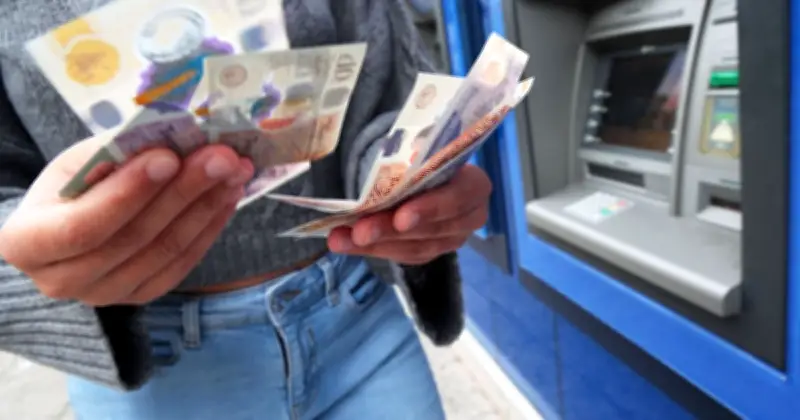
Cash withdrawals from UK ATMs have plunged since before the Covid pandemic, with around £119 million less per day typically withdrawn in the first half of this year than in the same period in 2019, according to the ATM and cash access network Link.
Link, which connects almost all cash machines across the UK, said every parliamentary constituency across the nation has seen a reduction in both the number and value of withdrawals over the period.
Sharp declines in city centres
Some city centres saw particularly rapid declines in ATM withdrawals. Link recorded a 77% drop in cash withdrawal volume in Bristol Central when comparing the first half of 2026 with the first half of 2019.

A 73% fall was recorded for Holborn and St Pancras, ex-Prime Minister Sir Keir Starmer's former constituency in London, as well as the Cities of London and Westminster, Edinburgh South, Glasgow North, and Sheffield Central.
Cambridge, Edinburgh North and Leith, and Edinburgh East and Musselburgh saw a 72% drop, with a 71% reduction recorded in York Central. Wales also saw sizeable reductions, with Link recording a 70% fall in ATM withdrawal volumes in Cardiff South and Penarth.
Not all areas saw steep falls
However, not all reductions were as steep. For example, withdrawal volumes in the Weald of Kent in southern England dropped 35%, and West Tyrone in Northern Ireland recorded a 37% fall.
Nick Quin, chief corporate affairs officer at Link, said: “Cash withdrawals are falling across every part of the country.
“More people find it convenient and prefer to pay using contactless cards and digital wallets on smartphones, but millions still rely on it day in, day out.
“People on lower incomes rely more heavily or entirely on cash to budget, which is why our job is to protect access to cash for as long as people need it,” he added.
Shift to cashless payments
A recent report from UK Finance estimated that around 1.4 million UK adults mainly use cash for their day-to-day spending, but 19 million use it only once a month or less frequently. In 2025, cash represented 8% of payments, falling from 9% in 2024. Back in 2015 it was far higher, at 45%, according to the financial institution.
Banking hubs, where banks share services in a single space, have helped to fill some gaps left by the closures of a great number of high street banks in recent years, as people increasingly do their banking online. The 250th banking hub is expected to open soon, and people can also make some day-to-day transactions in Post Office branches.