
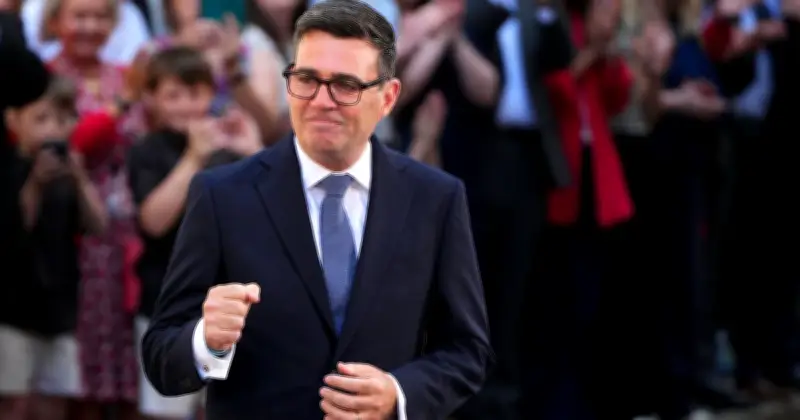
State pensioners could save £58.32 each next April thanks to a pair of pension rules committed to by new Prime Minister Andy Burnham. State pensioners will be given a special exemption from Income Tax under Andy Burnham in a continuation of a rule first announced by former Chancellor Rachel Reeves but which will now be put in place by new chancellor John Healey.
Triple lock protection confirmed
The exemption will come alongside protection for the state pension triple lock, the somewhat controversial mechanism for uprating state pension payments which Mr Burnham has promised to keep in place despite warnings from the likes of the OBR about its ballooning costs to the taxpayer.
It means that pensions will increase by at least 2.5% from April 2027, and that many state pensioners who would have owed tax for the first time will be spared at least £58 of bills, and possibly more if the triple lock rises by more than its minimum.
Triple lock mechanism explained
Before taking over as PM, Mr Burnham confirmed he would not be axeing the triple lock, despite recent pressures from the likes of the Office for Budget Responsibility and the Tony Blair Institute to remove it. The triple lock guarantees that state pensions must increase by one of three metrics each year: inflation, wage growth or a flat 2.5%, whichever is highest.
In April 2026 for example, wage growth was 4.8%, so that was the amount the state pension went up by, handing new state pensioners an extra £575 a year.
Tax exemption details
Crucially, state pensioners have always been liable to pay tax, but those with no other income have never collected enough from the state pension to exceed the threshold. But this will change in April 2027. In April, the minimum 2.5% increase would push pension payments to more than an estimated £12,861 for a new, post-2016 state pensioner with a full National Insurance record.
If state pensioners were to pay tax on this at 20%, then approximately £291 would have been taxable, which would result in a bill of £58.20 for a 20% taxpayer. And if the triple lock rose by a larger amount, the bill would be higher still.
State pensioners who have no other income, such as a private pension, earnings, savings interest or rental income, will not be made to pay this bill and will be exempted, the Treasury has now confirmed. Some older state pensioners, of course, are already paying tax. Now-defunct schemes such as the Second State Pension (SERPs), already boost basic state pensioners’ income to beyond the tax threshold today. HM Treasury confirmed to the Express earlier this year that older state pensioners' ‘incremental payments’ such as SERPs would not be exempted from tax.
Alternative proposals
Andy Burnham could solve two issues at once if he instead raised the tax-free Personal Allowance. A £500 increase would move the threshold above new full state pension payments and also hand relief to workers and other households battling the cost of living and higher tax bills through fiscal drag.
Tom Selby, Director of Public Policy at AJ Bell, said on Thursday that raising the tax-free allowance would help taxpayers ‘across the spectrum’. He said: “Increasing the personal allowance would help everyone by handing taxpayers across the spectrum the same tax saving. But for the lowest earners, the financial boost will be larger as a proportion of their total income, meaning it would make a big financial difference to those with the least financial strength.”
But he cautioned that sticking with the triple lock has ‘serious’ implications for the nation’s finances. He added: “But the policy of ratchetting up the state pension through the triple lock has serious long-term fiscal implications. The chancellor should be honest about the trade-offs and set out a sustainable policy for the state pension that gives pensioners certainty while recognising pressure on the public finances.”
An HM Treasury spokesperson said: “Anyone whose only income is the full new or basic State Pension without any increments will not pay income tax and we are committed to that over this Parliament. “By keeping the Triple Lock, 12 million pensioners will see their income rise by up to £470 this year, and they continue to benefit from the highest Personal Allowance in the G7.”




