
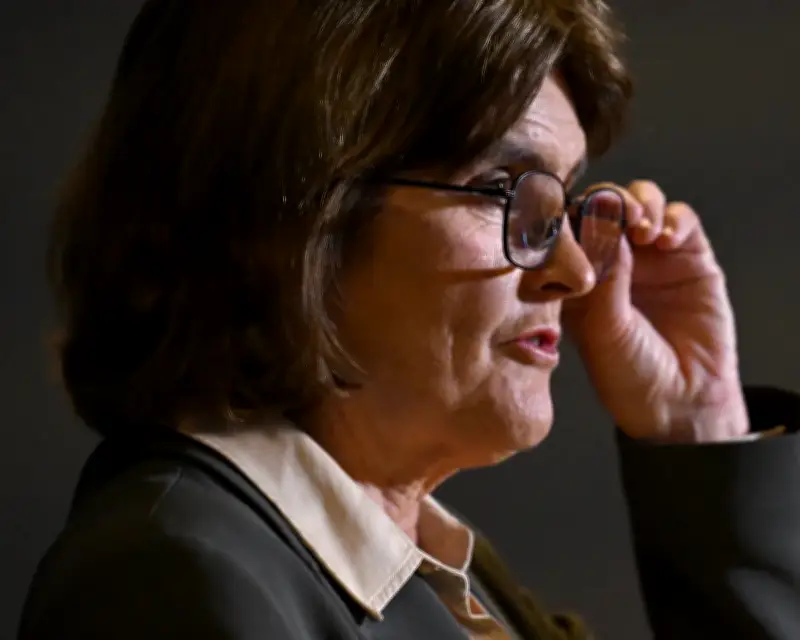
The Reserve Bank of Australia (RBA) has held the official cash rate at 4.35% but warned that higher interest rates are “quite possible” even if house prices keep falling. The decision to hold on Tuesday was widely predicted by economists and financial markets, following three rate rises earlier this year that have hit property values across the capital cities.
The RBA board unanimously voted to leave rates on pause, stating in a statement that “the economy appears to be slowing as expected.” Governor Michele Bullock told reporters after the announcement that the board had considered raising rates, with each member worried that inflation was still too high.
Governor's Warning and Market Reaction
“It’s important people believe that we will act if we need to,” Bullock said. “I think personally that it’s quite possible we might need to go but we’ll wait and see what the data tells us.” Markets responded by raising their bets on another hike in Australia by the year’s end, from 53% before the decision to 69% on Tuesday afternoon. Shane Oliver, chief economist at AMP, said traders had reacted to Bullock’s strong warnings.
The bank’s updated forecasts on Tuesday showed inflation was lower than expected this year as fuel prices had fallen, but would not return towards the targeted 2.5% until early 2028, even if rates edged upwards. Bullock said the board believed that was a “reasonable” timeline to bring inflation back to the low target level. The bank also forecast stronger jobs growth but higher unemployment than it expected in May, reaching 4.7% by the end of 2027.
Economic and Political Reactions
Stephen Smith, a partner at Deloitte Access Economics, said the forecasts suggested the RBA “increasingly feels its job may be done.” However, he added, “another rate rise in 2026 cannot be fully ruled out.” Treasurer Jim Chalmers said Tuesday’s decision to hold was “welcome” amid uncertainty in the global economy. “This will come as a relief to Australians with a mortgage,” Chalmers said.
Housing Market Not the Main Factor
The RBA said the housing market had slowed more than expected in the wake of rate rises and the federal budget. New home loans have already begun to slow, and investor loan commitments in June had fallen by roughly a quarter compared with the start of the year, as a share of total housing credit, the RBA reported. The bank warned that falling house prices would weigh on household spending and per person economic activity, as consumers who owned property felt poorer.
ANZ economists on Tuesday released separate forecasts predicting capital cities’ home prices would fall at least 5%, with Sydney to fall 14.5%. Bullock said the housing downturn was not “the main game” in Tuesday’s decision, with the RBA instead watching for strong jobs creation, tight capacity in the economy, the AI boom, and the effects of the Middle East conflict. “The housing market wasn’t a constraint,” Bullock said. “That’s not entering the equation.” She noted housing prices had risen by about 50% since 2020.
Less than 1% of homeowners were in negative equity, and the RBA believed even a 20% fall in house prices would mean about 5% of people were in negative equity, Bullock said. The RBA’s updated statement on monetary policy said mortgage holders have kept ahead on repayments as rates rise, with seven in eight borrowers holding almost a year or more worth of repayments in their offset and redraw accounts.
The RBA predicted a recovery in house prices, along with falling interest rates, could push per person economic activity back up again by 2028. “We still have a shortage of supply … that is going to resolve somehow in prices,” Bullock said.
Business Investment and Datacentres
The RBA also upgraded its predictions for business investment as demand for datacentre construction grows. Its statement said businesses had reported no issues finding workers and materials for datacentre projects. But Bullock warned the projects could add to inflation, as there was evidence they were taking construction workers away from the housing sector. “There’s already an area, which is under pressure, and it’s under more pressure because of datacentre investment in Australia,” she said. “If it puts a lot of pressure on some of these areas that are very tight, then it is possible that it keeps inflation elevated before we get the productivity improvements that we’re hoping for.”




