
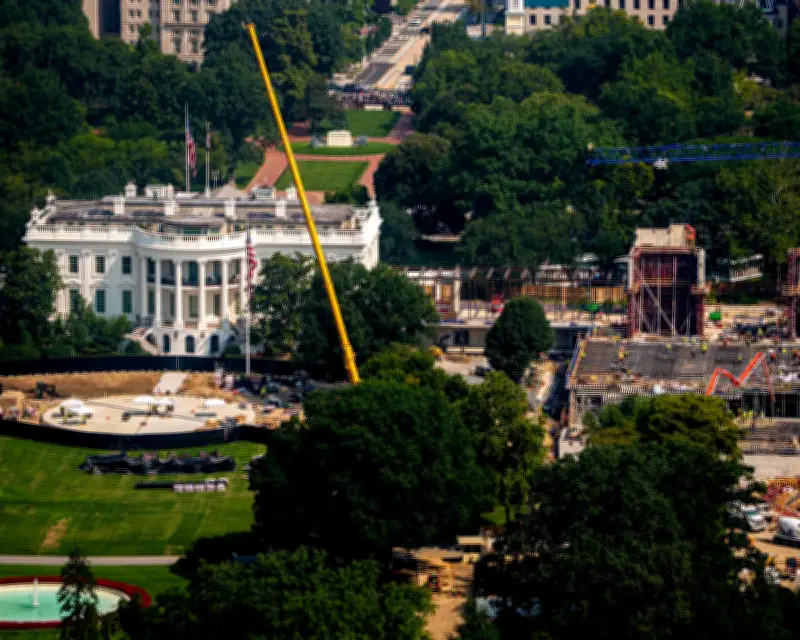
Donald Trump's plan to renovate the White House's East Wing into a massive ballroom complex has drawn sharp criticism from author Francine Prose, who argues the project symbolizes a broader assault on democratic norms. The project, which includes a 90,000-square-foot ballroom and a six-story underground bunker, has already begun with the demolition of the east facade, shocking observers with the visual impact on the historic building.
A Monument to Autocracy
Prose draws parallels between Trump's project and historical dictators who built monuments to themselves, such as Hitler's planned rebuilding of Linz and Mussolini's EUR neighborhood in Rome. She notes that the ballroom, estimated to cost hundreds of millions of dollars (with $400m the most recent figure), has already diverted funds from public agencies like the Secret Service, despite Trump's promise that taxpayers won't foot the bill.
The project's scale is unprecedented: the ballroom itself occupies 22,000 square feet, while the remaining 68,000 square feet are designated for what Trump describes as a "one big, expensive, and very complex unit, which is vital for National Security and Military Operations!" Beneath it, a six-story bunker would dwarf Hitler's 3,000-square-foot bunker, and Trump has floated using the roof as a launchpad for killer drones.
Legal Challenges and Autocratic Instincts
The renovation has faced legal hurdles. In a 2-1 decision, the US Court of Appeals for the District of Columbia Circuit ruled that Trump cannot continue without congressional approval. Judges Patricia Millet and Bradley Garcia wrote that "each president is a temporary tenant, not the owner, of the White House and its Executive Residence." The lawsuit, brought by the National Trust for Historic Preservation, argues that a temporary tenant cannot fundamentally alter a rental property without the landlord's permission.
Trump has vowed to take the case to the Supreme Court, which has shown a tendency to support him. Prose argues that Trump's actions, from tariffs to starting a war with Iran without congressional consultation, reflect autocratic instincts aimed at consolidating power.
More Than a Building
Prose emphasizes that the controversy is about more than architecture. It represents a "reckless grab for absolute power" and a subversion of ethical and democratic norms. She notes that Trump's criticism of the Smithsonian Institution for telling the truth about American history shows his disregard for historical preservation.
The case was initially brought by Alison Hoagland, an architectural historian and board member of the National Trust, who called the ballroom an "aesthetic, cultural and historical" affront. Prose concludes that the struggle is about ensuring future generations can visit the nation's capital without being reminded of Trump's defacement of it.




