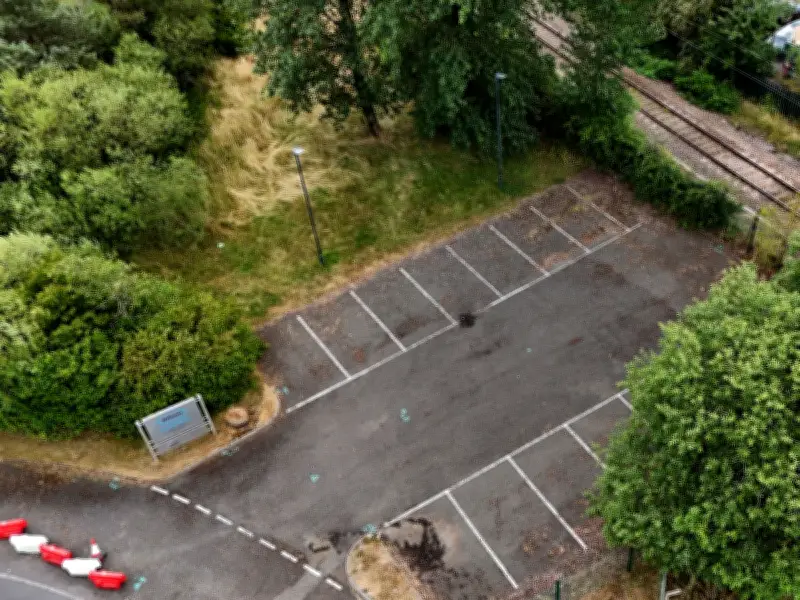
Williams Medical Supplies (WMS), one of Rhymney’s largest employers, has suspended use of its car park and affected access route after independent engineers flagged a “significant” sinkhole risk over a failing culvert that carries the entire flow of the River Rhymney.
WMS is the United Kingdom’s leading supplier of medical supplies and services to GPs and employs more than 150 people at Maerdy Industrial Estate. The issue has left WMS and neighbouring employer Eco Technology Ltd (ETL) caught in a dispute over the hidden infrastructure beneath their sites.
“The safety of our employees, visitors, contractors, and the wider community has been, and remains, our overriding priority,” the company said.
Landowner unaware of culvert
The land above the culvert is owned by ETL, an electronics and cable recycling business with more than 70 employees. ETL said it first became aware of the culvert in 2025, when Caerphilly County Borough Council carried out a statutory inspection and identified defects near WMS’s access. The age of the culvert is unknown.
ETL said the culvert did not appear on the property title and was not identified in any surveys before it bought the site in 2016. Although the land over the main defect belongs to ETL, it is used exclusively by WMS as access to its site. ETL said it has upgraded an access route within its own site so WMS can continue operating with supervised access.
Repair bill up to £4 million
As the landowner, ETL is the riparian owner and is legally responsible for maintaining the culvert under a principle that has been part of English and Welsh law for around 200 years. The company said it was initially told the repair cost would be around £150,000, but estimates have since risen to between £1.5 million and £4 million.
ETL said it cannot afford a bill of that scale and argued that responsibility should not fall on a private landowner when the culvert carries the River Rhymney. “The river is a national asset and to pass the responsibility for the maintenance of it to a private landowner does seem rather extreme,” it said.
“We do not have the spare funds to enable us to maintain the River Rhymney and run our business,” it added.
WMS stressed that it does not own or control the land above the culvert. “As the culvert and the land above it are not owned or controlled by WMS, identifying a sustainable long-term solution will require collaboration between the relevant landowners, infrastructure bodies, regulators, and public authorities,” it said.
Council, NRW and Welsh Government respond
Caerphilly council said the culvert carries the River Rhymney, for which Natural Resources Wales (NRW) has responsibility in relation to flood risk, but that the legal responsibility for maintenance rests with the respective landowners as riparian owners. The council said it identified structural issues during routine inspections of sections it is responsible for and has completed repairs on those sections.
“The culvert carries the Rhymney River, which is the responsibility of NRW in relation to flood risk. The legal responsibility for maintenance of the culvert rests with the respective landowners as the riparian owners,” the council said.
A NRW spokesman said the company, as owner of the land through which the river flows, is legally responsible for maintaining the river and its channel even though it has been culverted. “Whilst we have permissive powers under the Water Resources Act 1991 to undertake work to manage flood risk on main rivers, we are required to prioritise flood risk management efforts that reduce risk to residential properties over those that benefit commercial premises,” he said.
A Welsh Government spokesman said risk management authorities have permissive powers to manage flood risk, backed by £85 million in funding this year, but that river erosion remains the responsibility of the riparian landowner under common law.
Railway line unaffected
The culvert is located approximately 15 metres from the Rhymney railway line. Transport for Wales said there is currently no evidence of any risk to railway operations, and that the culvert is on private land and is not a Transport for Wales asset. The company said it would contact WMS to request copies of relevant reports for its engineering teams to review.
Political pressure grows
Local councillor Carl Cuss said relevant organisations were first brought together around a year ago, but the main issue remains unresolved and the estimated cost of a permanent solution is believed to run well into seven figures. He said the latest engineering report highlighted a “significant risk” of a sinkhole and that WMS has taken appropriate action given the health and safety implications for staff and visitors.
He warned that if the culvert fails, “the consequences could be far-reaching for local businesses, public safety and surrounding infrastructure”, and that continued deterioration could also have implications for the nearby railway line. He called for leadership and support from NRW and the Welsh Government because of the scale of the challenge.
Rhymney MP Nick Smith has written to the First Minister, Rhun ap Iorwerth, asking for all relevant organisations to be brought together to review the latest evidence, agree responsibilities and identify a practical solution. “The latest report makes clear that this situation needs urgent attention. It cannot keep being passed from pillar to post while the condition of the culvert continues to deteriorate,” he said.
“Every delay risks making the problem more difficult and more expensive to fix in the long run. This is about protecting local jobs and vital infrastructure. We need coordinated action now,” Smith added.
Both businesses remain operational, but say a long-term solution is urgently needed to secure their future in Rhymney.