
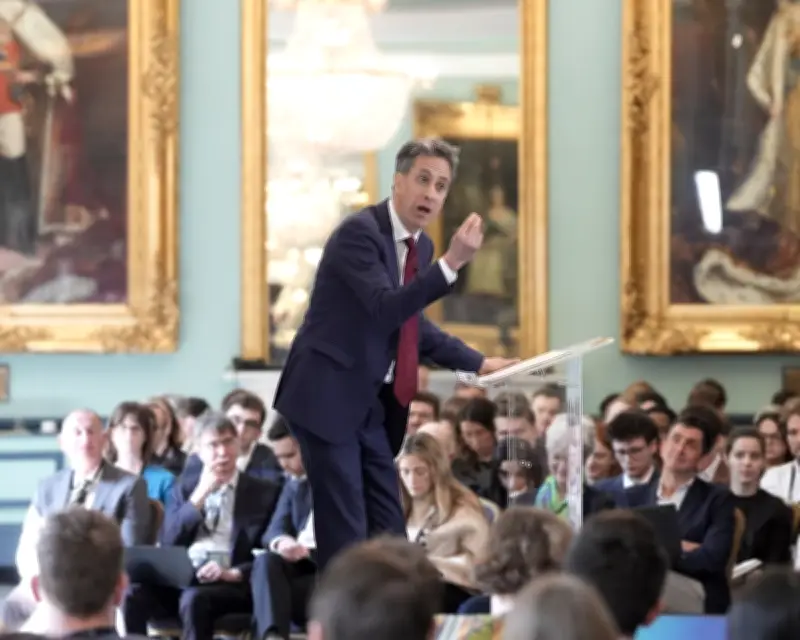
Energy secretary Ed Miliband is the clear frontrunner to become chancellor under Prime Minister Andy Burnham, with reports indicating he is already developing economic policy for his close ally. Shabana Mahmood, Pat McFadden, and Yvette Cooper have also been mentioned as potential candidates, but Miliband's experience and alignment with Burnham make him the likely pick.
Taking on the Treasury
Jonathan Portes, a professor of economic and public policy at King's College London and former Treasury adviser, explains that the UK Treasury is unusually powerful compared to other countries. “Many other countries separate out the budgetary function from longer-term planning and growth strategy,” he says. “And we’re exceptional in the weakness of No 10. The centre of government ends up, in many respects, being the Treasury, because No 10 is a glorified prime minister’s office, rather than a department.”
Portes acknowledges criticism of the Treasury's “institutional mind” but notes that the department is also very political. “If it has a strong chancellor who tells them what to do, it is much better at delivering than other departments.” The key question is whether Miliband and Burnham are sufficiently aligned. Portes points to successful partnerships like Lawson and Thatcher or Blair and Brown, which worked because both individuals were strong-minded and aligned enough, despite disagreements.
Critics argue that Miliband is insufficiently pro-business and that his radicalism will spook the City. Portes dismisses this: “Obviously nonsense, rightwing propaganda. He is clearly capable. The idea that he’s some sort of communist or that he’s going to be fiscally irresponsible is just stupid.” He also rejects the notion that Miliband's appointment would cause bond market turmoil, stating, “The government has a bunch of fiscal rules, and they’ve said they’re going to stick to them. If you want to know what the markets are saying, you look at actual money, prices, interest rates … And we can see that there’s no sense of panic.”
Look North
Sarah Longlands, chief executive of the Centre for Local Economic Strategies, based in Manchester, emphasises the need for a better relationship between the Treasury and devolved regions. “One of the big questions for any incoming chancellor is how to work better with devolved regions and the nations,” she says. The funding frameworks for areas like Manchester or the West Midlands come with “a huge burden of accountability, as they rightly should. But that burden is set by central government. More care needs to be taken with how we manage the relationship between the centre and those devolved nations and regions to make sure that we’re not putting such a burden on the process that you can’t actually deliver.”
During the Covid-19 pandemic, this relationship was tested to breaking point, with Burnham publicly criticising the UK government's lack of financial support. Longlands argues that “a future chancellor has to rebuild that, because the Treasury has taken such a role dictating the terms of devolution.” With the prospect of a “No 10 North” shifting the dynamic, she says, “they need to decide what kind of relationship they want to have. That can’t just be about collecting receipts.”
Green Growth
Miliband's commitment to net zero, including a moratorium on new North Sea oil and gas drilling licences, has drawn opposition from some union leaders. Unite's Sharon Graham said it would put a “noose around the neck” of job creation, and senior figures in the Trump administration reportedly cautioned against appointing Miliband. The Guardian's energy correspondent, Jillian Ambrose, notes that “the nagging issue of the North Sea must finally be agreed between the energy department and whoever moves into No 11.” A greenlight for the Jackdaw and Rosebank fields would not breach Labour's manifesto but would be viewed as a betrayal by many climate activists. Rachel Reeves was reportedly in favour of the extra tax revenue and economic productivity from these projects, but Miliband may prefer to wring more from other areas to avoid a green backlash.
Ambrose also highlights the electoral risk: “Voters across Britain’s former industrial heartlands have already turned against Labour’s net zero agenda, but alienating Labour’s progressive base too by failing to be ‘green enough’ could spell electoral disaster.” However, she sees a wider green dividend from a Miliband chancellorship: “The economic debate over ‘green v growth’ could finally be put to rest by a minister who believes that there needn’t be a choice. A green economic agenda is a ‘growth agenda’, in Miliband’s view, and the opportunity to prove this on an economy-wide scale will be irresistible, especially to a politician so keenly aware of their climate legacy, developing in real-time.”




