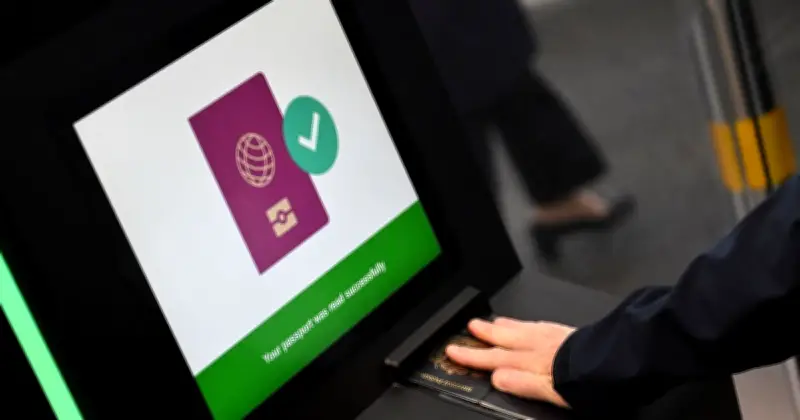
The chief executive of Aeroporti di Roma, Marco Troncone, has urged the European Union to deactivate its new entry/exit system (EES), citing a 'design flaw' that has caused border processing times to double since its rollout in April. The system, which requires non-EU travellers, including Britons, to provide fingerprints and photographs, has led to severe congestion at major European airports.
System Design Blamed for Delays
Troncone told The Times that processing times at Rome Fiumicino Airport have increased from one minute to two minutes per passenger, despite optimisation efforts that reduced it to 90 seconds. He stated: 'This is, of course, not compatible with 50,000-60,000 passengers every day.' The airport has already spent €12 million (£10 million) preparing for the EES.
Troncone argued that the problem is not implementation but design, noting that the operational framework was developed with 'limited input from airport operators, despite the fact that airports are the ones managing passenger flows every day.'
Widespread Disruption Across Europe
Airlines from the UK have identified several airports as particularly problematic for queues, including Lanzarote, Tenerife South, Malaga, Porto, Lisbon, Amsterdam, Krakow, Paris CDG, Rome, Palma, Malta, Menorca, Milan Linate, Milan Malpensa, Naples, and Budapest. The EES has been implemented across 29 Schengen Area countries, with varying government departments and technology providers causing integration issues.
Since its launch, the system has successfully identified 7,000 individuals who overstayed their visas. However, the delays have prompted calls from industry bodies and travel hubs to pause the system during the peak summer season.
Industry Calls for Suspension
ACI Europe, representing the continent's airports, has called for the European Commission (EC) to suspend the EES 'at least through July and August.' Beginning in September, ACI seeks the power to halt the system indefinitely during 'exceptional circumstances' until structural challenges are resolved, including sufficient border personnel, reliable technology kiosks, and a global pre-registration mobile app. Currently, only Sweden and Portugal have implemented this digital tool.
Other major airports, such as Amsterdam Schiphol, Naples, and Corfu, have also requested regulatory relief. Schiphol, handling around 220,000 travellers daily, noted that the EES is 'impacting operations at the border, particularly during busy moments.'
Political and Industry Pressure
Greek Tourism Minister Olga Kefalogianni stated that the EES should be 'rethought at a European level,' while the mayor of Naples wrote to the Italian government warning that the system 'could significantly impact tourism flows.' Ryanair has named seven airports where passengers face long delays due to 'insufficient staff, kiosks and system readiness.'
This summer is projected to be the busiest on record for air travel, with flight numbers up 2 per cent from last year and around 37,000 flights scheduled on peak days. Crisis talks between the aviation industry and the EC are scheduled for Tuesday, July 7, to address the disruptions.