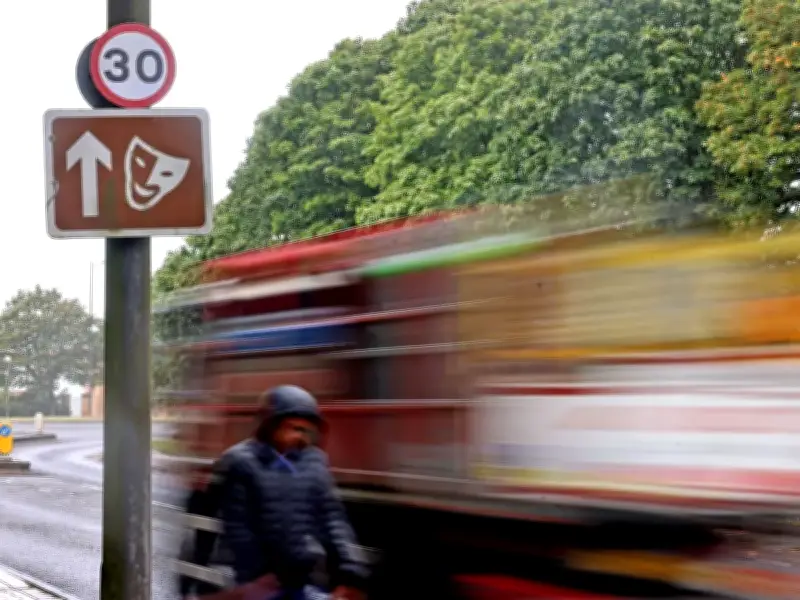
Fresh calls to scrap Wales' default 20mph speed limit were rejected in the Senedd after a Green Party MS warned that changing the law to apply only at schools and hospitals could cost £163m.
The law, which came into force in September 2023, sets a default 20mph limit on restricted roads — broadly those with streetlights no more than 200 yards apart, usually in residential and built-up areas. In July 2024, after widespread opposition, the then-Labour Welsh Government gave councils revised guidance to make it clearer where roads can revert to 30mph. Some roads have since been changed back to 30mph or higher.
Debate and failed vote
Reform UK put forward a debate in the Senedd on Wednesday, September 30, calling for the default speed limit to be scrapped. The vote, which would not have forced the government to make any change, failed. Both Reform UK and the Conservatives say roads outside schools, hospitals, and through residential communities should be at 20mph.
Reform UK leader Helen Jenner told the Senedd: "What we reject is the default. The starting point should be the road itself: its location, its character, its collision history, the number of pedestrians using it, whether there is a school or hospital nearby, whether it is a residential street or an important route connecting rural communities. That is what an evidence-led system should look like, a common sense system."
Conservative Janet Finch-Saunders said the law had affected businesses. "The Welsh Government's 2022 impact assessment estimated direct financial costs of around £33m and a central net economic disbenefit of £4.54bn over the years. Now, what kind of government actually persuades or brings forward legislation that then damages its own residents and businesses? Absolutely rubbish."
The Welsh Conservatives are clear: restore the 30mph default while retaining 20mph limits where they protect pedestrians and vulnerable road users.
Cost of change
However, Green Party MS Paul Rock told the Senedd that a change now, to 20mph in certain areas, would cost £163m. "The Welsh Government's nationwide implementation cost around £33m. But if we were to scrap the 20mph policy, which in itself would probably cost about £33m again, and then redesignate every school, every care home, every hospital and every playground individually, at the average of £33,000 per location, the cost of that would be £163m."
"I wonder whether Reform agree with me that £163m is more money than £33m. I understand that I can't use the B-word ('blanket') in this debate, which is a shame, because communities need a simple, consistent layer of protection."
"The alternative, of course, is an expensive patchwork quilt of varying speed limits requiring more signs, more admin, and more enforcement, leaving drivers confused as they try and work out which rule applies where."
Government defends policy
Plaid Cymru and Labour, which backed the plan when it was first voted on, argued the law has made roads safer and it was always the plan that some roads would have to change once the law came into force.
Backing Labour's decision, Vikki Howells told the Senedd: "At the start of this debate it's worth remembering why the previous Welsh Labour Government introduced the 20mph policy. That's to protect children and families from road collisions, to make our roads safer, and ultimately to save lives. And let's just take a second to remind ourselves of the evidence base. It's nearly a decade now since the OECD highlighted research that consistently showed that lower speeds reduce deaths and injuries. There's more time to react and collisions will lead to reduced levels of harm."
Wales' transport minister Mark Hooper told the debate: "Road safety is not a political issue to score political points with. Every road death is a tragedy. Every serious injury can change people's lives forever, impacting not only the individual, but also the family, friends and the whole community."
He disputed the way Reform UK's economy spokesman Jason O'Connell had used recent figures about deaths on roads in Wales. "Road casualty numbers fluctuate from year to year. It has always been acknowledged that this will take several years of monitoring and evaluation before firm conclusions can be drawn. That is the responsible position but, equally, it is not accurate to suggest that the evidence demonstrates the policy is, and I use quotes, 'clearly not working'. The published data simply does not support that conclusion."
"This government is absolutely committed to reducing the number of people killed and seriously injured on Welsh roads. The responsibility for road safety is shared between all those who use the roads, those who design, regulate, manage and operate the transport system, and those who enforce its rules. We all have a part to play."
"This government is clear that the 20mph speed limit in areas where pedestrians and cyclists mix with motorised vehicles is fundamentally the right policy. The evidence so far points absolutely in the right direction."
"There are many fewer collisions and fewer people injured on these roads now. This supports the aim we should all share of no family having to grieve a loved one because of an avoidable tragedy."
The Welsh Government has been asked to comment on the £163m figure suggested by Mr Rock.