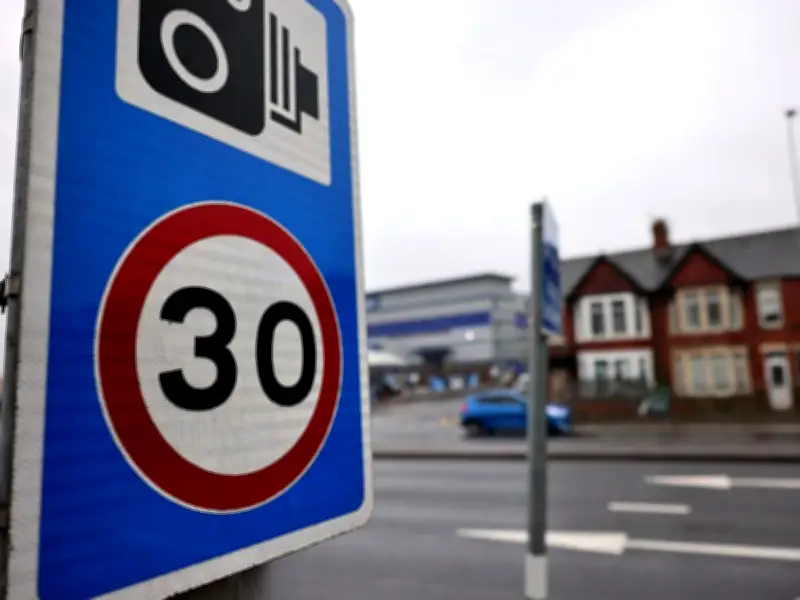
Reform UK has claimed that Wales' default 20mph speed limit has led to increased road casualties and wasted millions of pounds of taxpayers' money, ahead of a Senedd debate on the policy put forward by the party.
In a piece written by Reform UK's transport spokesperson Jason O'Connell, the party said the policy has slowed Wales down, cost £32 million to implement, and could inflict a £9 billion hit on the Welsh economy. Three years after its introduction, the latest road casualty figures raise serious questions about the justification Plaid Cymru and Labour gave for imposing it, he argued.
“The Welsh Government has continually let the people of Wales down,” O'Connell wrote. He accused the government of ignoring people and making decisions on their behalf without thought about consequences, allowing pet projects to dominate the agenda while genuine needs are ignored.
Transport policy driven by dogma
O'Connell said transport policy in Wales has been driven by dogma rather than evidence, with Labour and Plaid Cymru treating motorists as a problem to be managed, road building as something to be avoided, and economic growth as an afterthought. He said the result has been a de facto moratorium on new road projects, creeping pseudo-restrictions on everyday travel, and the steady decline of basic maintenance.
Reform UK wants to abolish the default 20mph policy, with appropriate speed limits at the discretion of local authorities where genuinely needed, such as outside schools and hospitals and at accident hot spots. “We will return to evidence-led limits that improve safety without strangling town centres or turning the daily commute into a daily irritation,” O'Connell wrote.
Casualty figures questioned
Three years after the default 20mph policy was introduced as part of a cooperation agreement in late 2023, recent statistics from the Department for Transport show that 91 people died on roads in Wales in 2025, up from 84 deaths reported in 2024. Additionally, 1,361 people were killed or seriously injured last year, the highest number of casualties since 2019, when 1,485 people were killed or seriously injured.
O'Connell said these statistics completely blow Plaid's justification for the policy being necessary to improve road safety out of the water. He added that the figures add credence to the massive outcry against the implementation of the speed limit, with people across Wales strongly opposing its introduction. At the time of the rollout, a petition against the speed limit broke a Senedd record with just shy of 500,000 signatures, becoming the largest petition in Senedd history.
Cost and economic impact
Supporters of 20mph have previously pointed to data showing the aim of making Wales' roads safer is being achieved, but O'Connell said the latest statistics prove otherwise. The policy has cost more than £30 million to implement and is set to cost up to £9 billion in damage to the Welsh economy, he said.
“Plaid Cymru are far too focused on ideology, while Reform believes that transport policy should be guided by common sense and the needs of the real-world Welsh economy, not Cardiff Bay bureaucracy,” O'Connell wrote. “That is why we will put the needs of Wales first and scrap the default 20mph speed limits.”