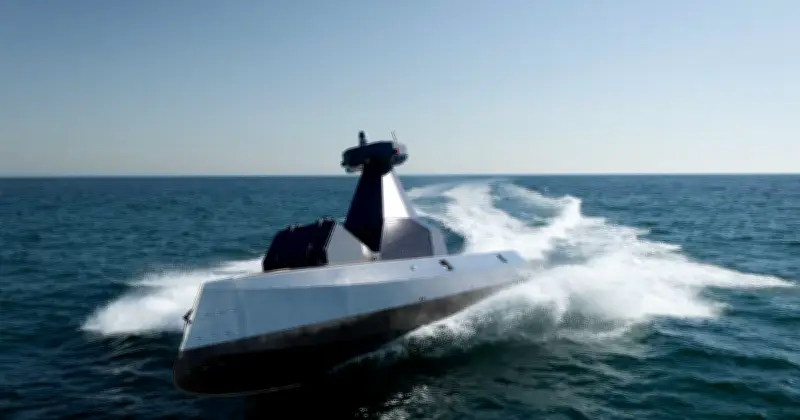
A new British-built drone boat designed to counter Vladimir Putin's shadow fleet has been unveiled. The autonomous Vanta 12 is capable of carrying out 1,200-mile patrols and travelling at speeds in excess of 40 knots, German manufacturer STARK said.
While headquartered in Berlin, STARK has built and tested the missile-armed Vanta 12 in south-west England. The vessel carries Sea Venom missiles, manufactured by Defence Prime MBDA, and is billed as a low-cost solution to tackling the Russian shadow fleet.
Export success story
Mike Armstrong, Managing Director of STARK UK, said: "Vanta 12 is the first unmanned vessel to bring together missiles, loitering munitions and surveillance to help NATO countries face down the threat. Vanta is an export success story for British defence, giving our NATO allies capability that can be produced at scale, deployed rapidly and adapted quickly."
The Vanta 12 has just undergone testing at REPMUS, NATO's largest annual maritime drone exercise off the coast of Portugal. The 12-metre boat can operate continuously at sea for weeks, allowing personnel to be deployed elsewhere, STARK added.
Pressure on Royal Navy
Tracking shadow fleet ships is putting additional pressure on the already-stretched Royal Navy, which is at its smallest in living memory. Royal Fleet Auxiliary vessels, the Navy's civilian support arm, have also been used to monitor the ships.
Around 300 suspected shadow fleet vessels transited UK waters in the first three months of 2026. They are accused of helping to fund Russia's war on Ukraine by transporting oil and gas while evading international sanctions. Britain, along with other NATO allies, is looking to clamp down on the vessels to tighten the purse strings of the Kremlin war machine.
NATO talks and capabilities
The Royal Navy is one of several NATO nations understood to be in talks about purchasing the Vanta 12. STARK said the AI-enabled platform can "easily" cover strategic areas such as the Greenland-Iceland-UK gap and the Baltic Sea.
The unveiling comes after the First Sea Lord said Britain needs more warships and drones to reinforce the Atlantic amid Russian aggression. General Sir Gwyn Jenkins stressed the country must "rediscover what it means to be a maritime nation" and has spoken of ambitions to develop a "Hybrid Navy", comprising crewed ships, drones and other technology. Uncrewed escort vessels are expected to begin patrols alongside conventional warships by 2028.
Russian activity around the UK coast is on the rise, with incursions into British waters up by nearly a third in the last two years. European countries are bracing for intensifying Russian sabotage and hybrid attacks as tensions ratchet up.
The Vanta 12 could be ideally suited to protecting key undersea infrastructure, such as data cables and pipelines. STARK said the technology is also capable of taking on more conventional military targets, with loitering munition capabilities, electronic warfare systems and anti-submarine effectors.
The uncrewed vessel is also armed with Sea Venom missiles, already in service with the Navy's Wildcat helicopters, which can be used against warships and land targets. Andrew Blackburn, from MBDA, said: "MBDA is developing a surface-launched variant of Sea Venom to meet the growing demand for precision maritime strike in complex littoral environments, to both deter and defeat a wide range of threats. This collaboration with Stark has showcased a potent new capability that is made possible through the integration of a precision weapon system such as Sea Venom onto autonomous maritime platforms such as Vanta 12."
The uncrewed vessel is also equipped with intelligence, surveillance and reconnaissance (ISR) technology. Vanta 6, a smaller version of the Vanta 12, has already been supplied to the German navy.