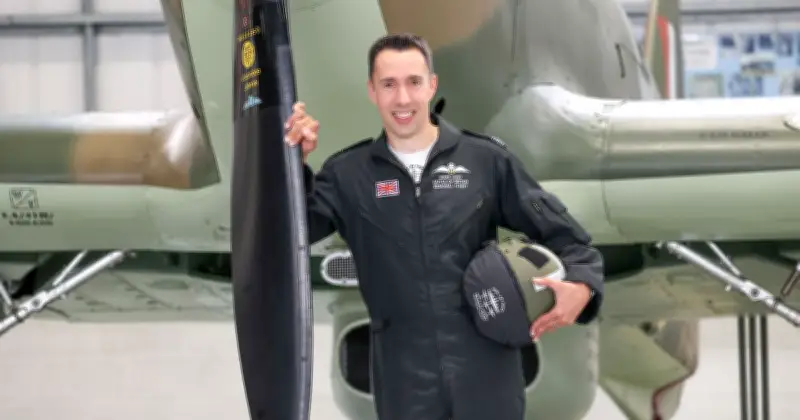
Investigators have concluded that debris which had remained inside a crashed Spitfire for decades was “highly likely” to have contributed to the accident that claimed the life of a Royal Air Force pilot. Squadron Leader Mark Long, 43, was killed when the historic Supermarine Spitfire he was flying came down during a Battle of Britain Memorial Flight (BBMF) event near RAF Coningsby, Lincolnshire, on May 25, 2024.
Crash during planned display
The aircraft crashed at around 1.16pm, moments after taking off, as the pilot was carrying out a planned display and a series of flypasts as part of the BBMF programme. He was flying Spitfire MK356, which was built at the Castle Bromwich Aircraft Factory, owned by the Morris Motors Company, in Birmingham in early 1944.
A report, now released by the Defence Safety Authority, stated that the investigation was carried out to provide both military commanders and the public with a clear account of its findings, while also setting out recommendations aimed at enhancing safety across the defence sector.
Fuel starvation identified
The service inquiry panel determined that evidence gathered from engine performance records and witness testimony was consistent with an aircraft suffering from fuel starvation. Investigators said the available data matched the conditions that would be expected if the Spitfire's engine had been deprived of an adequate fuel supply.
The report said: “The panel concluded that it was very likely that debris in the carburettor partially blocked the lean metering jet.
“This blockage reduced fuel flow, resulting in an overly lean mixture, decreased engine power and ultimately reduced thrust, preventing Fighter two from maintaining the performance required for safe flight.
“The panel concluded that debris within the carburettor was very likely to be the causal factor that prevented the engine from producing the thrust required to maintain flight.”
Decades-old debris
Chemical analysis indicated the debris had been “present for decades”, according to the report. The inquiry also examined the restraint system, which includes the harness and other structures designed to hold the pilot in position.