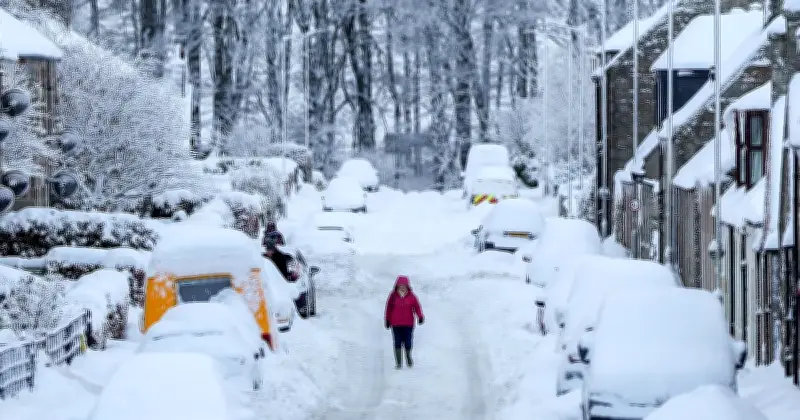
The Met Office has issued an update on the likelihood of a white Christmas in the UK this year. The national forecaster said that "for most parts of the United Kingdom, Christmas is only at the beginning of the period when it's likely to snow".
According to Met Office data, "We are more likely to see snow in January and February than in December, with snow actually settling on the ground (snow lying) an average of 3 days in December, compared to 3.3 days in January, 3.4 days in February and 1.9 days in March (1991 - 2020 long-term averaging period)".
What counts as a white Christmas
The forecaster explained that for them to declare a 'white Christmas', "a single snowflake has to be observed falling on the 24 hours of 25 December, by either an official Met Office observer or by a Met Office automated weather station". It added: "This is because it needs to be officially verified both for our climate records and also to provide consistency and certainty."
The deepest snow on Christmas Day was recorded in 1981, when Kindrogan, Perthshire, had 47 cm, according to Met Office records. The forecaster noted: "There was no record of snow falling at any station in the UK in 2018 or in 2019. The last widespread white Christmas in the UK was in 2010. It was extremely unusual, as not only was there snow on the ground at 83% of stations (the highest amount ever recorded), but snow or sleet also fell at 19% of stations."
Historical snow records
A white Christmas was recorded in 2009, when 13% of stations recorded snow or sleet falling, and 57% reported snow lying on the ground. The forecaster added: "There has only been a widespread covering of snow on the ground (where more than 40% of stations in the UK reported snow on the ground at 9 am) four times since 1960—in 1981, 1995, 2009 and 2010."
In a separate forecast, the Met Office also said temperatures are likely to plunge soon, with daytime lows of 11°C forecast on Wednesday, and even across the Southeast of England, the mercury is unlikely to exceed 15°C at the end of the week. However, it also said that while it will be chilly with frosty mornings, snow is highly unlikely anytime soon. This is despite a looming stratospheric polar vortex, which is expected to herald a change in conditions.