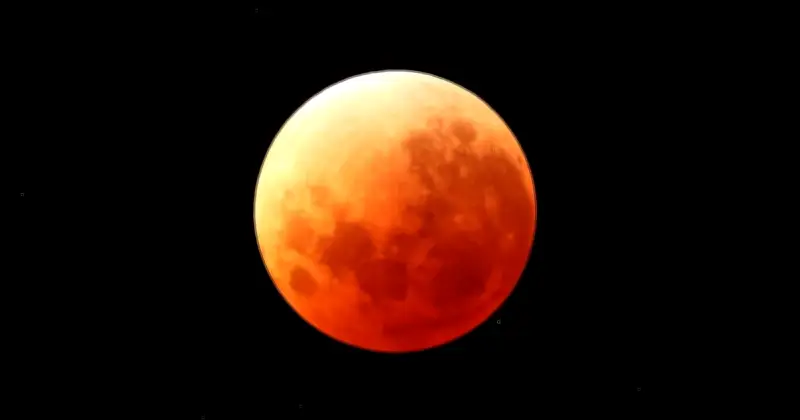
A partial lunar eclipse will be visible across the UK and US in the early hours of Friday, August 28, with the Moon turning a reddish hue as Earth passes between the Sun and the Moon. The event begins at 3.33am BST and reaches its maximum at 5.12am BST, when up to 93% of the Moon will be covered by Earth's shadow.
Skywatchers in the UK should look toward the west-southwest horizon from a high point, though the Met Office has warned that cloudy conditions may obscure views for many. In the US, the East Coast and parts of the Midwest will be able to witness the entire eclipse.
Best UK viewing spots and weather forecast
The Met Office said on Wednesday that “conditions are expected to be challenging for many hoping to see the eclipse” due to cloud cover. A spokesperson added: “The greatest chance of seeing something is likely to be across southern and eastern England during its earlier stages, before cloud becomes more extensive. Elsewhere, any temporary breaks in the cloud could still provide brief views.”

Met Office operational meteorologist Niamh Murray told the Press Association: “The majority of the UK is going to be quite cloudy, particularly anywhere north of the M4 corridor and even below that, there’s quite a lot of cloud around.” She noted that some of the south coast, including Devon and Dorset, might have clearer skies, but the Moon will be low in the sky, making visibility tricky for those with horizons in view.
Eclipse timings and how to watch
The penumbral phase begins at 2.23am BST, with the more noticeable partial eclipse starting at 3.33am as the Moon enters the darker umbra. The maximum occurs at 5.12am, when around 93% of the Moon is immersed in Earth's deepest shadow. However, UK and Ireland observers will not see the eclipse to its conclusion, as the Moon sets before the event ends at 6.51am; in London, moonset is expected around 6.15am.
No specialist equipment or protective eyewear is needed, making it safe to observe with the naked eye, just as you would a full Moon. To get the best view, find an elevated spot with an unobstructed view of the south-western sky.
Why a blood Moon occurs
A blood Moon happens when the Moon turns a reddish or copper colour during a lunar eclipse. The Earth moves directly between the Sun and the Moon, blocking direct sunlight from hitting the lunar surface. The Moon passes into the darkest part of Earth's shadow, the umbra, and sunlight passing through the edges of Earth's atmosphere is scattered—short blue light waves are scattered away, while longer red light waves pass through and bend toward the Moon, giving it a rusty glow.
Emma Alexander, an astrophysicist and research fellow at the University of Leeds School of Physics and Astronomy, explained that lunar eclipses occur only twice a year in an “eclipse season,” adding: “Due to the Moon’s orbit being tiled by five degrees compared to the Earth’s orbit around the Sun, most of the time it passes above or below where it would need to be for an eclipse to occur.” She said it is “not a coincidence” that this follows a solar eclipse, as “we usually get them in pairs during ‘eclipse season’, separated by around two weeks, or half of a lunar cycle. Solar eclipses happen at new Moon, and lunar eclipses happen at full Moon.”