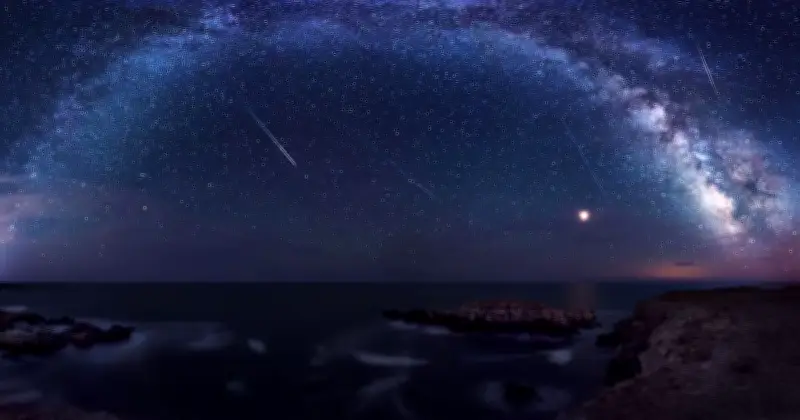
The Draconid meteor shower is set to peak on the evening of 9 October 2026, offering Britons a chance to see shooting stars across the night sky. The shower is active from 6 to 10 October, and is one of three meteor showers peaking this week.
Met Office forecast for the UK
The Met Office forecast from 9 to 12 October reads: "Cloud and rain clear in the north to leave sunny spells and showers, some heavy. Breezy with strong coastal winds.
"Temperatures near average, but warmer across southern and eastern areas. Sunny spells with blustery showers, most frequent in the north and west, easing Sunday. Rain spreads east Monday, windy at times, especially in the northwest. Temperatures near average, briefly mild."
What is the Draconid meteor shower?
NASA describes the Draconids as an "occasional" meteor shower because its activity can vary dramatically from year to year. Some years bring noticeable bursts of shooting stars, while in others the display is so sparse that casual skywatchers may struggle to spot any meteors at all.
Draconid meteors tend to appear relatively faint because they travel through Earth's atmosphere at a comparatively slow speed of around 40,000mph, according to the US space agency. As a result, larger particles are needed to generate the bright flashes typically associated with meteor showers. Such sizeable fragments are uncommon unless the shower enters an active outburst period, when Earth passes through a denser section of the comet's debris trail.
Meteor showers occur when Earth passes through streams of dust and debris left behind by comets. The Draconids are created by material shed by Comet 21P/Giacobini-Zinner, which burns up as it enters Earth's atmosphere, producing bright streaks of light across the sky.
The number of meteors visible during the shower's peak varies depending on which section of the comet's debris trail Earth encounters each year. While recent displays have been relatively modest, the Draconids have a history of producing spectacular outbursts. In both 1933 and 1946, the shower generated some of the most intense meteor storms ever recorded, making them among the standout celestial events of the 20th century.
Best time and place to see the Draconids
While most other meteor showers are best seen in the early hours, the Draconids are best seen in the evening, after nightfall.
According to Royal Museum Greenwich, meteor showers are best seen with a good, clear view of the stars on a night with no clouds. It explained: "Try to find somewhere with dark skies, an unobstructed horizon and very little light pollution.
"In 2026 the peak of the Draconids on 9 October occurs when skies are dark, as the thin waning crescent Moon rises just before dawn."
"Make sure there are no direct sources of light in your eyes, so that you can fully adapt to the local conditions and ensure that fainter meteors become visible. There’s no advantage to using binoculars or a telescope; just look up to take in the widest possible view of the sky."