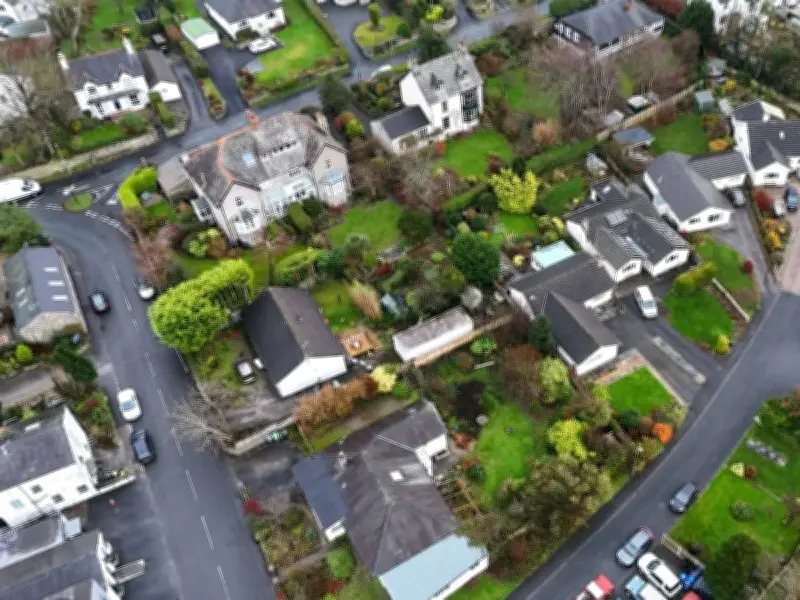
An investigation is underway into why the village of Silverdale in Lancashire has been struck by 25 earthquakes in the past year. Seismologists are monitoring the coastal settlement after a series of tremors strong enough to shake beds.
More than two dozen quakes have registered on the Richter scale in the last 12 months, with the most recent on September 21. The largest, last December, had a magnitude of 3.2 and was felt by people living 12 miles away. CCTV footage showed cameras shaking, lights flickering and sleeping dogs jumping out of their baskets.
Residents describe the tremors
Andrew Smith said his house in the Morecambe Bay parish was left quaking. "I was upstairs just sorting out some stuff and all of a sudden, there was this almighty crash," he said. "I thought something had hit the house or exploded somewhere."
Smith said he was concerned the tremor was not just a one-off. "It does seem to be a continuing theme," he said. "There is always that concern. Will there be worse ones? It is obviously a concern. You don't expect that sort of thing. It wasn't on our list when we were looking for a property: 'Avoid an earthquake zone!'".
Fellow villager Tom Bradfield said he had felt tremors on more than one occasion. "The first one I thought a truck had crashed into our house," he told the BBC. "The bed was shaking upstairs. The dog woke up."
Scientific explanation and risk
According to the British Geological Survey, quakes are caused by the sudden release of built-up stress and energy in the Earth's crust, most often driven by the movement of tectonic plates which constantly drift over the planet's mantle beneath.
Dr Brian Baptie, who leads the survey's earthquake seismology team, said western England was in the UK's 'hot spot' zone along with north-west Wales and west Scotland. The UK gets up to 300 quakes a year, about 30 of which are noticeable. Dr Baptie said earthquakes "usually happen in clusters so when there is one we usually get lots of others".
"People are probably familiar with the idea of when there is a big earthquake around the world we get these aftershocks which can maybe last for days, or weeks, or even months," he said. "Usually those aftershocks are smaller than the first event but very rarely they can actually be bigger. So we can't rule out a bigger earthquake but it's really quite unlikely."
Research on earthquake distribution
Researchers from the University of Cambridge and Dublin Institute for Advanced Studies discovered variations in the thickness of tectonic plates relate directly to the distribution of earthquakes. While quakes happen frequently in Britain, they are almost completely absent from neighbouring Ireland.
The researchers produced a computer-generated image of Earth's interior using a technique called seismic tomography, which works like a medical CT scan. The data they collected revealed variations in the thickness of the solid outer part of Earth, also known as the lithosphere, across Ireland and Britain.
Sergei Lebedev, lead author of research at Cambridge's Department of Earth Sciences, said: "Earthquake locations are surprisingly uneven across Britain and Ireland. We can now explain this disparity which has puzzled scientists for over a century."
The researchers found the lithosphere is thin and weak beneath western Britain, meaning the rocks can bend easily, triggering earthquakes across this region. In contrast, Ireland sits on top of thick and strong lithosphere, explaining the lack of tremors. Even though the UK is located far from the nearest plate boundary, minor tremors are still relatively common.
Earthquakes in the UK do not reach the magnitude of those in other parts of the world, said Lebedev. "But we still need to understand why they happen where they do so that engineering projects can consider seismic hazards. The properties of the lithosphere are clearly controlling the location of earthquakes. We didn't expect that link to be quite so striking."