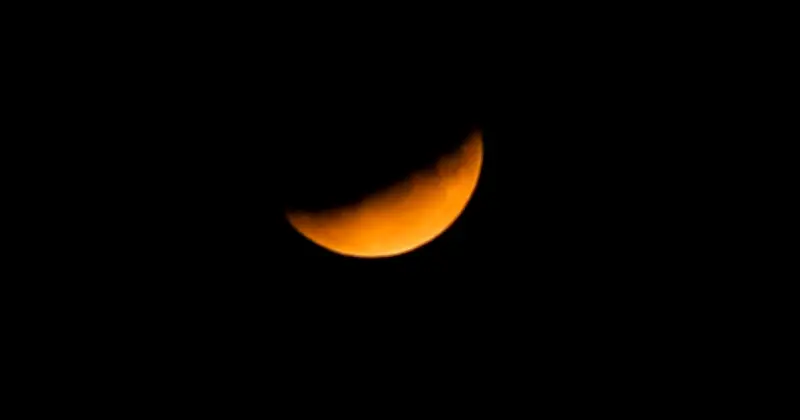
Skywatchers across the UK and Ireland will have the chance to witness a deep partial lunar eclipse in the early hours of August 28, when around 93% of the Moon will be covered by the darkest part of Earth's shadow at the peak of the event.
A lunar eclipse occurs when the Earth passes directly between the Sun and the Moon, causing the satellite to move into Earth's shadow. The event comes two weeks after the striking partial solar eclipse on August 12.
Timing of the eclipse
The event will begin at 2.23am when the Moon enters the penumbra, the lighter outer region of Earth's shadow, causing a gradual and initially faint dimming. At 3.33am BST, the partial phase starts as the Moon moves into the darker umbra, with the shadow steadily spreading across its surface.

The eclipse will reach its peak at 5.12am, when around 93% of the Moon will be immersed in the deepest part of Earth's shadow. Although the partial eclipse is set to continue until about 6.51am, many observers will miss its final stages as the Moon will dip below the horizon at around 6.15am in London, with moonset times varying across the country.
Why the timing is no accident
The timing is no accident, as solar and lunar eclipses typically occur within a fortnight of each other due to the alignment of the Sun, Earth and Moon during an eclipse season, explains Royal Museum Greenwich.
To get the best possible view of the sky spectacle, stargazers would need to get to a high vantage point with a clear view towards the south-western horizon. However, no special glasses are required to view this eclipse; it's as safe as looking at the full Moon.
What causes the Blood Moon colour
During a total lunar eclipse, the Moon often takes on a striking reddish or copper-coloured hue. This happens because sunlight passing through Earth's atmosphere is filtered and bent toward the Moon, allowing predominantly red wavelengths to reach its surface while shorter blue wavelengths are scattered away.
As a result, the eclipsed Moon glows with the distinctive colour that has earned it the nickname "Blood Moon".