
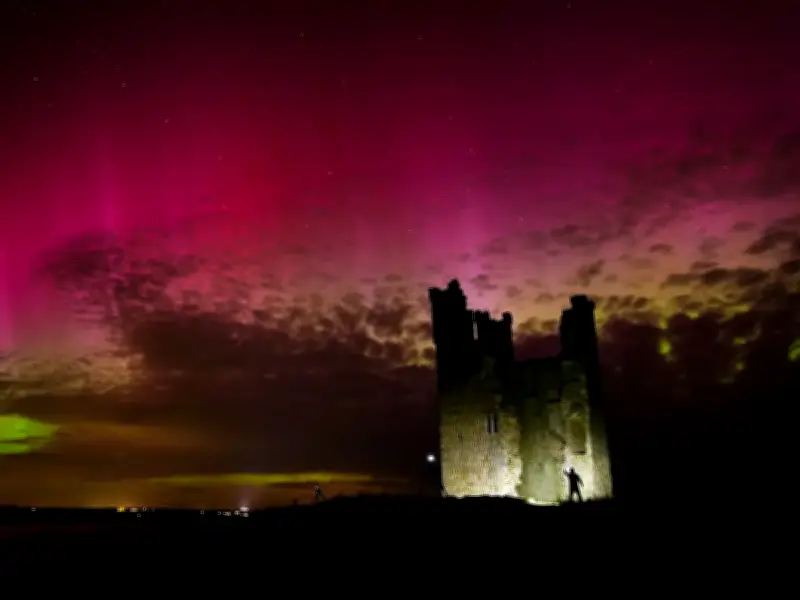
The Met Office has indicated that the Northern Lights could be stronger on Monday evening than on Sunday, potentially offering another remarkable display in the night sky.
Senior Operational Meteorologist Greg Dewhurst said the aurora may be visible further south into central areas. He stated: "They may be a little stronger again Monday night so could be seen further south into central areas. Long exposure camera shots may show something each night a little further south than the above visible by eye forecast."
Weekend displays and visibility
The heavens were lit up by brilliant hues of the natural spectacle over the weekend, with stunning photographs captured across Scotland, Northern Ireland, Wales, northern England and even as far south as southern and eastern England.
According to the Met Office, Britons might even glimpse the aurora until Tuesday.
Space weather forecast
In its space weather forecast published on Saturday, the Met Office stated: "Two glancing coronal mass ejections followed by a coronal hole high speed stream bring a daily chance of enhancing the auroral oval, with sightings possible across Scotland and similar geomagnetic longitudes where skies are clear between 10-13 Oct."
The breathtaking aurora was set off by a Coronal Mass Ejection (CME), a natural occurrence in which the Sun releases vast clouds of particles that interact with the Earth's atmosphere.
What causes the colours
The stunning colours of the Northern Lights are generated when solar particles collide with oxygen and nitrogen gases in the Earth's atmosphere. Oxygen atoms produce a striking green glow, which is the shade most commonly linked with the Aurora Borealis. By contrast, nitrogen atoms give rise to vivid tones of purple, blue, and pink.
The optimal opportunity to witness the aurora is when the sky is dark and free from cloud cover and light pollution, particularly in remote locations facing the northern horizon.




