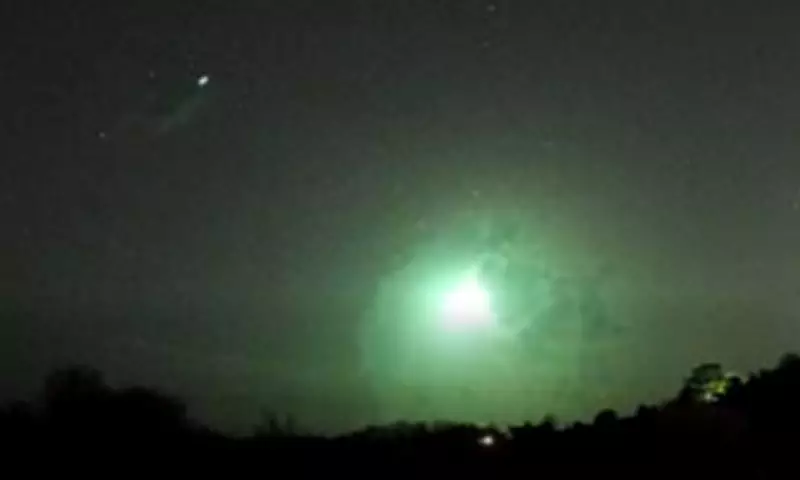
Incredible footage has emerged showing a massive green fireball streaking dramatically across British skies late last night. Doorbell cameras across multiple regions captured the extraordinary celestial event at approximately 00:30 BST, creating a viral sensation among skywatchers and residents alike.
Widespread Sightings Across Britain
The North Yorkshire Weather Updates Facebook page sparked initial discussion by posting: '00:26 anyone see that big meteor burn up just now?' This query prompted hundreds of responses from observers throughout the United Kingdom, with many expressing astonishment at the brilliant display.
One eyewitness recounted: 'I saw that. It was bright green. It was massive. I thought it was a firework at first it seemed so close.' Another observer from Derbyshire noted: 'Yes I saw it walking home in Derbyshire. Looked like a firework the colours it was giving off. Glad I read this...wasnt sure what Id seen.'

Humorous Reactions and Scientific Explanation
Some responses took a lighter tone, with one person joking: 'Yep my bathroom lit up I thought I was hallucinating… lol.' Despite the initial alarm for some viewers, astronomers confirm this was simply a meteor entering Earth's atmosphere.
Multiple videos recorded across the UK show the fireball zooming toward Earth before erupting into brilliant green illumination. Fortunately, the object appeared to disintegrate completely before reaching the ground, posing no threat to populated areas.
Enthusiastic witnesses shared their experiences online, with one Facebook user writing: 'Saw that from the M62 and I'm still buzzing! Can't believe how bright it was!' Another reported: 'Camera on edge of the moors in Winterburn just caught it.'
Understanding Bolides and Atmospheric Entry
Fireballs that explode in the atmosphere are scientifically classified as bolides. NASA explains the process: 'During the atmospheric entry phase, an impacting object is both slowed and heated by atmospheric friction. In front of it, a bow shock develops where atmospheric gases are compressed and heated.'
The space agency further details: 'Some of this energy is radiated to the object causing it to ablate, and in most cases, to break apart. Fragmentation increases the amount of atmosphere intercepted and so enhances ablation and atmospheric braking. The object catastrophically disrupts when the force from the unequal pressures on the front and back sides exceeds its tensile strength.'
Common Celestial Events
Globally, thousands of fireballs occur daily, though most go unnoticed as they happen over oceans, uninhabited regions, or during daylight hours. This particular event gained attention due to its timing over populated areas and the proliferation of home security cameras.
Space Rock Terminology Explained
Asteroids represent large rocky remnants from collisions or the early solar system, primarily located between Mars and Jupiter in the Main Belt.
Comets consist of rock covered in ice, methane, and other compounds, following orbits that take them far beyond the inner solar system.
Meteors describe the flash of light visible when debris burns up in Earth's atmosphere, while the debris itself is termed a meteoroid. Most meteoroids vaporize completely during atmospheric entry.
Should any fragment survive to reach Earth's surface, it becomes classified as a meteorite. Meteors, meteoroids, and meteorites typically originate from asteroids and comets. When Earth passes through a comet's tail, numerous debris particles burn up simultaneously, creating spectacular meteor showers.